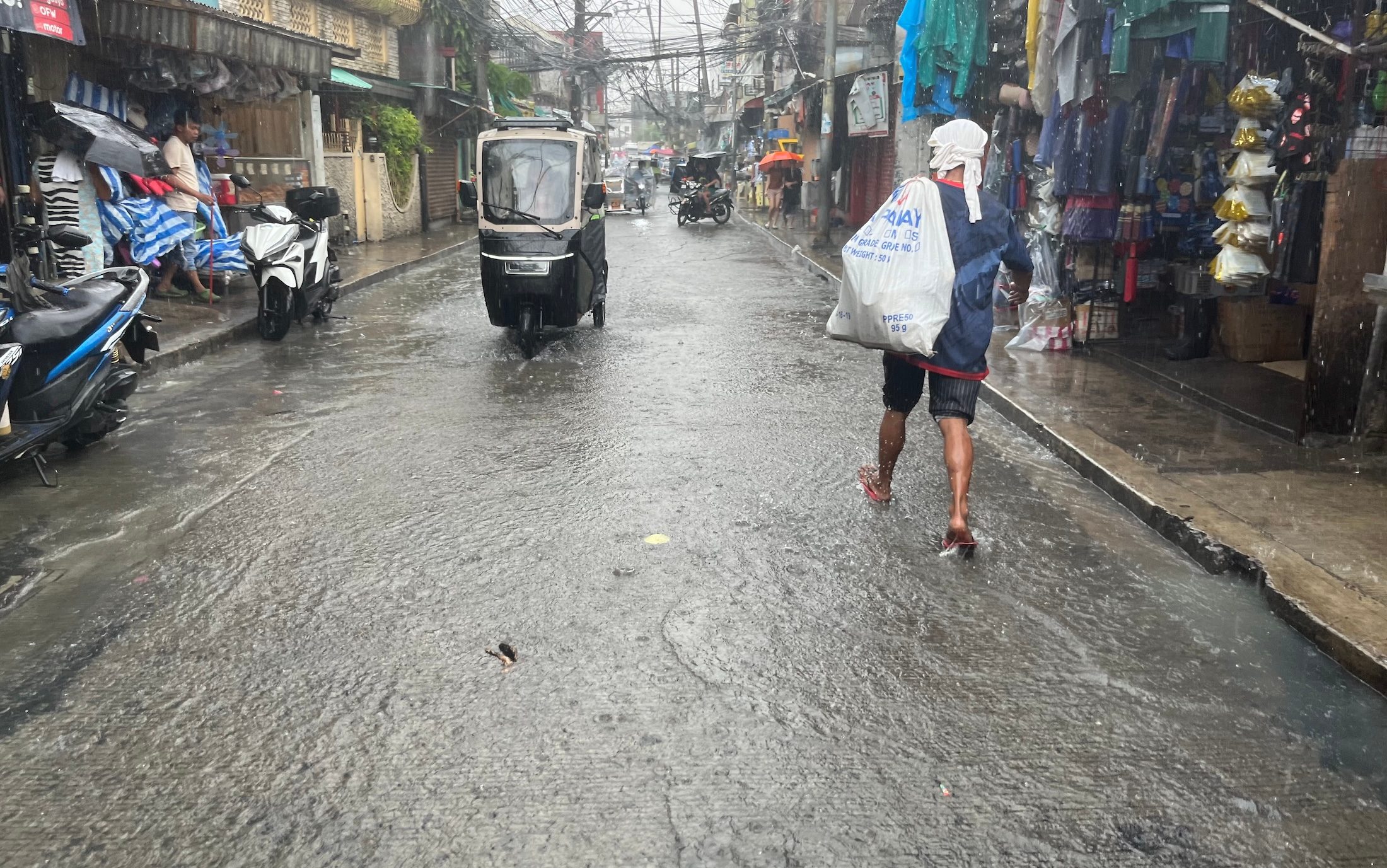
MANILA, Philippines – Since the southwest monsoon or habagat began last May, residents of Caloocan City have again borne the brunt of what they describe as “substandard” infrastructure projects in their communities. In June, as heavy rains inundated parts of Metro Manila, the Batang SoCal Facebook page posted a photo of ankle-deep flooding in Libis Espina Street where the road and drainage system had just been “rehabilitated.” In the comments section of the post, Caloocan residents took turns lambasting the P9.6-million road rehabilitation and drainage system (Phase 3) project in Libis Espina carried out by Dreamworx Builder and Trading Incorporated. The project is situated between Barangay 14 and Barangay 16. Vegetable and fruit vendor Karen Libiran shared their sentiment. “Nagsasayang lang [sila] ng pera. Hindi rin nawawala ‘yung baha sa pag-aayos nila,” she told Rappler when asked about the recent project in the community. (They’re just wasting money. The flooding remains even after they finished the project.) “‘Yun ‘yung purpose ng pag-aayos nila di ba? Para mawala ‘yung baha. E ganoon din e, wala rin namang nangyayari,” Libiran added. (That’s the purpose of the rehabilitation, right? To prevent flooding. But it’s still the same.) Libiran’s sister-in-law, fellow vendor Jessica Santiago, said there was some improvement in the appearance of the street gutters but the flooding problem was not addressed. “Umayos nga ‘yung kanal pero hindi nawala ‘yung baha,” Santiago told Rappler. (The street gutter improved but the flooding is still there.) Impact on livelihood For fish vendor Liza Cadiz nothing has improved in the area of Libis Espina Street, Barangay 14, Caloocan, where she sells her wares. Waist-level flooding is a regular occurrence whenever there’s prolonged heavy rains, hampering their livelihood. “Malaking epekto talaga kasi bukod sa bumabaha, hindi kami makatinda, wala rin kaming mapakyaw. Walang pakyaw, e [kapag] may bagyo. Matumal talaga,” she told Rappler in an interview. (It hugely affects us because aside from flooding, we can’t sell, we can’t buy in bulk. There’s no wholesale because of a typhoon. Business is really slow.) Whenever she learns that there will be bad weather, Cadiz would opt to stay at home. There was a time, she said, when her table piled with fish floated and got swept away by floodwater. She said the project was supposed to fix the flooding problem but nothing was solved, raising questions about the construction and funds for that project. Pedicab driver Lolito Layson said nothing changed in the area where he waits for passengers, despite seeing Libis Espina Street being rehabilitated almost every year. Flooding affects his livelihood, as passengers would choose tricycles that can better navigate flooded streets. Those who pick him would have to squat on their seats to keep themselves dry. Asked about the rehabilitation project, Layson said it looked okay on the surface but when put to the test, the drainage system could not handle the volume of water. The flooding situation, he said, remained the same. The rehabilitation project was 96.72% accomplished according to the transparency website of the Department of Public Works and Highways (DPWH). The DPWH transparency website shows proof of accomplishment of the project as well, but it only in the Libis Extension alley, which is in Barangay 16. This road floods even when it’s not raining. Authorities only budged after public complaints and social media posts. According to a DPWH project billboard, the project was supposed to have started in March 2025 and completed months after, in August 2025. But residents, including tricycle drivers, pedicab drivers, and vendors in the community whom Rappler talked to echoed Batang SoCal’s Facebook post that the project only began construction in February this year and was completed in July. Rappler reached out to the Metro Manila 3rd District Engineering Office and Dreamworx for their comments. The DPWH Stakeholder Relations Service and Dreamworx have acknowledged our request. We will update this story once they respond to our queries. Root of the problem Libis Espina, Barangay 14, and Barangay 16 are part the Dagat-Dagatan area, which spans portions of Caloocan, Malabon, and Navotas. The whole area was such named as it used to look like a virtual sea with private fishponds that were connected to Manila Bay. The first Marcos government expropriated the fishponds and reclaimed the area for a pet project of Imelda Marcos, who was human settlements minister at the time, according to a paper published by the Ateneo de Manila University. The purpose of this reclaimed area was to make way for a “massive low-cost housing project” that was pursued despite warnings of massive flooding in surrounding areas without proper mitigation systems in place. As predicted, the project led to flooding in Malabon and other areas because the natural waterways were plugged in — a problem that persists to this day. Eventually, Caloocan became one of the most flood-prone cities in Metro Manila. Twenty barangays in the city, including Barangay 14, have been identified as areas that are at “very high risk” of flooding by 2020 and 2030, according to a study published in the Journal of Urban and Regional Planning. Rappler earlier reported that decades of costly flood-mitigation infrastructure have failed to provide relief to Caloocan residents. – Rappler.com Eunicito Barreno is a 2026 Aries Rufo Fellow. He is a senior journalism student at the University of the Philippines Diliman, where he is also news staffer at the Philippine Collegian, the university’s official student publication.
‘Waste of taxpayers’ money’: Caloocan residents slam ‘useless’ drainage project
Full Article
Original Source
Read the full article at Rappler →KhanList aggregates and links to publicly available news content. We do not host full articles from third-party sources. Always verify important information with original sources.