
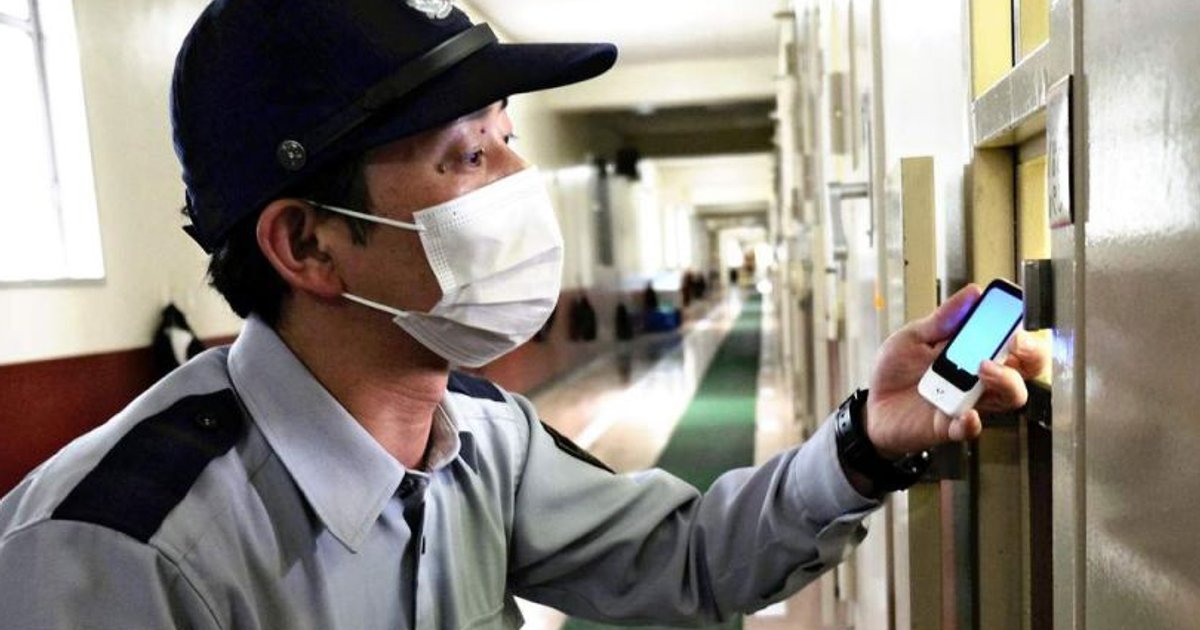
TOKYO – Palm-sized AI translators have been playing an important role in prisons and detention houses across Japan that house many non-Japanese inmates.The Japanese Justice Ministry distributed about 200 devices in summer 2025 to improve communication between such inmates and prison officers. It is hoped these devices will help the officers to better understand the inmates’ feelings and lead to better support for their reintegration into society.“How are you doing? Do you want to see the factory?” said a male prison officer at Fuchu Prison in Fuchu, Tokyo, in late October.The officer was speaking in Japanese while holding a translation device in his hand. When the officer held the translator near the small window of a one-person room housing a sentenced Chilean man, the device gave the Spanish translation in a female voice.The Chilean man thought for a moment, and then replied to the device in Spanish. A few seconds later, the device gave the translation of the man’s reply: “Yes. I’m going to have a look around the factory.”The man does not understand Japanese and was unable to follow prison officers’ instructions when he first arrived at the prison. It was judged that it would be difficult for him to take part in communal activities, so he was placed in a one-person room and had not participated in prison labour at the factory.Through repeated communication with officers via the translation device, the man has adopted a more positive attitude and expressed interest in taking part in work at the factory.“Slowly but surely, we’re building a relationship of trust,” the officer said.More than 20% of the prison’s 1760 inmates – including sentenced persons and others – were non-Japanese from overseas who do not hold permanent residency, as of the end of 2025.Before the introduction of the translators, officers could only try to give them instructions through gestures, which often resulted in frustrating the inmates.The device has allowed non-Japanese inmates to ask more questions, such as: “Why can’t we trade leftover food with each other?” and “Why aren’t we allowed to stand up while doing prison labour?”“It’s easier to understand their feelings when we can communicate with words. For rehabilitation and recidivism prevention, it’s important to appeal to their feelings rather than force them to obey,” said a prison officer who is in charge of teaching the rules to those who enter the prison.Those who cannot speak Japanese are sent to six institutions, including Fuchu and Osaka prisons and Tokyo Detention House, in principle. International affairs specialists are allocated to those institutions and serve as interpreters.However, their number is capped at 28, so prison officers and others are responsible for their day-to-day treatment, as well as at night and on holidays.Those awaiting a judicial decision are generally sent to a detention house near the police station where they were arrested. The lack of interpreters and resulting communication difficulties is an issue.In light of the situation, the ministry deployed AI translators to 129 of the 171 institutions in August 2025. The device supports about 90 languages and can translate text. The supplier of the translators was selected on conditions, including that translation content is not used for AI training.As prison officers are not allowed to carry their smartphones inside the facilities, the ministry plans to allocate more translators from next fiscal year, with a focus on institutions with many foreign inmates.According to the ministry, the number of foreigners serving a sentence, in detention prior to sentencing or detained in workhouses in lieu of payment of a fine, was 2,779 as of the end of 2025, an increase of 30% from 2015.They are from more than 20 countries, with those from Vietnam making up the largest group at 682, followed by China at 510.Inmates who cannot speak Japanese are rarely provided with “special guidance for reform”, in which they are shown the viewpoint of victims, or vocational training, in which they can obtain certifications and licences to support their reintegration into society.“There need to implement support for foreign inmates’ reintegration into Japanese society and recidivism prevention has grown, as there are cases in which they remain in Japan after release by receiving special permission to stay,” said Tatsuya Ota of Keio University, an expert in criminal policy.“By lowering the language barrier with the translator, paths for special guidance and vocational training could open up.” THE JAPAN NEWS/ASIA NEWS NETWORK
Japanese prisons begin using AI translators to aid communication with foreign inmates
Full Article
Original Source
Read the full article at Straitstimes →KhanList aggregates and links to publicly available news content. We do not host full articles from third-party sources. Always verify important information with original sources.