
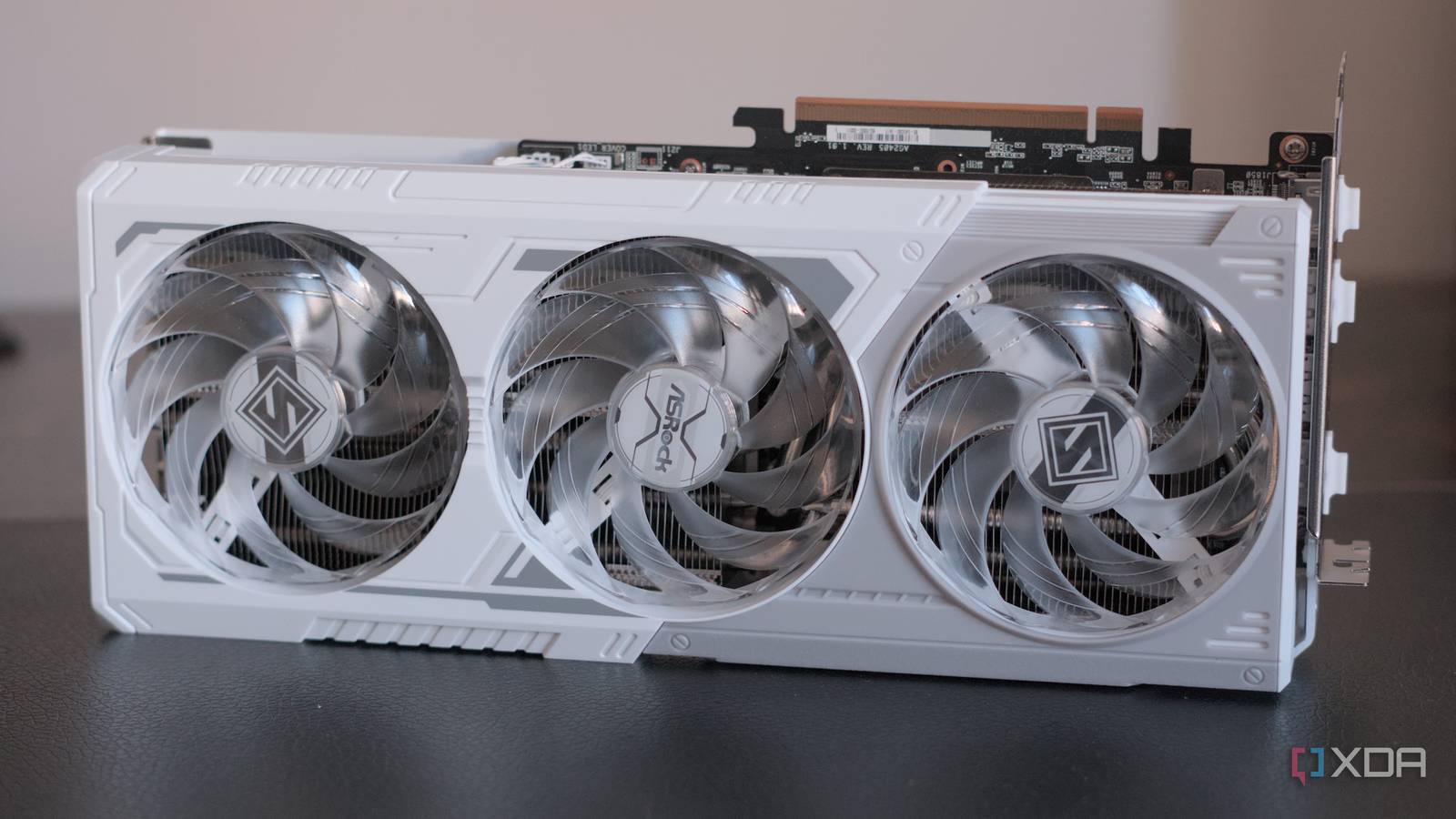
Published Aug 28, 2026, 12:00 PM EDT Hamlin has been in the tech field for over nine years. Since 2017, his work has appeared on MakeUseOf, Android Police, OSXDaily, Beebom, and more. He served as the Senior Editor at Valnet's MakeUseOf for over two years before joining XDA. He uses a high-end gaming rig for desktop use and a MacBook for traveling, but dislikes some of the quirks of macOS. You're more likely to catch him at the gym or on a flight than anywhere else. I recently wrote that I'd rather buy a used RTX 4080 than pay Nvidia's current mid-range tax, and a couple of readers quickly pointed out in the comments that they'd rather go with AMD. And after looking at what the RX 9070 XT costs, I can't really blame them. I've only used Nvidia GPUs since I switched to PC gaming back in 2012, and I still think there are valid reasons to side with Team Green, especially if you care about things like DLSS and ray tracing. At the same time, I don't like being a fanboy. If AMD can offer something similar and undercut Nvidia in price, I don't mind switching sides. The only reason I haven't all these years is that I usually get flagship GPUs, and AMD hasn't been competitive at the high end. It's a completely different story in the mid-range, though, and from a value perspective, AMD actually has Nvidia beat. In fact, the RX 9070 XT makes Nvidia's mid-range options like the RTX 5070 and 5070 Ti almost impossible for me to recommend at current street prices. Street prices only made it worse for Nvidia You're looking at over $1,000 just for an RTX 5070 Ti Even if we go by official launch prices, the RTX 5070 Ti wasn't exactly a good value compared to the Radeon RX 9070 XT. Nvidia launched it at $749, whereas AMD priced the 9070 XT at just $599. That's a $150 gap for a GPU that's comparable in terms of performance. You could call that the "Nvidia tax," but if rasterization was all you cared about, the 9070 XT was pretty much a no-brainer for the money you saved. Fast-forward to today, and you won't find a new RTX 5070 Ti anywhere for less than $1,000. The cheapest option I found on Newegg as of this writing costs about $1,087, which is unreasonable for what's essentially an upper mid-range GPU. Just a couple of years ago, you could snag an RTX 4080 Super for roughly the same price, which is still slightly faster on average. The RX 9070 XT has also gotten more expensive since launch, but you can still get one for around $750 or less. At that price point, there's no reason to even consider the RTX 5070 Ti, no matter how much of a fanboy you are. You're not compromising by choosing AMD this time Driver updates have only made the RX 9070 XT better since launch If you looked at early benchmarks and comparisons, you may have noticed that the RTX 5070 Ti generally pulled ahead, but only slightly. The RX 9070 XT has aged like "fine wine" since then, though, as driver updates have helped it close the gap almost completely. It's now on par with the RTX 5070 Ti in rasterization performance, so you're not really settling for a slightly slower card for a lot less. Sure, the RTX 5070 Ti may still have the edge in ray tracing, but if you spend most of your time gaming without it, that doesn't really matter, anyway. You're not compromising on VRAM either, since it comes with 16GB just like the 5070 Ti. More importantly, AMD has improved FSR over the last couple of years, much like Nvidia has with DLSS. Yes, DLSS 4.5 is still superior, but FSR 4.1 isn't all that far behind either. From the comparisons I've seen, FSR 4.1 reconstructs details better in motion than older versions, and we've sort of reached a point where it's good enough not to feel like a compromise. When you're saving about $300 in the process, that difference in image quality is probably the last thing you're thinking about. Nvidia still has the better software stack But that's not enough to save the RTX 5070 Ti at these prices Credit: Nvidia There's a reason why people like me who've been buying Nvidia GPUs for years keep going back to them. As much as AMD has narrowed the gap with FSR, DLSS 4.5 is still the better upscaler overall. Nvidia also has something AMD still doesn't offer: Multi Frame Generation. With FSR frame generation, you're stuck with one additional frame, whereas you can generate up to five additional frames with Dynamic Multi Frame Generation. Throw in better ray tracing performance and features like DLSS Ray Reconstruction, and you can see why people wouldn't hesitate to side with Team Green if money wasn't a problem. That said, when you're looking for a GPU in the mid-range segment, price is probably a factor that you simply cannot overlook. I can understand paying a $50-$100 premium for a better feature set, but when the difference is around $300, I'd rather keep that money in my pocket and live without some of Nvidia's extras. For that price, I'd want something more high-end, like an RTX 5080, not an upper mid-range card that's supposed to cost $749 in the first place. Switching sides makes more sense than paying the Nvidia tax Considering I personally use an RTX 4090, I don't see myself switching to AMD anytime soon. Nvidia has no competition at the high end, so unless AMD surprises me in the next few years, Team Green will keep my money. But if I were building a mid-range gaming PC today, I'd have no problem switching to AMD because the RX 9070 XT is simply too good of a deal to ignore, even at slightly inflated prices. You're getting a GPU that performs about the same as a slightly inferior software stack. I'm sure your wallet will appreciate that trade-off a lot more than you'll miss Nvidia's features. ASRock Radeon RX 9070 XT Steel Legend 8.5/10 Shader Units 128 Ray Accelerators/Cores 64 AI Accelerators/Cores 64 Stream Processors 4096 The Radeon RX 9070 XT is the only upper mid-range GPU that's actually worth considering in this tough market. It performs on par with the RTX 5070 Ti, while being significantly cheaper.
It's a terrible time to buy a mid-range Nvidia GPU, and the RX 9070 XT is why
Full Article
Original Source
Read the full article at Xda-developers →KhanList aggregates and links to publicly available news content. We do not host full articles from third-party sources. Always verify important information with original sources.