
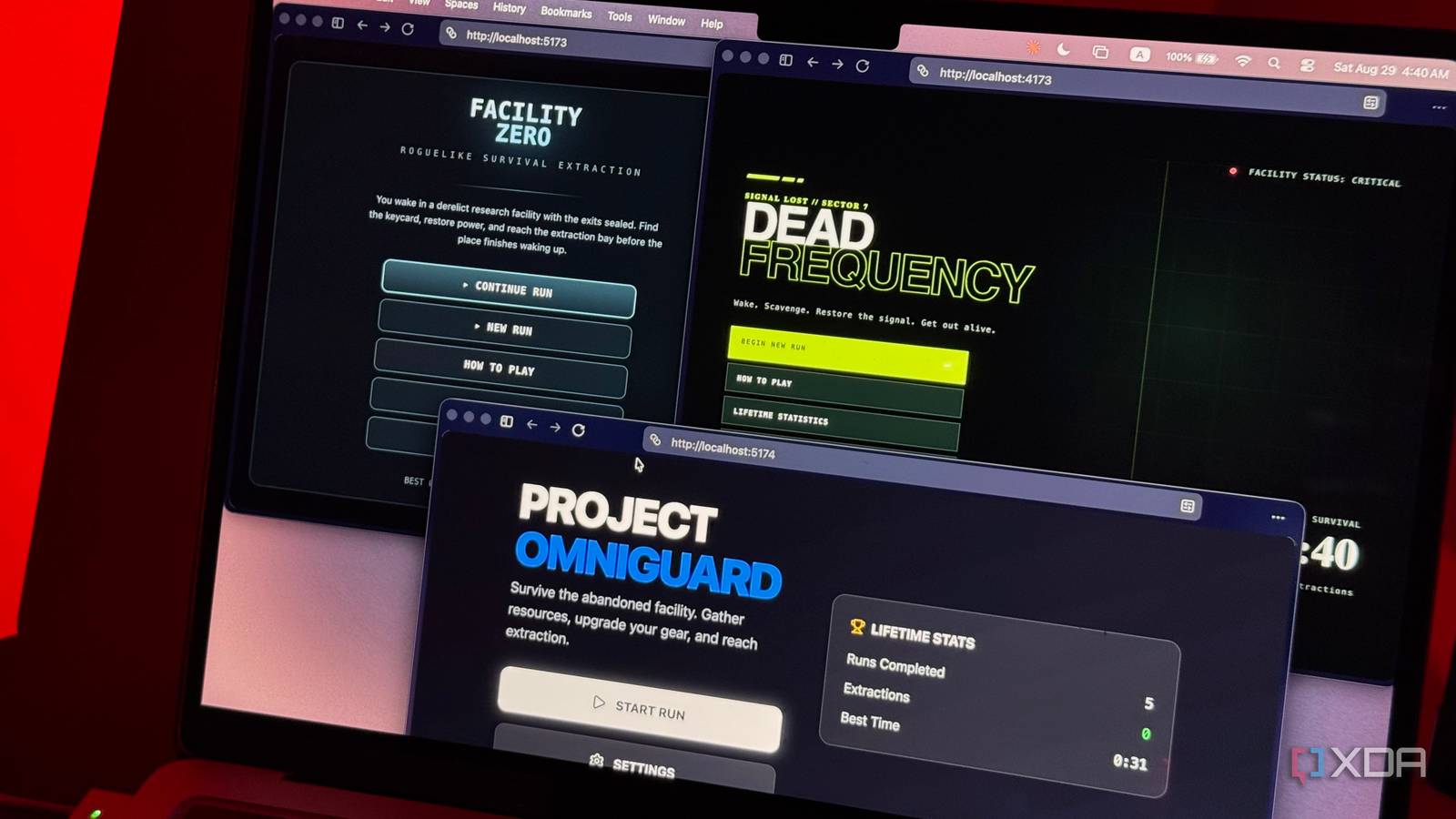
Published Aug 30, 2026, 5:30 PM EDT Mahnoor Faisal is a tech journalist covering AI and productivity tools with bylines at XDA, SlashGear, MakeUseOf, Laptop Mag, and Android Police. She's been writing professionally since she was sixteen, and has since penned hundreds of articles. This includes in-depth coverage of AI tools like NotebookLM to breaking news across the AI space. Her passion for technology started when she received her first iPod Touch (4th generation) on her 8th birthday, and she's been deep in the tech world ever since. Currently pursuing a degree in computer science, Mahnoor brings both a journalist's eye and a technical foundation to her coverage of how AI is reshaping the way we work and learn. Sign in to your XDA account I'm not a gamer, and I've never been particularly good at gaming either. Despite that, I've always enjoyed sitting in front of a console or PC and playing whatever game someone else happens to have. I've spent hours playing GTA 5 on my sister's PlayStation 5, mostly just running around, stealing cars, and murdering people. That said, I've always found game development intriguing. I remember attempting to teach myself Unity years back, and even spent hours building random games on Roblox. None of it ever went particularly far, but I loved the idea of being able to create an entire game from scratch. Given that I don't have the time or the skills to build one myself, I figured this was the perfect job to hand over to AI. So, I gave Claude Code, Codex, and Google's Antigravity the exact same prompt and asked each of them to build me a full-fledged browser game from scratch. I used the exact same prompt for all three One prompt, three very different games This isn't the first time I'm pitting different AI agents against each other. I've asked the same set of tools to build me a portfolio website, landing pages, Pomodoro timers, and countless other projects. However, there's something different about those tests and the one I'm writing about here. In all the other tests I've done, I always keep my prompt intentionally vague. LLMs have a tendency to follow your instructions almost too literally, and the more specific you get, the less room you're leaving them to make their own decisions. If I'm trying to figure out which tool can build the best portfolio website, for example, I don't want to tell it exactly where every element should go, what every section should look like, or how it should approach the project. I want to give it the idea, tell it what I consider essential, and see what it comes up with on its own. This time, though, I wanted to do things a little differently. A full-fledged game has far too many moving parts for me to simply ask each tool to "build me a game" and call the results comparable. One could make a basic platformer, another could build something significantly more ambitious, and I'd ultimately be comparing three completely different projects. So, I came up with a much more detailed brief and gave the exact same one to Claude Code, Codex, and Antigravity. I asked them to build a browser-based roguelike survival game set in an abandoned facility, complete with a procedurally generated map, real-time combat, multiple enemies and weapons, loot, an inventory system, character upgrades, an objective-driven extraction sequence, persistent stats, settings, and a polished interface. I also added one particularly important condition: they weren't supposed to stop once the code compiled. I specifically told all three tools to run the game, play through it themselves, test every major system and interaction, fix anything that broke, and only stop once the complete gameplay loop worked reliably. Claude Code exceeded even my highest expectations It understood the assignment a little too well I've been an early Claude Code fan, but if you've read some of my recent coverage, I've been quite critical of it lately. Limits have gotten worse, other LLMs seem to have gotten relatively better, and the tool has just felt exhausting to work with as a whole. This experiment, though, single-handedly reminded me why I became such a fan of Claude Code in the first place. Claude Code spent over an hour building out the game. Given I have a MacBook Air with just 8GB of RAM, I had to pretty much forfeit my laptop for almost the entire duration and let Claude do its thing. During this time, I reached a point where I was tempted to interrupt it and reclaim my laptop. Thankfully, I didn't! By the time Claude Code was done, it had added over 10,000 lines of code, and the result exceeded even my highest expectations. In my prompt, I had asked for at least three different weapons, and Claude added eight! The weapons ranged from a basic pipe and knife to an SMG, shotgun, railgun, and plasma cutter. I asked for three enemy types, and Claude created five. It also threw in 18 different upgrades, multiple types of ammunition, armor, healing items, buffs, elite enemies, critical hits, damage numbers, particles, lighting effects, and even procedurally generated music. The actual game loop was much more elaborate than I expected, too. Claude built a procedurally generated facility with different room types, locked areas, hazards, fog of war, and a minimap that revealed itself as I explored. Enemies didn't simply know where I was at all times either. There was actual detection and line-of-sight logic behind their behavior! Most importantly, Claude took the progression system seriously. I couldn't simply wander over to the extraction point and win. I had to find a security key, restore power to the facility, activate the extraction terminal, survive a 60-second wave of enemies, and then actually make it out alive. What impressed me most, though, wasn't something I noticed while playing the game at all. I had explicitly told all three tools to test everything before they considered the job finished, and Claude Code took that instruction to an almost ridiculous extreme. It created its own headless simulation that tested things like map generation, weapons, enemy behavior, inventory, upgrades, saving and loading, and complete runs. Then, it even built a separate Playwright browser test hundreds of lines long to test the game itself. That second test went through the menus, movement, sprinting and dashing, every weapon and enemy type, inventory management, leveling, the entire objective chain, victory and death, save and resume behavior, different screen sizes, console errors, and even actual gameplay. In other words, Claude Code didn't just build me a game. It effectively built itself a little QA department to make sure the game worked too! All the time spent, lines of code, and the effort clearly showed. Of all the three games I ended up with, Claude Code's was easily the most polished, the most complete, and the one that felt the closest to an actual small indie game! Codex didn’t overdo it, but it delivered Codex didn’t show off, it just delivered Codex took a very different approach from Claude Code. Where Claude seemed determined to turn my prompt into the biggest game it possibly could, Codex mostly stuck to the assignment. I asked for at least three weapons, and Codex gave me exactly three. I asked for three enemy types, and it created three different ones, including a faster enemy and a ranged one. There was a proper inventory system for picking up, equipping, using, and dropping items, along with healing items, armor, hazards, loot, limited inventory space, and a progression system with upgrades. More importantly, Codex didn't cut corners on the actual objective chain. I still had to find a security key, restore power using a generator, reach the extraction terminal, and then survive a timed enemy wave before I could win. Difficulty settings actually affected the game, the audio controls worked, screen shake could be toggled, and even the light and dark themes were functional rather than just options sitting in a settings menu. The code itself was much leaner than Claude Code's. Most of the game was packed into a single large JavaScript file rather than being split across a more elaborate game engine, renderer, persistence layer, and everything else Claude created. From a maintainability perspective, I'd much rather work with Claude's project. But considering how much Codex managed to squeeze into a significantly smaller implementation, I was impressed. It also didn't completely ignore my instruction to test its work. Codex created its own browser regression harness with around two dozen checks covering movement, weapons, enemies, inventory interactions, healing, armor, hazards, pausing, the entire objective chain, victory and death, settings persistence, refreshing during a run, and browser console errors. So, while Claude Code did win this round, Codex did the job I asked for incredibly well. It built everything I asked for, the game worked smoothly, and it even tested all the important parts. Antigravity felt more like a prototype Antigravity was in a bit of a hurry Trust me when I say this: there probably hasn't been anyone cheering on Google's AI efforts harder than me. I've spent the past year recommending NotebookLM, experimenting with Google's newest AI tools, and generally being impressed by how quickly the company has caught up after a rough start. That said, Antigravity has always sort of disappointed me. Unfortunately, it maintained its streak of doing so this time around as well. Antigravity was the quickest out of all three to finish building, and the game looked underwhelming from the get-go. Granted, this could be because my expectations were already sky-high after seeing what Claude Code and Codex had managed to build, but even putting those aside, Antigravity's version immediately felt much more like a prototype than a finished game. The biggest issue was that a lot of the features I had explicitly asked for were either missing entirely or only half-implemented. I asked for at least three different weapons, but Antigravity effectively gave me one standard blaster. The level-up system presented multiple upgrades, but one of them didn't actually do anything. The objective chain was stripped back too: there was no proper power-restoration step and no real extraction wave to survive before winning. Even some of the settings felt more decorative than functional. Antigravity gave me controls for difficulty, sound, music, and screen shake, but several of those weren't meaningfully wired into the game itself. It was the sort of project that looked like it had all the right pieces at a glance, but the deeper I went, the more obvious it became that many of them were just sitting there. What really sealed it for me, though, was that the very first time I launched the game, I couldn't move at all. This was after Antigravity had already told me it had finished building a polished, fully playable game. I had specifically instructed all three tools to play through their games, test movement, combat, weapons, objectives, settings, and persistence, and fix anything that broke before stopping. Antigravity somehow missed the most basic interaction of all. Once I pointed it out, it fixed the movement bug quickly, but by then the pattern was pretty clear. Antigravity was much faster than Claude Code and Codex, but it also seemed far more willing to declare the job finished before the game actually felt finished. All three interpreted "finished" very differently Antigravity got there the fastest, though its result felt much more like a prototype. Codex struck a much better balance, building almost everything I asked for without going overboard. Claude Code, meanwhile, took by far the longest, but it was also the only one that consistently went beyond the brief rather than simply checking off requirements. If I were judging purely on speed or efficiency, Claude Code would be difficult to defend. But once I actually played all three games, there wasn't much of a contest. The extra time Claude Code spent building, testing, and refining its version showed in practically every part of the final result.
I asked Claude Code, Codex, and Antigravity to build the same game, and one absolutely crushed the others
Full Article
Original Source
Read the full article at Xda-developers →KhanList aggregates and links to publicly available news content. We do not host full articles from third-party sources. Always verify important information with original sources.