
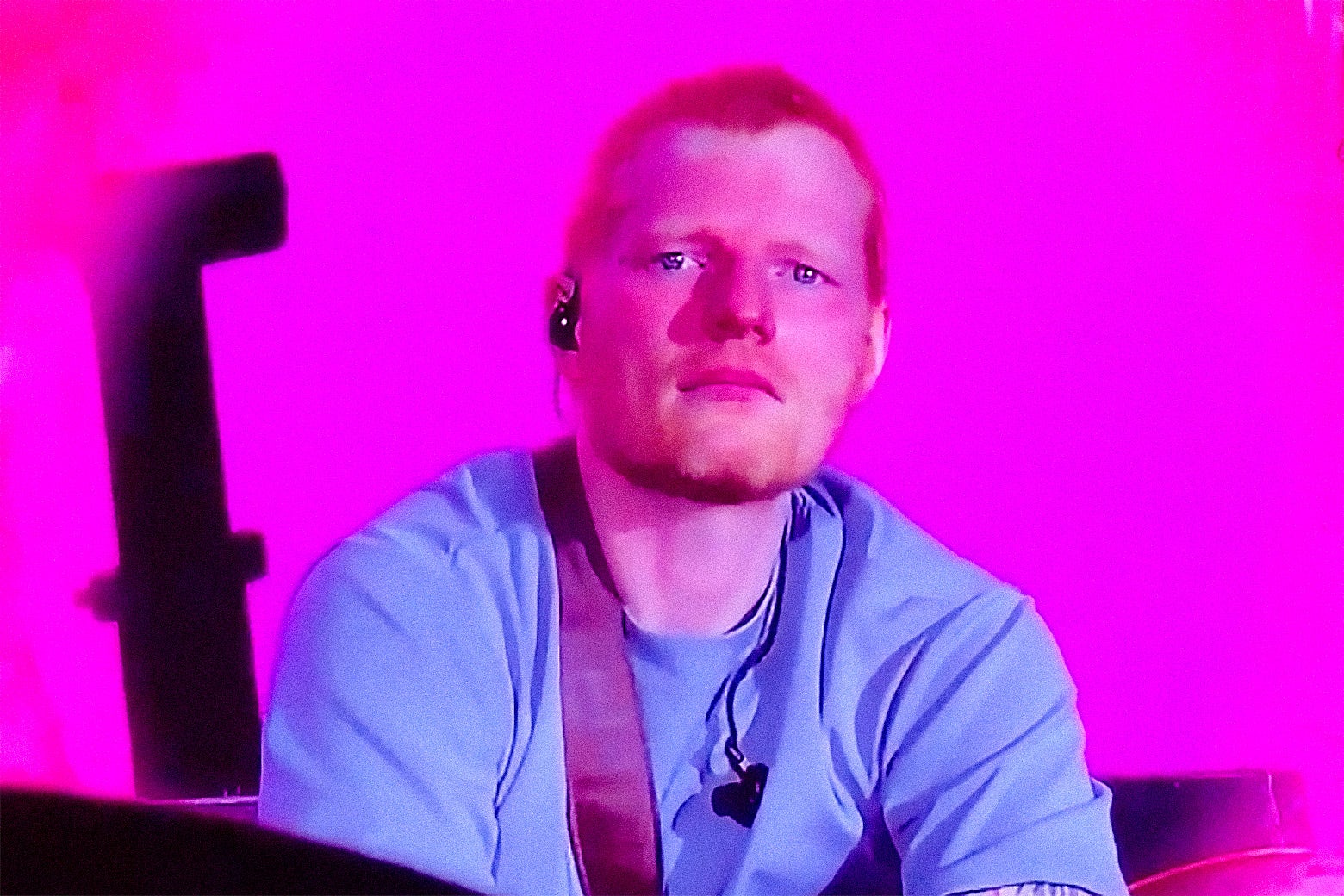
Music By Enter your email to receive alerts for this author. Sign in or create an account to better manage your email preferences. Unsubscribe from email alerts Are you sure you want to unsubscribe from email alerts for Nadira Goffe? Sept 22, 20266:43 AM Nadira Goffe Sign up for the Slatest to get the most insightful analysis, criticism, and advice out there, delivered to your inbox daily. It didn’t look good on Saturday night outside Lincoln Financial Field in Philadelphia, my hometown stadium where the Philadelphia Eagles play, and, that night, the site of Ed Sheeran’s first stop of his Mack-no-more tour after a week of controversy. Sheeran was set to go on stage on Saturday with a 5:30 p.m. start time; so, too, was a planned protest, organized by the Philly Palestine Coalition and Shut Down D&Z, set for 4:30 p.m. Instead, given the lack of opening acts—every single one had resigned in protest of the decision to remove Macklemore from the tour—the performance was pushed back to 8 p.m. But the protest raged on. By 6:30 p.m., protesters remained outside of the subway station to the Philadelphia Sports Complex, where concertgoers were getting off and were loudly told, “It’s not too late to get a refund!” “When I found out, I was like, ‘Oh, I’m going, but I’m going to start some shit,’” Sarah Padilla, 57, told me while standing outside of the stadium. She bought a ticket to Sheeran’s “Loop” tour back in January, but not for Sheeran. Instead, she was most excited to see Macklemore, who, up until last week, was one of many opening acts the acoustic pop artist had invited to perform for the remaining tour dates. Macklemore, whose most popular sing came out 14 years ago, had earned new fans over recent years for being outspoken, both in person and in his music, about the genocide in Gaza. “I love his stance and his songs on the genocide and his support and calling out billionaire bullshit,” Padilla said. “But when I found out he got fired, it broke my heart.” To recap how that happened: Last week, Macklemore announced that he was kicked off of Sheeran’s tour because, at a tour stop in New Jersey, the rapper made a speech advocating for a “Free Palestine” before performing his song “Hind’s Hall” on stage with images related to the Israeli occupation of the West Bank and pro-Palestine protests in the U.S. Macklemore said a lot of things during his set—from “Free Cuba to the Congo to Sudan to Iran” to calling ICE a “terrorist organization”—but it was his decision to display images related to Gaza that upset Pink (yes, another artist most of us forgot about), who reposted an Instagram post criticizing Macklemore’s statements, received backlash for the repost, and subsequently issued a lengthy social media statement that, frankly, cleared up nothing. This drama made it all the way to Robert Kraft, the billionaire real-estate developer and proud owner of the New England Patriots (which would be up there among the worst of his crimes if his ever-shifting reputation didn’t include things like this and this). Kraft called up his NFL pals and fellow moguls and issued Sheeran an ultimatum, getting a number of venues to agree to disallow tour performances if Macklemore was on the bill. So Sheeran dropped him from the tour completely, which led to all of the other billed acts—Irish singer-songwriter Aaron Rowe, Danish band Lukas Graham, Finneas (the producer-sibling of Billie Eilish), and Irish folk band Beoga—pulling out of the event in solidarity. A day later, Sheeran posted an astonishingly tone-deaf statement to Instagram, maintaining a fence-sitting position while claiming “I am not complicit” and blaming the decision to oust Macklemore on his promoter while maintaining that he purposefully keeps politics out of his “professional platform” because his audience includes many “young people.” All week, various other musicians took it to Sheeran by showing their support for Palestine on stages. Outside the show, Padilla told me she was one of a few people she knew who kept her ticket to try to disrupt from within, upgrading to a closer seat to unveil a Free Palestine shirt where Sheeran could actually see her (“He will definitely see me because I’m a Puerto Rican New Yorker. And I get seen,” she said.) Other protesters who had tickets returned them, including Hillary Steinberg, 34, who bought tickets with her boyfriend a year ago, for what would have been her first Sheeran concert despite formerly being a fan. She worked hard to get a refund because, she said, “we should not let corporate entities and wealthy people dictate what people can and cannot say”: “If it’s just about money, why are we here?” At one point, a protestor walked over and proudly exclaimed “I got one!” after he convinced a woman to get a refund instead of attending. A father, ushering his young daughter into the stadium, fist bumped the protestors as they walked by. Another man, Adam, a 31-year-old of Irish and Palestinian descent, said he hoped that the bad press indicated that “they’re most likely going to cancel this if there isn’t a solid turnout because people don’t want to show up and essentially be complicit in supporting genocide by showing up and paying for a ticket.” But inside the stadium, the opposite proved to be true. Sheeran took the stage in front of what appeared to be a full house (though it’s worth nothing resale ticket prices had plummeted). My section was full of tweens, children, and middle-aged couples out on date night. They did the wave before the show began. (This still happens?) I overheard my next-seat neighbor mentioning having seen Pink. When I asked her if artists’ views have any bearing on how she enjoys their music, she was quick to say no. One of her best friends is transgender, she told me, and she eats at Chick-fil-A. Sheeran opened up with a statement, reading off a teleprompter, about how he has been placed “in the middle of an important and passionate argument about freedom of speech and the most complex political issue on the planet.” He also mentioned that he has tried “not to be a political commentator of any kind” because he wants his “music and shows to be about unity, not division, about humanity, not politics.” Sheeran, though, has performed in support of Ukraine and has spoken on a number of British political matters, like Brexit. It was a simple rehashing of what he already wrote in his milquetoast offering on Instagram: He was careful not to say the word “genocide,” and he did not mention any of the former tour acts by name. Still, to my surprise, Sheeran spoke on the matter throughout the night, endlessly commenting on how grateful he is that a crowd showed up for him, with vague statements about how he wants his shows to be a place for unity and love and people with different views coming together. “That is why I’m here on my own and continuing my current tour,” he said. At many points throughout the night, the crowd raucously cheered on their feet for him. I first saw Sheeran with my best friend in 2017, back when the Xfinity Mobile Arena was called the Wells Fargo Center. At the time, and for most of his career, Sheeran was most notable for the soundscapes he could create with a simple acoustic guitar and a loop pedal. The “Loop” tour is, in many ways, a return to that earlier version of the artist—and it felt even more so without an opening act or a set backing band. However, Sheeran did call on some musicians he toured with previously, who only had three days to rehearse, to fill in for Beoga to back him for a few songs. “They said yes to being on stage with the knowledge that the world thought I was a certain type of person. They said yes with the knowledge that the world may hate them too for standing on stage with me,” he said. It was also at this midpoint that Sheeran revealed that he got rid of his B stage because he “didn’t know what this audience would be like,” if “people would be angry” with him or if they “would have thrown things” at him. The B stage, I remembered, is exactly where Padilla upgraded her seat to display her Free Palestine shirt. I wondered what happened with that plan. It wasn’t like this in 2017, that Sheeran would be the type of performer who would speak before nearly every song, almost like an open mic. But he had a lot to say. Before the song “Old Phone,” Sheeran joked that, “Before I introduce this song, I usually say: If you read about my name in the press, it’s usually due to a court case. But that’s not true anymore.” He referred to the last week of his life as “one of the worst weeks” of his life, he said, a little cheekily, that he’s “had a week of learning.” Toward the end of the show, Sheeran spoke again on the whole ordeal before breaking down, briefly, in tears: “Today has been one of the weirdest days of my life. Tonight has been honestly the best show of my life, the best show. I really didn’t know whether this tour would be carrying on. I really didn’t know whether I’d be even getting on stage again, whether I even wanted to be an artist at all. In these situations, you really find out who your friends are. And it’s been a weird week. I just feel like it happened very quickly. And the whole time, I have so many people telling me to cancel this tour and so many people falling out of my life that I’ve known for years and years and years, people just kind of backing away. And in the back of my mind, I saw the ticket sales for this gig and I didn’t see cancellations. I saw people buying tickets for this gig. And I’m there and everyone’s telling me to cancel and I’m feeling all of my friends and family and people I know abandon me. And I look at the end of the week and I see 50,000 people who haven’t abandoned me.” At some point before or during an encore that went on for two or three songs too long, Sheeran apologized for having to even get political in the first place. “I understand that people have children here, and I understand the families didn’t buy a ticket to hear that first bit of the show, but that was something I felt like I needed to say,” he started. A woman near me even wiped a tear off her cheek. The spectacle was complete. In high school, my best friend used to drive me home whenever I stayed late at her house. We only lived a few minutes’ drive away in the same suburb, meaning we only really had time to play one or two songs before we reached my doorstep. One of our favorites was, and is, Sheeran’s ballad “Thinking Out Loud.” Sheeran is an artist I had followed since his nascent days, when videos of him covering Johnny Cash’s “Wayfaring Stranger” went gangbusters on YouTube, when his songs like “The City” off of his earliest EPs were soundtracking many YouTuber’s videos. So much and so little has changed since then. He is still just one, singular guy with his guitar and his loop pedal. When I sent a video of “Thinking Out Loud” to my friend, she replied with a crying emoji. I haven’t listened to a new project of his in years, yet I know so much more now about structural politics, the world, and oppressive systems than I did then. It is baffling, to say the least, that Sheeran doesn’t or won’t. When he thinks out loud, the world listens. It is disappointing that he still doesn’t have much to say. Free Speech Israel Music Palestine
It Wasn’t Looking Good for Ed Sheeran. Then I Saw His Most Recent Concert.
Full Article
Original Source
Read the full article at Slate →KhanList aggregates and links to publicly available news content. We do not host full articles from third-party sources. Always verify important information with original sources.