
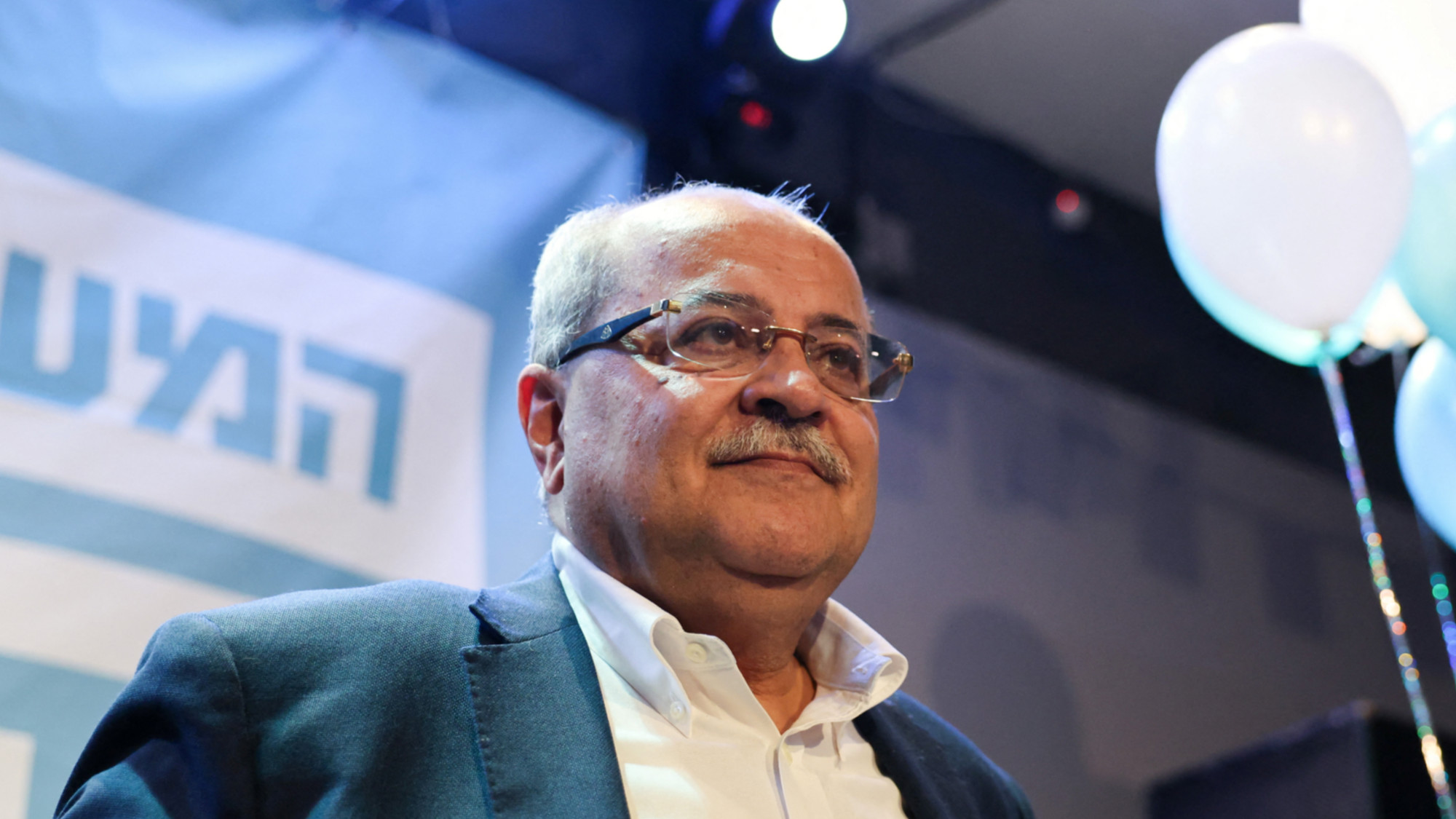
Palestinian lawmaker Ahmad Tibi has urged Israeli opposition leader Gadi Eisenkot to show political courage and work with Arab parties to end Prime Minister Benjamin Netanyahu’s rule. In an interview with Middle East Eye on Friday, Tibi called on Eisenkot to summon “the courage of [former prime minister] Yitzhak Rabin”. In 1993, Rabin’s minority government of 56 seats relied on Palestinian-led parties for parliamentary support, amid the push to advance the Oslo Accords. Tibi, founder and leader of the Ta’al party (Arab Movement for Renewal), said there was no democratic justification for ruling out cooperation with Palestinian representatives in the Knesset, Israel’s parliament, this time around. “I hope Eisenkot will be courageous enough to go forward and form a minority government, which will end this government of Netanyahu immediately,” Tibi said. New MEE newsletter: Jerusalem Dispatch Sign up to get the latest insights and analysis on Israel-Palestine, alongside Turkey Unpacked and other MEE newsletters A minority government occurs when the ruling coalition holds fewer than 61 of the Knesset's 120 seats. It survives by securing a "safety net" agreement, relying on outside parties to vote against opposition no-confidence motions without officially joining the cabinet. Tibi’s party is part of the Joint List, alongside two other Palestinian-led parties, Hadash and Balad. Together, they won 11 seats. Another Palestinian party, Ra’am, secured eight, giving the two slates a combined 19 seats - a record for Palestinian parties in parliament. The results mean that neither a Netanyahu-led nor an Eisenkot-led bloc can secure a 61-seat majority without Palestinian parties. 'We prefer a new government by Eisenkot, as a minority government, and we are ready to help' - Ahmad Tibi, Palestinian lawmaker Tibi said the Joint List’s strategy was to support anyone willing to remove Netanyahu from office and pave the way for an alternative government. The veteran politician dismissed proposals for a national unity government. Such an arrangement could bring Netanyahu’s Likud, the largest party in parliament, together with opposition parties to secure a majority, while excluding far-right figures such as Bezalel Smotrich and Itamar Ben Gvir. Tibi argued that this would allow Netanyahu’s policies to continue while giving another political leader the task of presenting them more favourably to Western governments. “We don't like a unity government, because one side will continue his brutal policy and the second will help him market this policy,” he said. “We prefer a new government by Eisenkot, as a minority government, and we are ready to help,” he added. Palestinian vote emerges as kingmaker Tibi hailed the Palestinian vote as decisive, saying unprecedented turnout had prevented Netanyahu from securing another majority. Netanyahu’s bloc won 64 seats in 2022, paving the way for what was widely described as one of the most right-wing governments in Israel’s history. It won 53 seats in Tuesday's elections. The outgoing government oversaw the genocide in Gaza, mass displacement and violence in the occupied West Bank, as well as a series of regional wars. Its tenure also saw a surge in discrimination and incitement against Palestinian citizens of Israel. Palestinian citizens of Israel are descendants of the indigenous Arab population of historic Palestine. Their families survived the mass expulsion and ethnic cleansing of Palestinians by Zionist militia in 1948 and remained within the territory that became Israel. Today, they number around two million, accounting for roughly a fifth of Israel’s population. Who are the Palestinian citizens of Israel? Read More » Tibi praised Palestinian citizens who turned out to vote despite old age, illness and mobility difficulties. He described their participation as a historic achievement. He said the immediate priority was to use these electoral gains to bring down what he called Netanyahu’s criminal government and improve the status of Palestinian citizens. Tibi also dismissed allegations that Qatar had financed efforts to boost turnout among Palestinian citizens. He described the claims as politically motivated and predicted the controversy would quickly collapse, with no impact on the election results. “Two, three, four, five days, everything will be relieved. It will be a minor issue; it will have zero effect on the results and on the process,” he said. He accused Netanyahu of using the allegations to intimidate Palestinian voters and discourage Eisenkot from cooperating with Palestinian parties. Tibi defended the high turnout as an act of political self-defence against racism and incitement. He also rejected Netanyahu’s attempts to question the legitimacy of the Arab vote, pointing instead to allegations of foreign financing surrounding the prime minister’s own office. “The only corrupted party here is the prime minister and the prime minister's office,” he said. Tibi also called on opposition parties to move quickly to replace Knesset Speaker Amir Ohana, a Likud lawmaker. He accused Ohana of turning parliament into a racist institution and fuelling hostility towards Palestinian lawmakers. Netanyahu is going nowhere until Israel's Palestinians are taken seriously Read More » “Amir Ohana made the Knesset racist,” Tibi said, describing him as a major factor in the deterioration of relations, particularly over Palestinian representation and its treatment in parliament. He urged opposition parties to nominate a replacement, pledging that Palestinian lawmakers would support their candidate. “The best practical step should be removing Amir Ohana, the speaker of the parliament, and voting for the candidate of the opposition. It should be done, no hesitation,” he said. Tibi said the opposition’s 67 seats - including those of the Palestinian parties - represented a democratic majority. He argued that Palestinian citizens, who make up around 20 percent of Israel’s population, had a legitimate right to help determine the country’s next government.
Israel: Tibi urges Eisenkot to show 'courage' and form minority government with Palestinians
Full Article
Original Source
Read the full article at Middleeasteye →KhanList aggregates and links to publicly available news content. We do not host full articles from third-party sources. Always verify important information with original sources.