
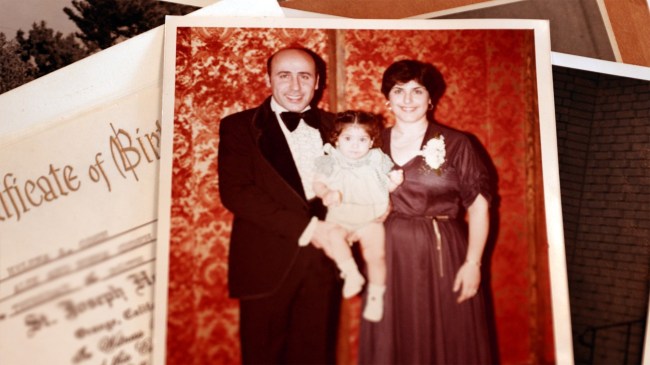
Times change, the arc of the moral universe bends towards progress, and yet one thing that has remained true for as long as I’ve been alive is that prejudice, bigotry, and explicit displays of racism have always been openly permissible in America — so long as they’ve been targeted at Arabs and/or Muslims. That sad and immutable fact was on full display throughout Zohran Mamdani’s mayoral campaign last year, and the say the quiet part out loud reaction to Abdul El-Sayed’s current senate race has somehow managed to be even worse on both sides of the aisle (Democrats lament that he “doesn’t share our values,” while Republicans straight up just call the guy a jihadist). But anyone old enough to remember 9/11 knows that it didn’t start with the likes of Vicky Paladino, just as I assume that anyone old enough to remember the assassination of Alex Odeh knows that it didn’t start with 9/11. The sole fatality of a bomb that had been planted at the California office where he served as the West Coast Regional Director of the American-Arab Anti-Discrimination Committee (ADC), Alexander Michel Odeh was murdered on the morning of October 11, 1985, leaving behind his wife Norma and their three young daughters Helena, Samya, and Susan. To this day, his slaughter remains “unsolved.” And yet, as Jason Osder and William Youmans’ scattered but vital documentary “Who Killed Alex Odeh?” makes clear soon after it begins, there’s little doubt as to who was behind the killing. Indeed, the film establishes that the case was effectively solved within days of the attack, and that all three of the primary suspects — all members of a right-wing terrorist group known as the Jewish Defense League — were only allowed to flee to Israel because powerful forces within the American political system preferred for them to get away with it. And to get away with it. And to get away with it. More than 40 years later, no efforts have been made to prosecute or extradite the presumptive murderers. One of them has even moved back to the United States. And so, despite affecting the aesthetic and tropes of the true-crime format, “Who Killed Alex Odeh?” directly contradicts the expectations of its supposed genre. Instead of establishing a vast mystery for their movie to explore, Osder and Youmans — one of them Jewish, the other a Palestinian-American — give shape to the galling absence of one. Stunted and searching by design, their film unpacks the sociopolitical context of Odeh’s killing in order to illustrate how the easily Google-able question posed by its title could possibly remain “unanswered” for so long, and even partakes in some light subterfuge as part of an effort to pin down the culprits on camera. What the documentary finds, or at least calls new attention towards, is alternately eye-opening, obvious, and eye-opening for its obviousness. First and foremost, Osder and Youmans use Odeh’s murder as a lens through which to examine the militarization of Jewish extremism at home and abroad (with an emphasis on the emergence of ultra-nationalist JDL founder Meir Kahane). Propelled by archival footage, the film has little room for personal reflection, but implicit in its focus is the willfully short-sighted extent to which “terrorism” has long been framed as an exclusively Muslim practice; Osder suggests in the press notes, but not the documentary itself, that American Jews are seldom taught about the more violent expressions of Zionism, an implication supported by my own memories of going to Hebrew School at a conservative New England synagogue. “Who Killed Alex Odeh?” also examines how the tacit permission of such violence is what also allows it to ferment. That Israel welcomed Odeh’s alleged killers back to the holy land, and that President Reagan refused to recognize the severity of the hate crime they had committed against a fellow American on American soil (he never so much as sent a letter of condolence to Odeh’s widow), sent a clear and enduring message that the world’s most powerful governments were okay with the spilling of Palestinian blood. It’s since been alleged that Mossad and the U.S. State Department combined to shut down the murder investigation. In the most harrowing sequence of a film that has little use for suspense, Israeli investigative journalist David Sheen disguises himself as an ultra-Orthodox Jew and meets one of the alleged killers while wearing a hidden camera — Baruch Ben-Yosef’s outspoken prejudices seem inextricable from his comfortable position as a pillar of his community. Later, when Osder lures him into a sit-down interview under false pretenses, Ben-Yosef excuses himself from the conversation when Odeh’s name is mentioned, his irritation softened (and made even more upsetting) by the “this again?” attitude of someone who seems to believe that no one could possibly still give a shit about the 1985 murder of a single Palestinian expat. Somewhat diminished in the film’s erratic attempts to contextualize this ever-metastasizing sickness is Odeh himself. Born in Palestine but displaced to Egypt as a child because of the 1967 Arab-Israeli War, the righteous but mild-mannered Odeh dedicated his adult life to combating discrimination against his people in America. Home video footage and old clips from his television panel appearances paint Odeh as more of an egghead than a firebrand. He worked to make in-roads with the local Jewish community, and didn’t have much of a public profile aside from an occasional appearance on “Newsline.” During his final appearance on the show, he debated a member of the JDL. Osder and Youmans also interview members of Odeh’s immediate family, whose “what is there to say besides the obvious?” has already been internalized by the rest of the documentary. A different and possibly more rewarding film might have done more to investigate the pain of living in a country that has all but signed off on the hate-based murder of your husband or father, but “Who Killed Alex Odeh?” has little patience for investigations. The only thing more obvious than the identity of Odeh’s murderers is the continued lack of political will to hold them accountable. And a country that lacks the political will to address the slaughter of one Palestinian is a country that lacks the political will to address the slaughter of Palestine itself. Grade: B “Who Killed Alex Odeh?” is now playing in theaters.
‘Who Killed Alex Odeh?’ Review: A Scattered but Searing Documentary Examines America’s Tacit Acceptance of Anti-Arab Discrimination
Full Article
Original Source
Read the full article at Indiewire →KhanList aggregates and links to publicly available news content. We do not host full articles from third-party sources. Always verify important information with original sources.