
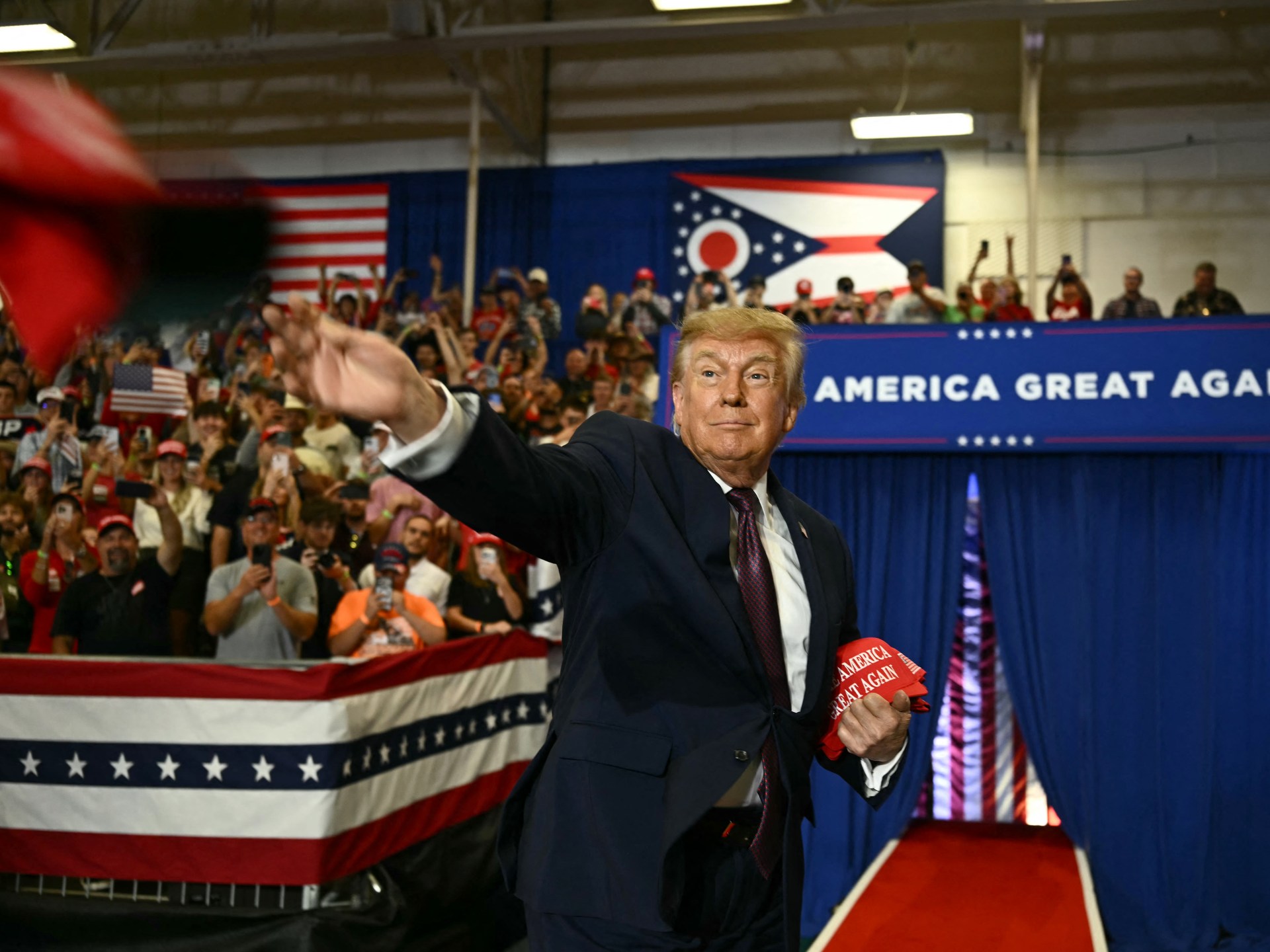
Democrats have flipped some long-held Republican seats and secured a majority in both houses of the US Congress, but a defiant President Donald Trump has given a mixed reaction, expressing his willingness to accept the results and work with the Democrats while also positioning himself to put up a fight.In posts on Truth Social following Tuesday’s midterm vote, Trump pinned the defeat on the fact that he wasn’t personally on the ballot, stressing that if he had been running, Republicans would have “won IN A LANDSLIDE!”Recommended Stories list of 3 itemslist 1 of 3‘Call me senator’: How Abdul El-Sayed beat Trump’s hate to create historylist 2 of 3Musk makes light of defeats after record spend on Republican candidateslist 3 of 3America is heading for two years of constitutional brinkmanshipend of listIn an interview with The New York Times while watching election returns at the White House, he said he was “absolutely willing to accept those results” and to “work with the Democrats”, only to then post on social media an image of a red MAGA hat with his slogan replaced by the word: “VETO”, referring to his the presidential power he has to block legislation passed by Congress.But critics and commentators are already declaring that, with the Republican midterm losses, the president is “lame duck”.What is a ‘lame duck’ president?The ‘lame duck’ period for a president refers to the period at the end of a president’s term, usually after their successor has been elected but before they have left office. An outgoing politician is largely believed to have considerably less influence due to their limited time remaining in office.The use of the term has expanded to include longer periods when the scheduled or expected departure of a politician results in a depreciation of their ability to influence policymaking.With Trump leading the Republican Party and the Republicans in control of Congress, the president had a great deal of influence over the US legislative agenda. But now that the Democratic Party will lead both houses of Congress, his influence over that agenda will be greatly diminished, and Democratic worries about the president’s opposition may be reduced by his nearing, and unavoidable, departure from office – assuming Trump does not find a way to seek a third term.Moreover, with the midterm election losses largely being interpreted as a repudiation of Trump’s policies and a date set for his exit from office – January 2029 – his ability to convince or cajole his fellow Republicans to support his policies could also be curtailed.This has led pundits to propose that Trump is already entering the lame duck period of his second presidency with two years still remaining in his term.While “lame duck” presidents are often viewed as weak or ineffective, history shows they are far from powerless in pushing their agenda forward.What powers does Trump still have?The US president is entering a period of divided government but, despite losing his strong legislative influence, he still has executive powers.Trump has been known to use executive orders to bypass legislative gridlock in the past, centralising authority in the White House even when the Republican Party controlled Congress.In January 2025, when Congress allocated only a fraction of the funds requested for controlling the southern US border, Trump declared a national emergency in order to divert billions of dollars toward building a physical border barrier by executive order instead.When a president declares a national emergency, Congress can enact a joint resolution terminating the emergency, but the president can then use his veto power to block that.Presidential vetoes can only be overturned by a two-thirds majority in both the House of Representatives and the Senate, which the Democratic Party cannot command by itself.Going forward – as Trump’s new apparel boldly states – the president is likely to make abundant use of his power of veto.On Tuesday, he told Fox News that he would veto all “insane” legislation from Democrats. “And after a couple of months of vetoes, they’ll go out, and they’ll say, ‘How do we get this stuff done?’ And we’ll work together,” he added.Have other ‘lame duck’ presidents managed to get things done?Yes. Historically, lame duck presidents have been able to achieve major policy goals, but they tend to focus on areas where the executive branch has broad autonomous powers.“Despite the damaging results for the Republican Party, many issues remain beyond the reach of Congress,” James Boys, research fellow at the Centre on US Politics at UCL, told Al Jazeera.“The US Constitution grants the president of the United States wide-ranging powers in the area of foreign policy, and it should be anticipated that this is where Trump will spend much of his remaining time in office.”Several presidents in US history have opted to do just that. After losing control of Congress to the Republicans in the 2014 midterms, for example, former US President Barack Obama used his executive authority to finalise the Iran Nuclear Deal, also known as the Joint Comprehensive Plan of Action (JCPOA), and to normalise diplomatic relations with Cuba.President Barack Obama was able to defend the Affordable Care Act (ACA), his embattled health care law, during his lame duck period.Former President Bill Clinton spent his final months in office focusing on foreign policy to broker peace between Israelis and Palestinians by hosting the Camp David Summit 2000. The talks eventually collapsed, however.He also used his executive authority to push through plans to protect 58.5 million acres of forestland, restrict large-scale mining and logging on designated federal grounds and preserve watershed resources.Former President Joe Biden also entered a lame duck period after announcing he would not run for the presidential race in 2024. In his last days as president, Biden issued a sweeping federal pardon for his son, Hunter Biden, and preventative pardons for other family members and staff.Reversing prior US policy, Biden granted Ukraine permission to use US-supplied missiles to strike deeper inside Russia. He also directed the Department of Defense to give the remainder of a $61bn aid package to Ukraine to avoid risking it being cancelled by the incoming Trump administration.
Is Trump really a ‘lame duck’ after losing both houses of US Congress?
Full Article
Original Source
Read the full article at Aljazeera →KhanList aggregates and links to publicly available news content. We do not host full articles from third-party sources. Always verify important information with original sources.