
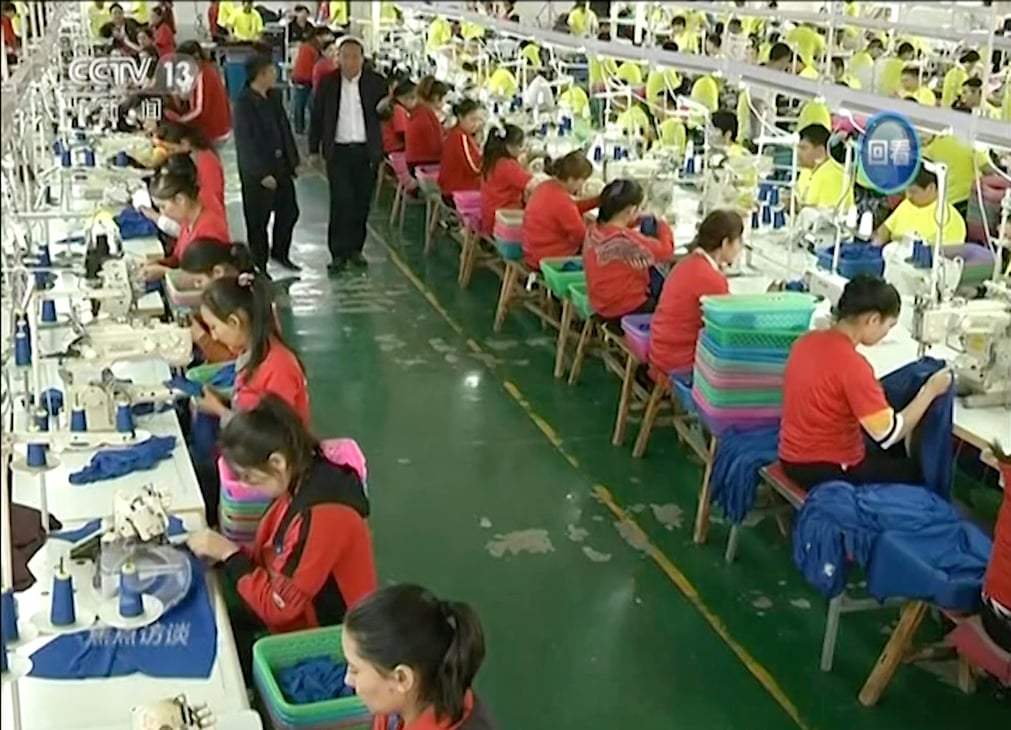
The Seventh Circuit asked if the Trafficking Victims Protection Act gave American courts jurisdiction over accusations of forced labor in American manufacturing facilities abroad.CHICAGO (CN) — A former political prisoner of a Chinese prison maintained Wednesday before a Seventh Circuit panel that a Wisconsin-based company should be held responsible for violations of federal forced labor laws.The plaintiff accused Milwaukee Tool Corporation in 2024 of cramping him and other prisoners in a grueling manufacturing facility and exploiting them for the production of Milwaukee Tool’s gloves.The plaintiff’s attorney Jennifer Bennett argued before the three-judge panel that an amendment of the Trafficking Victims Protection Act — a 2000 law enacted to eliminate modern forms of slavery — grants U.S. courts extra-territorial jurisdiction over any offense, civil or criminal.“That’s for two reasons, each of which is independently sufficient to reverse. First, this lawsuit is a domestic application of the statute,” Bennett, an attorney with San Francisco-based firm Gupta Wessler LLP, said. “Second, even if an American company profiting in the U.S. from its U.S. participation is not a domestic application, the statute applies extraterritorially, whether it is criminally or civilly enforced.”The plaintiff brought his claims under subsection 1589(b) of the act, which prohibits “knowingly benefit[ing] … from participation in a venture which has engaged” in forced labor. But a lower court determined that although the statute grants the government extra-territorial jurisdiction, it does not apply when the statute is enforced civilly.Chief U.S. Circuit Judge Michael Brennan pressed Bennett further on her understanding of the statute.“Would your reading make the civil remedy reach farther with fewer safeguards than the criminal prosecution that it rests on?” the Donald Trump appointee asked.“I don’t think so, your honor, because the civil provision directly only applies to the predicates prohibited by the statute, and so the extraterritorial reach of the civil provision would not be greater than any of the predicates that the remedies enforce,” Bennett said.Milwaukee Tool’s attorney David Horniak maintained that Bennett wrongfully interpreted the extraterritoriality provision of the act to apply not only to criminal prosecutions, but also to civil remedies.“We are not looking for whether one can squint at the statute and find a way to read it to apply to civil actions,” Horniak, an attorney at Washington-based firm DLA Piper LLP, said. “We are looking for whether Congress gave us clear, unmistakable instruction.”U.S. Circuit Judge Joshua Kolar raised concerns about comity, given that the Fourth Circuit ruled in favor of the plaintiff in a 2019 case, in which the plaintiff sought relief after she was sexually abused while working as a housekeeper in the U.S. Embassy in Yemen.“We’re a little bit worried about just letting anyone dabble in international relations, right? So, if you don’t have that rule, how do you account for that?” the Barack Obama appointee asked.Bennett noted that the extraterritorially provision is not limited to U.S. citizens, it also applies to companies and people that are present in the United States.“I think this statute makes it very clear that Congress was thinking about international trafficking, the entire statute is about international trafficking. Congress expanded the extraterritorial jurisdiction at the same time,” Bennett said. “It expanded the cause of action to ensure that it applied to every offense under the TVPA, the findings in the statute explicitly say the reason the United States is getting involved in this is because we don’t think foreign countries are doing it good enough job. In other words, Congress itself is making that balance.”Horniak rebuffed Bennett’s characterization of the statute.“I think this case raises a paradigm example of the kinds of comity concerns that could have motivated Congress not to extend [the statute] extraterritorially,” Horniak said. “While Milwaukee Tool is the defendant, the underlying conduct at issue here is alleged forced labor in Chinese prisons by the Chinese government.”“Imagine France enacted a similar law enabling former prisoners in the United States to sue in France for alleged violations of French law based on how they were treated in U.S. prisons,” he added.Alongside Judges Brennan and Kolar, U.S. Circuit Judge Kenneth Ripple, a Ronald Reagan appointee, also sat on the panel Wednesday. The judges did not indicate when they might rule on the matter.Subscribe to our free newslettersOur weekly newsletter Closing Arguments offers the latest about ongoing trials, major litigation and rulings in courthouses around the U.S. and the world, while the monthly Under the Lights dishes the legal dirt from Hollywood, sports, Big Tech and the arts.Additional Reads
Ex-prisoner argues liability of US companies over slave labor abroad
Full Article
Original Source
Read the full article at Courthousenews →KhanList aggregates and links to publicly available news content. We do not host full articles from third-party sources. Always verify important information with original sources.