
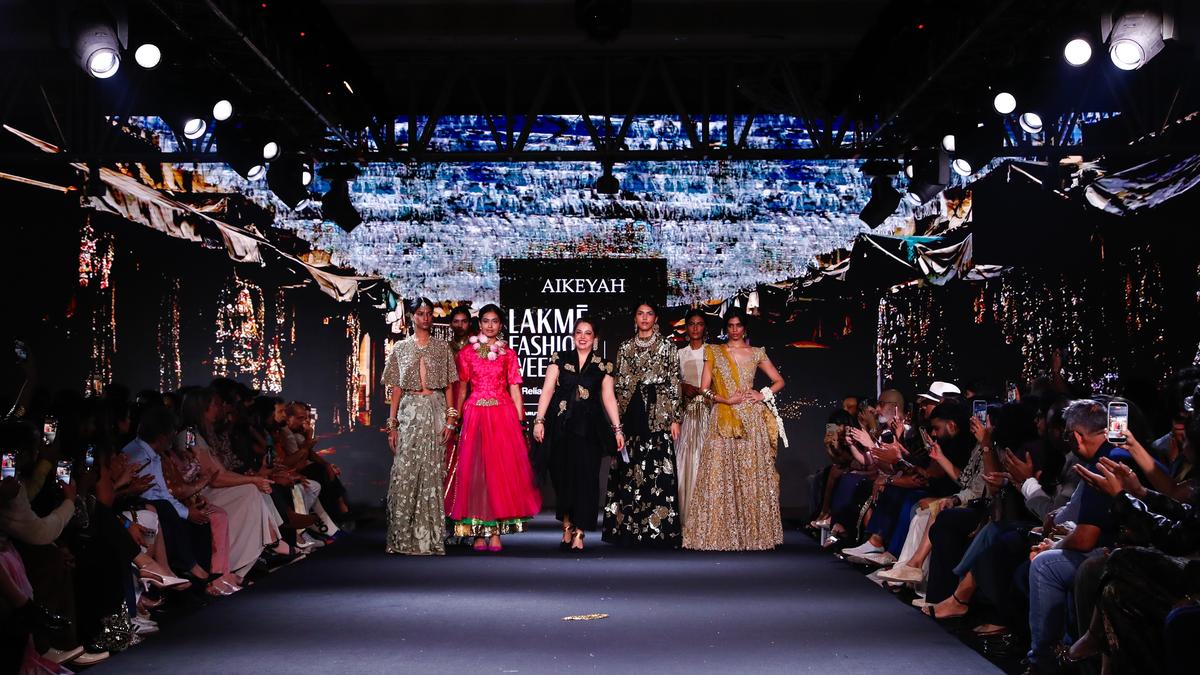
Last month at Lakmé Fashion Week x FDCI, the real showstopper at designer Padma Yangchan’s show was sitting next to me. As Namza Couture coats came out — pashmina blooming with brocade motifs, rust and mustard ones dyed with rhubarb and marigold — my neighbour lifted her phone, angling for selfies. I leaned left and right, catching the clothes between her poses. Padma Yangchan (in black) with models wearing Namza Couture | Photo Credit: Courtesy: FDCI x Lakme Fashion Week She wasn’t alone. The day before, at Sushant Abrol’s Countrymade show, designer Ashdeen Lilaowala watched an influencer beside him take selfies mid-event. “It’s disrespectful to the designer,” he states. A collection is half a year’s work, shown in minutes. “For those 15 minutes, you hope people notice all the details. Now everybody’s recording. Who will clap?” he asks. Ashdeen Lilaowala At Sushant Abrol’s Countrymade show, a model leans over while the front row holds up its phones | Photo Credit: Courtesy: FDCI x Lakme Fashion Week Distractions extended beyond the audience. Manish Malhotra’s show started an hour late, then a sponsor’s car rolled down the runway, followed by actors Sara Ali Khan and Ayushmann Khurrana. Roughly 10 film stars closed shows that week: a textbook one-two punch of celebrity and Instagram fodder. “Celebrity showstoppers turned the story towards the celebrity and away from the clothes,” says Shefalee Vasudev, journalist and author. “Influencers offered brands more views, and reviewers lost space to them.” At Malhotra’s show, I counted at least a dozen influencers, all dressed by him.The result? Plenty of content, little criticism. “Fashion week should create the conditions for genuine observation and analysis, rather than treating coverage as just another form of content generation,” says Fern Mallis, who created New York Fashion Week and later helped build India’s at IMG. Instead, critique is often elbowed aside these days: fewer writers, more room for cameras. Without it, designers lose the record of how their work grows, buyers lose a second opinion, and readers lose an expert who can share why a collection matters. Fern Mallis, who created New York Fashion Week | Photo Credit: Special arrangement Fashion week is just a handful of days out of 365. But with designers launching collections, stores and digital shows year-round, somebody ought to be keeping score. The question for 2027 is whether there is still room for that somebody.Business elsewhereOnce the arrangement was simple: designers showed, buyers ordered, critics judged, everyone had work to do. Buyers used to fight for front-row seats; now they’re scarce. “I do miss seeing those familiar faces in the front row. The influential buyers and editors whose presence signalled that the industry was paying attention,” says Mallis.Tina Tahiliani Parikh still attends. The CEO of Ensemble, founded in Mumbai in 1987 as India’s first multi-designer store, spent a day and a half at this edition, mostly at the trade stalls. Stoïque and Three, two labels Ensemble works with, were there, but not on the runway. “Honestly, we don’t do most of our buying at fashion week,” she says. The runway, meanwhile, has found other uses. Labels launching prêt lines or opening stores book a show because no launch party can summon 30 photographers. Tina Tahiliani Parikh, CEO of Ensemble | Photo Credit: Special arrangement But Tahiliani Parikh remembers the late 2000s, when it meant something. “We were an industry on the cusp,” she says. “You met journalists thinking critically. You met young designers doing exciting work. It was an ecosystem.” She used reviews to judge which designers were growing. “Does it matter now? Everybody sends press gifts. Who knows who likes or doesn’t like what?” she asks.Tina Tahiliani Parikh, CEO of Ensemble, founded in Mumbai in 1987 as India’s first multi-designer store, used reviews to judge which designers were growing. “Does it matter now? Everybody sends press gifts. Who knows who likes or doesn’t like what?” she asks. Elli AvrRam walks the ramp during the ORCR show | Photo Credit: Courtesy: FDCI x Lakme Fashion Week Who keeps a record?Today, you don’t see the editors, says Lilaowala: “If 200 people have already posted [from the show], what is the point of the magazines coming?” Those who still come work on a short leash. “When designers and sponsors are also advertisers, a critical review is a commercial risk,” says Vasudev. A harsh review, she adds, can get you dropped from the guest list.“When designers and sponsors are also advertisers, a critical review is a commercial risk,” says Shefalee Vasudev, journalist and author. A harsh review, she adds, can get you dropped from the guest list. Shefalee Vasudev A review needs pictures, and most publications rely on the official images. Jaspreet Chandok, director, Lakmé Fashion Week, and group vice-president, Reliance Brands, says more than 20 images from each show reach the media within 90 minutes, with more on request. He dismisses industry talk of plans to charge media for wider access to these images. “It’s counter-intuitive… considering our main job is to ensure as much content dissemination as possible,” he says. Jaspreet Chandok, director, Lakmé Fashion Week | Photo Credit: Special arrangement What does get in the way, however, is control. “Most images now arrive already approved [publications once received full runway sets],” says Vasudev. Designer PR teams also decide who gets invited, where they sit and which quotes go out. Some journalists write paid copy, host events or edit designer-funded magazines until they blur into the influencers beside them.What designers lose in the end is continuity. “A good critic remembers your last several collections. They can tell growth from repetition, and creative risk from costume,” says Vasudev. “Indian fashion’s history risks shrinking to an album of comments that say ‘amazing’ and ‘OMG, great work.’” “A good critic remembers your last several collections. They can tell growth from repetition, and creative risk from costume. Indian fashion’s history risks shrinking to an album of comments that say ‘amazing’ and ‘OMG, great work.’” Shefalee VasudevJournalist and authorYoung designers feel it most. Shweta Gupta, who launched her label SWGT in 2018, felt seen when a review caught the mood of A Periwinkle Wednesday, her 2024 collection about ordinary days in the mountains where she grew up. “What made that review so special was that it understood the feeling I was trying to create, beyond what was written in the press note,” she says. “A post gives you visibility, but a thoughtful review gives perspective.” Shweta Gupta (centre) with her models during Lakmé Fashion Week x FDCI | Photo Credit: Satej Shinde An outfit from Gupta’s A Periwinkle Wednesday | Photo Credit: Special arrangement Livestreams on Instagram and the criticNot everyone has given up on the critic. “Social media can tell you what is getting attention; thoughtful criticism can help explain why something matters,” says Mallis.At a time when smartphones have thrown open the runway doors, critics like Lisa Armstrong, who has helped lead print and digital fashion coverage at Britain’s The Daily Telegraph since 2011, see the upside. “I always thought it was a pity that incredible shows like Alexander McQueen’s They Shoot Horses Don’t They? [Spring/Summer 2004], which were mini works of art, lasted about nine minutes and were seen by 800 people at most. Now you can watch it all on social media in real time. There’s a much bigger, more informed audience out there.” Lisa Armstrong of The Telegraph | Photo Credit: Special arrangement Gen Z in the loopIt’s easy to think young people don’t care about fashion criticism. That isn’t what I see in my fashion classrooms, where journalism is one module among styling, graphics and design. Aditi Dhanorkar, 18, a second-year Fashion Communication and Styling student at Unitedworld Institute of Design in Gandhinagar, started out on Instagram carousels and YouTube. Now she reads Vanessa Friedman, chief fashion critic at The New York Times, for what the feed leaves out: research, context and the nerve to call out hype or bad practices. Her classmate Sanjana Parvathy Mahalakshmi S., 19, made the same jump, from influencers to critics on sites like The Impression. “A critic’s review feels honest, like a common person looking at the clothes,” she says. The audience for criticism is there. The critics are harder to find. Honest voices have now moved to podcasts, newsletters and independent sites, which is exactly where my students find them.The catch, though, is that there are too many shows, and “the repetitiveness is making people engage less”. Armstrong posts on Instagram, but saves the verdict for the paper. “My Instagram is my personal take with behind-the-scenes content. The Telegraph is the front-facing stage.” It was on this stage, in August, that she called out Condé Nast, which would let The Telegraph run images of Nicole Kidman from British Vogue’s September issue only if the article was “positive”. “It’s important to call out censorship, which is essentially what this was,” she told me.Diet Sabya, the anonymous Instagram account known for its call-outs since 2018, grew its following in the space journalists left. Lately, its scope has widened. “The format evolved into talking about whole collections rather than a single look,” says the person behind the account, who reviewed péro’s opening show this season. Having taken up the critic’s job, they expect journalists to do theirs. “There is absolutely room for criticism in Indian fashion. Journalists must take onus of their jobs and stop paraphrasing show notes and calling it a day.” Diet Sabya has gone back to the basics. “I realised the freshest thing I can serve is one of the oldest forms of fashion writing: a stiff review.”“There is absolutely room for criticism in Indian fashion. Journalists must take onus of their jobs and stop paraphrasing show notes and calling it a day.” Diet Sabya has gone back to the basics. “I realised the freshest thing I can serve is one of the oldest forms of fashion writing: a stiff review.”So yes, there is room for a fashion critic in 2027, if anyone is brave enough, or paid enough, to take the job. Phones can record a show, but it still takes a critic to tell us if it was any good.The writer is a columnist and critic, with a keen focus on fashion, textiles, and culture.
Is there room for a fashion critic in 2027?
Full Article
Original Source
Read the full article at Thehindu →KhanList aggregates and links to publicly available news content. We do not host full articles from third-party sources. Always verify important information with original sources.