
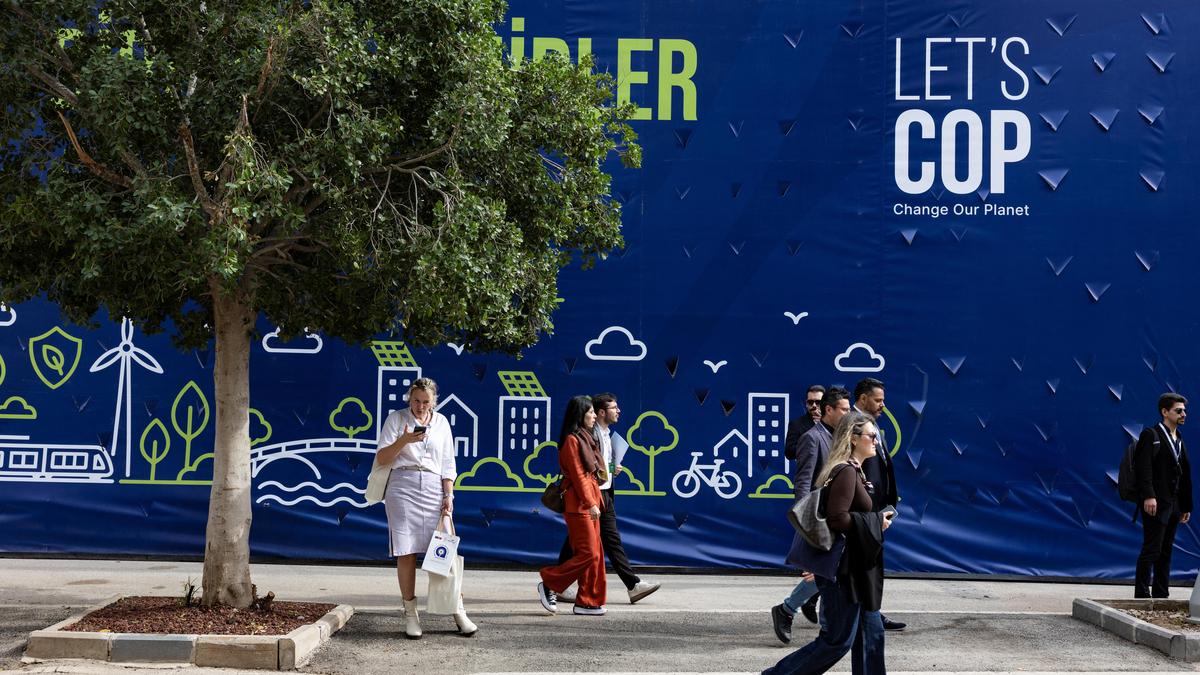
Participants attend the UN Climate Change Conference (COP31) in Antalya, Turkey. File. | Photo Credit: Reuters Much like the 1.5 degree Celsius warming ceiling, COP31 proceedings under way at Antalya in Turkiye also breached upper limits with countries, as of Saturday (November 21, 2026) evening, yet to behold a final text or convene a final plenary meeting to decide on the path forward for climate action.Proceedings were expected to officially conclude on Friday (November 20, 2026), though historically it almost always goes into overtime and extends into the early hours of the weekend. The inability to reach a compromise — every clause of the final text must be agreed upon by every participating country — is due to the familiar division between a bloc of European countries and developing countries over a timeline to phase out fossil fuels and defining and paying out the trillions of dollars necessary to fund that transition as well as adapt to ongoing climate change.Latest iterationThe latest public iteration of the COP31 draft cover text, as of November 19, has eliminated references to fossil fuels phase out and net zero dates but has also deleted references to a firm US $120 billion adaptation-finance target that developing countries have been asking for as “legally binding financial obligations” on developed countries.Taking off from the previous editions of the COP in Baku, Azerbaijan and Belem, Brazil, developed nations said they would “take the lead” in contributing at least $300 billion annually towards mitigation and adaptation to climate change by 2035, though developing countries say this should be at least $ 1.3 trillion.Other than the thorny debate on whether loans, grants, and for-profit investments in green projects are all included in this number, there is also debate on how much of the annual money should be split between adaptation and mitigation. The $120 billion was a proposal but that now has disappeared from the latest version of the text.This suggests that the most ambitious demands of both the developed and developing country blocs have been eliminated.A cover text is an overarching political decision that frames the outcome of a climate conference rather than settling any single agenda item. It is usually finalised last, and like every outcome it needs the consensus of all Parties. The Presidency has said earlier drafts were not meant to reflect consensus.Carbon captureHowever, a widely expected outcome of raising electricity’s share in final energy consumption to 35% by 2035 and scaling up the use of carbon capture, utilisation and storage (CCUS) technologies. The latter involves unproven, expensive technology to extract atmospheric carbon dioxide. Proponents say this is necessary to counter the effects of the carbon that’s already in the atmosphere and responsible for the 1.5C temperature breach that has already occurred. To reiterate, the Paris Agreement goal is to keep temperatures below 2C and “as far as possible” below 1.5C. However, this has also been criticised by several civil society organisations as being an excuse to delay fossil-fuel phaseout.“CC[U]S has been researched and developed for decades yet has achieved no discernible breakthroughs in efficiency, capture rates, or costs. Indeed, costs are getting higher. CCS is a tax on energy supplies at a time when affordability is strained and demand growth is seeking efficient supplies,” said Grant Hauber, Strategic Energy Finance Advisor, Asia, Institute for Energy Economics and Financial Analysis (IEEFA) in a statement,” CO2 capture and disposal are a pure cost to the energy and production system.”“We’re down to the wire at COP31, and the latest texts are alarmingly far from ambitious or equitable,” said Rachel Cleetus, Climate Program director at the Union of Concerned Scientists (UCS), in a statement. “ Rich nations, most notably the EU nations, are still holding a harsh line against committing to tripling adaptation finance to at least $120 billion annually by 2035. Instead of reaching agreement on urgently needed climate finance, some countries seem willing to push negotiations toward failure.” “The attempt to prove that a flashy headline target signals success for this COP has gone wrong in many ways for this Presidency,” said Avantika Goswami, Programme Manager, Centre for Science and Environment. “This text is a messy collation of disparate targets, some proposed as a menu of options, and some new decisions to establish new agendas. It lacks coherence and vision.” Published - November 21, 2026 10:03 pm IST
COP31 extends into overtime in Turkiye meeting
Full Article
Original Source
Read the full article at Thehindu →KhanList aggregates and links to publicly available news content. We do not host full articles from third-party sources. Always verify important information with original sources.