
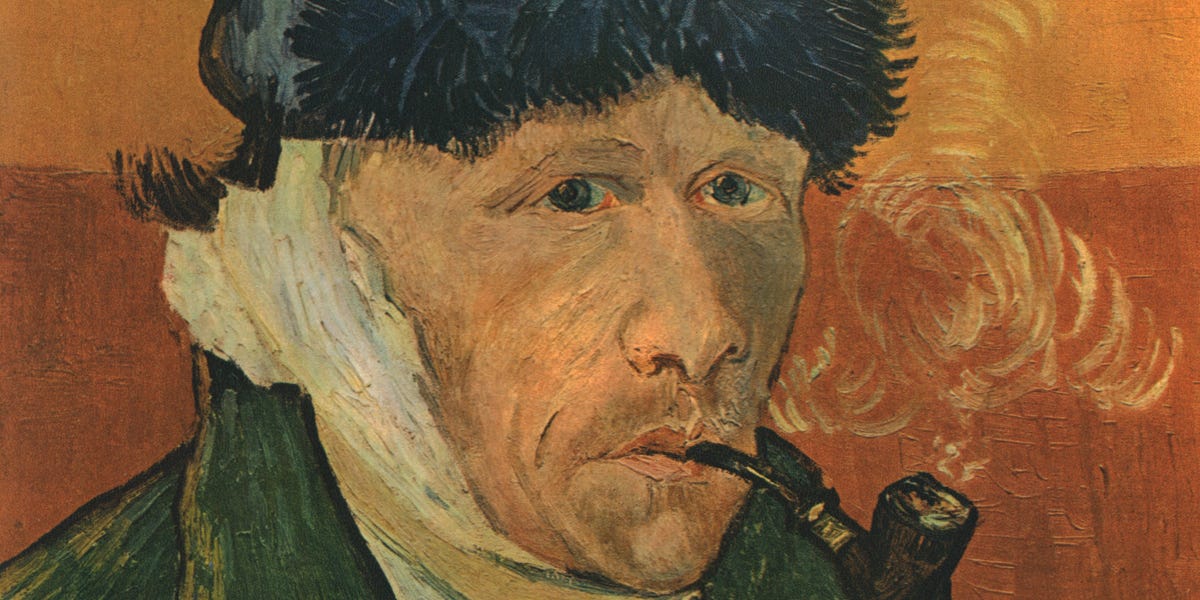
Aristotle once said that “no great mind has ever existed without a touch of madness.” While that millennia-old hypothesis doesn’t hold up to modern scientific scrutiny, researchers are interested in exploring the relationship between artistic and scientific creativity and mental health. While there are many high-profile artists who’ve very publicly struggled with mental health (Vincent van Gogh cut his own ear off, after all), those cases are purely anecdotal. Does scientific evidence suggest there’s really a correlation?Getting closer to an answer to that age-old question was the primary goal of a new study published in the journal Molecular Psychiatry that was led by researchers at the Max Planck Institute for Empirical Aesthetics and Karolinska Institutet in Sweden.“There is a longstanding idea that genius and ‘madness’ go hand in hand, particularly in creative fields, with many famous artists believed to have struggled with mental health problems,” Karolinska Institutet’s Miriam A. Mosing, a co-senior author of the study, told Medical Xpress. "However, the empirical evidence for this association remains mixed.”To even attempt to understand this possible mental correlation, the team needed an immensely large dataset. Luckily, they could pore over two surveys conducted in 2012–2013 and 2022–2023 that collected mental health data from 14,658 individual twins in Sweden, fewer than half of whom participated in both surveys. The first survey assessed artistic and scientific achievement and noted self-reported psychiatric symptoms and openness to experience, while the second one tracked divergent thinking, or the ability to solve complex problems.“This idea is fueled by many anecdotal examples of famous creators with eccentric personalities and psychiatric problems, from Vincent van Gogh and Ernest Hemingway to Virginia Woolf and Camille Claudel,” the authors wrote in the study. “Research including some systematic reviews and meta-analyses, has suggested that creativity and engagement in creative activities are associated with an increased risk of mental health problems.”The study also aimed to assess the role genetics and environment play on this correlation, and that’s where the twins aspect of the dataset comes in handy. With identical twins, for example, researchers could effectively remove genetic and environmental factors and assess whether the associations remained.They found that artistic creativity did have a positive correlation with poorer mental health, much as previous studies indicated. However, scientific creativity didn’t hold a similar correlation. One theory, proposed by the authors, suggests that scientific environments are “more unforgiving” of mental health problems than artistic ones are, leading to indirect selection processes. Interestingly, the team also found a positive correlation between depressive symptoms and openness, suggesting that an introspective personality might lead one to question social norms. They also noted that genes appeared to play a significant role.“Though our study suggested the importance of genes, it doesn’t mean environment is not important,” Max Planck Institute’s Penghao Xia, lead author of the study, told Medical XPress. “Therefore, we still need to investigate other explanations of the association."Darren lives in Portland, has a cat, and writes/edits about sci-fi and how our world works. You can find his previous stuff at Gizmodo and Paste if you look hard enough.
Is There Really a Link Between Genius and Madness? A Study of 14,658 Twins Just Uncovered a Surprise.
Full Article
Original Source
Read the full article at Popularmechanics →KhanList aggregates and links to publicly available news content. We do not host full articles from third-party sources. Always verify important information with original sources.