
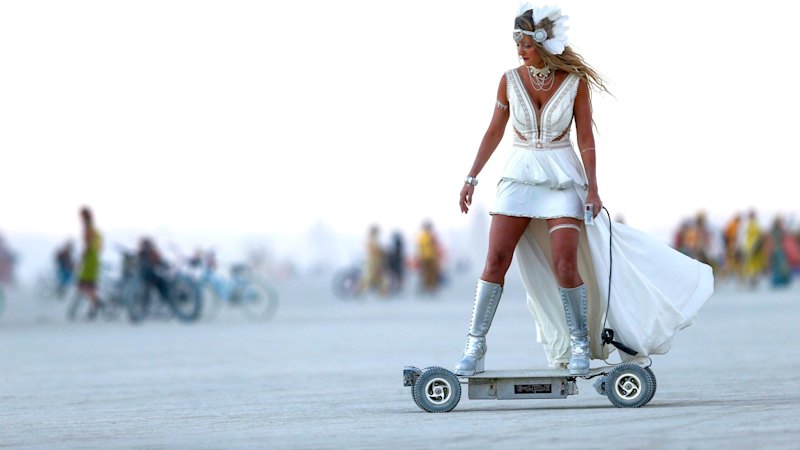
Neil VigdorSeptember 4, 2026 — 3:30pmNew York: Burning Man is becoming a midlife fever dream.At this time of year, the festival, which draws tens of thousands of attendees to the Nevada desert seeking spiritual enlightenment, creativity and disconnection from the outside world, is losing appeal, particularly among people in their 20s, according to attendance figures released this summer.Burning Man has built a reputation as the world’s wildest, weirdest festival.ALAMYBut as the years pass, it appears to be appealing to an older demographic. That decline has been so pronounced that attendees in their 40s and 50s, part of a generation that helped establish Burning Man as a cultural phenomenon, have overtaken 20-somethings in attendance.Built around the concept of “radical self-reliance”, the Burning Man experience still draws thousands to the harsh Nevada desert.iStockIn 2014, nearly one-third of festival-goers were in their 20s, but in 2025 that number declined to about 10 per cent. People in their 30s continue to make up the highest number of attendees.Aerial images give a sense of the festival’s scale.Maxar TechnologiesOverall attendance has also slipped from its 2019 peak, when about 80,000 people flocked to the event.The attendance data, collected by a group of volunteers at the festival and via an online survey, has helped paint a portrait of the average ticket holder, known as a Burner.The conditions don’t deter tens of thousands from making the journey to Burning Man.APIt also reflects the festival’s evolution, from its inception in 1986 as a small gathering of friends on a San Francisco beach to burn an 8-foot wooden man to a sprawling production associated with celebrities, tech titans, long lines and glamping.‘Today’s event is built for the consumption of Western elites and the middle-class creatives who service them.’John Law, Burning Man co-founderThat metamorphosis has alienated some people with early connections to Burning Man, including John Law, one of the event’s founders.A woman rides an electric skateboard at Burning Man 2016.Chase StevensWriting in The San Francisco Standard late last month, Law bemoaned what the festival had become, describing it as unrecognisable.“Burning Man has lost its anarchist soul,” Law wrote. “Today’s event is a massive, kaleidoscopic extravaganza for the senses – a phantasmagoric, immersive spectacle built for the consumption of Western elites and the middle-class creatives who service them.”This year’s festival began on Sunday and runs until Monday in Black Rock City, the name of the site on federal lands where the annual celebration of arts and music takes place. The desert venue is referred to as the “playa”.Organisers of the festival, which frames itself as a movement, did not immediately respond to requests for comment on Wednesday about attendance trends or Law’s criticism of the event.Burning Man is known for its elaborate sculptures and art installations.APIn 2025, more than 30 per cent of the Burners earned over $US150,000 a year ($207,900) – and 11 per cent had incomes of at least $US300,000, according to the data.A decade ago, 11 per cent of attendees earned over $US150,000, though it is unclear whether the figures were adjusted for inflation.The cost of attending Burning Man, which has included Elon Musk, Mark Zuckerberg and Jeff Bezos as past attendees, can reach thousands of dollars.“It’s just sort of like a crazy Mad Max meets Vegas meets Alice in Wonderland,” Musk said in a 2013 conversation with actor Rainn Wilson about his admiration for Burning Man.For the first time this year, reality television star and entrepreneur Bethenny Frankel is attending Burning Man, documenting her journey aboard a private plane and luxury accommodations in a recreational vehicle via social media.The festival climaxes with the fiery destruction of a giant wooden figure. APIndividual ticket prices for this year’s festival range from $US550 to $US3000, according to the event’s website, which noted that reduced-price tickets were available to applicants with limited income or those meeting other unspecified criteria.Law suggested that Burning Man had become like Disneyland.“You can buy into luxury camps with private chefs and have a stylist curate your outfits,” he wrote. “You can fly in on a chartered plane. It’s become a commercialised escape hatch – a week when anyone with enough money can leave their real life behind entirely.”This article originally appeared in The New York Times.Get a note directly from our foreign correspondents on what’s making headlines around the world. Sign up for our weekly What in the World newsletter.From our partners
Is Burning Man burning out? America’s mega-festival is facing a midlife crisis
Full Article
Original Source
Read the full article at Smh →KhanList aggregates and links to publicly available news content. We do not host full articles from third-party sources. Always verify important information with original sources.