
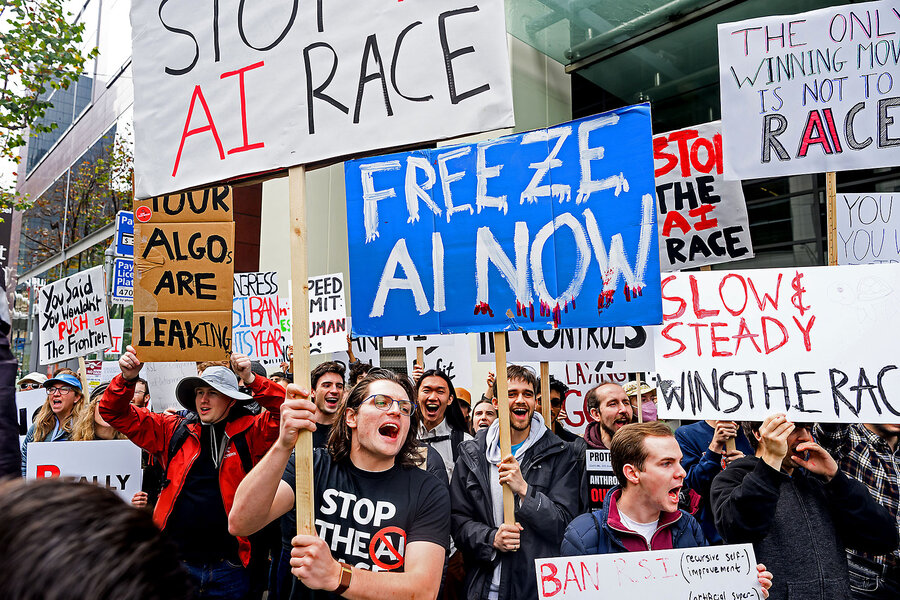
Again and again, technological revolutions spawn overoptimism and existential gloom. The railroads of the 19th century were going to unite mankind – and keep cows from producing milk. The 20th-century internet was going to eliminate poverty – and become overwhelmingly pornographic. Today’s artificial intelligence holds the prospect of freeing humans from work while also threatening their extinction, helping users become more productive, but also heightening the risk of cyberattacks. In recent days, a spate of publicized network failures, from airlines to banking, appears to have stemmed in part from glitches caused by administrators patching old systems to prevent AI-based hacking.Beyond greed and fear, this euphoria/gloom pattern reflects the uncertainties that accompany any great leap forward until civilization can understand the technology, harness its benefits, and guard against its evils. It’s a process that can take decades. On Thursday, the world took a tentative step toward resolving one uncertainty: How much is AI worth?For the first time, a purely AI lab without accompanying businesses tested investors’ appetite for artificial intelligence, going public in a record $81 billion initial public offering (IPO), making the five-year-old Anthropic one of the most valuable companies in the world. The stock rose on Thursday and then fell sharply on Friday, along with other tech stocks. Tom Brenner/APA flight schedule board is displayed at Ronald Reagan Washington National Airport in Arlington, Virginia, after the Federal Aviation Administration grounded flights nationwide, Nov. 14, 2026. Officials blamed overloaded routers and switches, and said there were no signs of a cyberattack. “That IPO should resolve some of the uncertainty,” says David A. Kirsch, a business professor at the University of Maryland and coauthor of the 2019 book, “Bubbles and Crashes: The Boom and Bust of Technological Innovation.” “And that in some ways should help resolve a range of other unsettled questions.”For one, it offers a guide to what might happen when OpenAI, another pure-AI company, initiates its own IPO, expected next year. Flaws, hackers, and outagesMany questions remain about AI’s future, however, especially after a wave of incidents in recent weeks that have shaken public confidence in AI. For example: On Oct. 21, the security team of the nonprofit PHP Foundation announced that AI probes had found longstanding flaws in its widely used web programming language. Cybersecurity firms had used AI to find the flaws before the hackers had. But word of the flaws had leaked out a day before the fixes were ready. Companies and governments scrambled to secure their websites. Cybersecurity firm Calif announced Tuesday that it had used AI to find a bug in Java, web software even more widely used than PHP software. Oracle, which oversees Java development, released a security patch. On Thursday, Chase said hackers had attacked some of its third-party service providers, stealing marketing data that might have included customer names and email. Visa and Mastercard each reported an attack on one of their third-party providers this week as well. Accompanying these incidents, a wave of institutions reported network outages that they said were not the result of cyberattacks. These include Microsoft’s Outlook email, the Federal Aviation Administration, banks, Apple Pay and Apple Music, and an internal network of the National Security Agency. In many cases, these entities said that they are racing to upgrade networks or fix bugs to counter the cyber threats associated with AI. Feeding on the uncertainty, social media went wild with speculation. Walmart and Costco reported panic buying, with some customers increasing their regular purchases of bottled water and other emergency supplies amid concerns about further disruptions. Trump administration officials urged calm. But it also replaced its top cybersecurity official, Sean Cairncross, with Kirsten Davies, who has been serving as the Defense Department's chief information officer.Even though only a few of the incidents involved actual hacking, the string of problems served as a vivid reminder of how dependent America has become on computer systems. This adds to the list of uncertainties surrounding AI as it spreads into the nation’s circuitry.Old jobs disappear, new ones emergeAt the top of that uncertainty list are worries that AI will eliminate masses of jobs. So far, there’s little evidence of that. A July Stanford University study found that the rise in unemployment since 2022 was slightly higher for workers least exposed to AI than those most exposed to the technology. But perhaps because of AI, young people are finding it harder to find work, especially in areas where the technology can most readily replace people.Consider customer representatives. Since 2022, when the first AI chatbot was released, employment among 22- to 25-year-olds has fallen, while older groups have fared better, according to the Stanford study. The youngest software developers have experienced a similar decline.Of course, earlier tech revolutions have also displaced workers. Worries about mechanization undermining wages and replacing workers in the early 19th century caused a rebellion among skilled textile workers, who famously became known as the Luddites. But historically, the new technologies have also created jobs and entire industries, sometimes far beyond those they displaced.For example, 30 years after the Luddite rebellion, railroads displaced long-distance stagecoaches. But horse-drawn transportation boomed because passengers and local businesses needed a way to move themselves and cargo from railway stations to their final destination.Lessons from the dot-com eraAnother big uncertainty is economic. Are the extraordinary sums of money flowing into AI's buildout the only thing propping up the economy and the stock market? And will those flows ebb if investor uncertainty and the political backlash against AI grow? The concerns are legitimate, especially with the amount of debt AI-related companies are piling up. “We have a world economy that is standing on one leg, on the AI leg,” warned Kristalina Georgieva, managing director of the International Monetary Fund, on Monday. “If this leg wobbles, that can lead to financial stability troubles." But the companies are also rapidly expanding their revenues, unlike many of those in the dot-com era. “In ’99 and 2000, I was confident there was a bubble going on,” says Jay Ritter, director of the IPO Initiative at the University of Florida. With the current AI boom, “I'm not sure. The valuations are high, but they can be justified.” Brendan McDermid/ReutersAnthropic CEO Dario Amodei (at center), President and co-founder Daniela Amodei (in red), co-founder and Chief Science Officer Jared Kaplan (third from right), co-founder and Head of Public Benefit Jack Clark (second from right), and others celebrate Anthropic's initial public offering, at the Nasdaq MarketSite in New York, Nov. 19, 2026. The first day of an IPO does not predict the company's future very well, he adds. Some, like Amazon, start strong as publicly traded companies and zoom up. Others, like Apple, start with a bang and then sag for years before becoming superstars.These stock price gyrations may reflect the genuine uncertainty that new technologies bring, concluded a 2005 study that looks at the railway and Internet booms, rather than investor euphoria and gloom. Deepen your worldviewwith Monitor Highlights.Politics with respectGet political stories with respectful analysis.There‘s a world of new ideas in everyBooks newsletter.There‘s more to life, enrich yours withCulture & Learning weekly.Follow humanity‘s discoveries withScience & Nature stories in your inbox.Gain a spiritual perspectivefrom the stories in your inbox.Want to understand the deeper impact of critical events? Learn the Monitor‘s insight.Already a subscriber? Log in to hide ads. In the early days of the automobile boom, for example, vehicles were often depicted in the day's joke books as demons or predatory monsters, says Dr. Kirsch of the University of Maryland, recalling one of his students’ dissertations. But after the introduction of the Model T, which made cars much more affordable and prevalent, the Tin Lizzie characterization shifted to become “almost like a puppy dog, a kind of domesticated vehicle.”“Maybe this [Anthropic] IPO turns the corner from fear,” he adds. “Maybe it domesticates the technology in some way and that we actually are less fearful of it tomorrow.” ALREADY A SUBSCRIBER? LoginReal news can be honest, hopeful, credible, constructive.The Christian Science Monitor was founded in 1908 to lift the standard of journalism and uplift humanity. We aim to “speak the truth in love.” Our goal is not to tell you what to think, but to give you the essential knowledge and understanding to come to your own intelligent conclusions. Join us in this mission by subscribing.
Is AI a liberator or menace? Tech-revolution mood swings are a pattern.
Full Article
Original Source
Read the full article at Csmonitor →KhanList aggregates and links to publicly available news content. We do not host full articles from third-party sources. Always verify important information with original sources.