
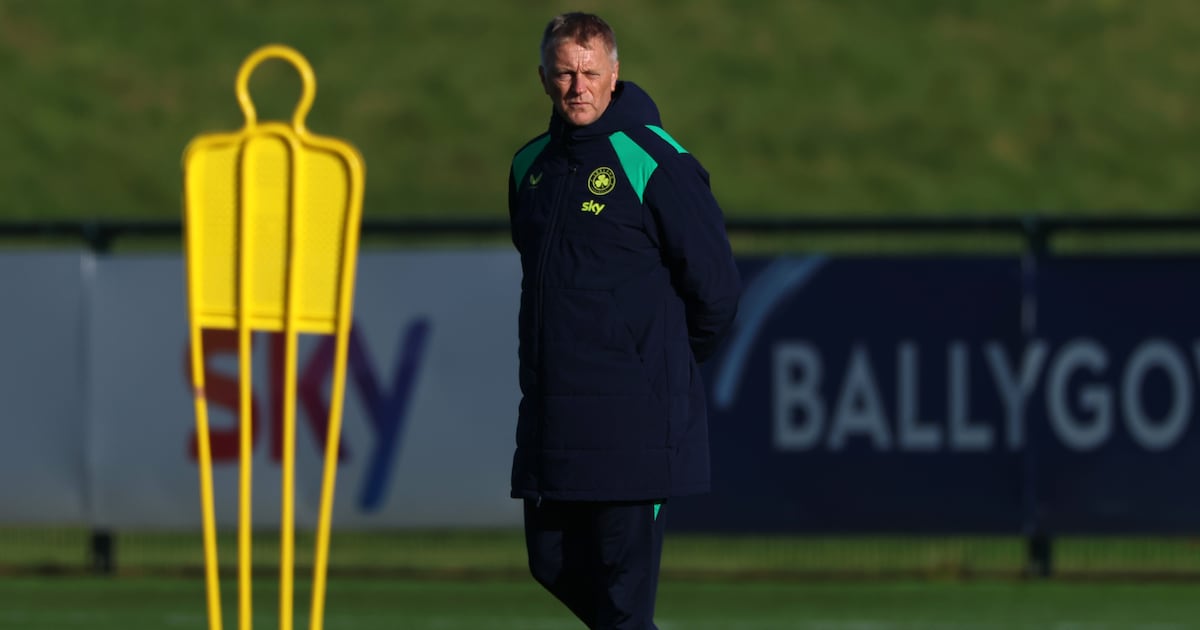
Nations League B Group 3: Republic of Ireland v Kosovo, Aviva Stadium, Tuesday, 7.45pm – Live on RTÉ2Kosovo provide Heimir Hallgrimsson with a nicely polished looking glass. An Irish victory on Tuesday night means this turbulent Nations League campaign will be viewed as a success, whereas anything less would bear the mark of either stasis or regression. “It is clear we need to win the game, a draw will do nothing for us,” said Hallgrimsson at his pre-match press conference, “and that is our mentality going into the game.” READ MOREIreland have finished third in a League B group in all four previous editions of the Nations League, but a win against Kosovo would mean a second-place finish and an end to this absurd consistency. The attendant benefits of finishing in second spot include a leap to the status of second seeds in next month’s Euro 2028 qualifier draw and a promotion play-off next March against a League A side, a much more worthwhile use of the window than a pair of friendlies. Defeat for Ireland on Tuesday night could break their League B cycle in all the wrong ways, however, as it would condemn them to bottom place and a relegation play-off if it is coupled with an Israeli win over a much-changed Austrian side. Republic of Ireland goalkeeper Caoimhín Kelleher during training. Photograph: James Crombie/Inpho A win on Tuesday night would also validate the squad’s positivity in the wake of the loss in Linz, where consensus from the manager and the players is that Ireland did not deserve to lose. While there was much to like about that Irish performance, it turned on a couple of recurring faults: the concession of late goals and a vulnerability on defensive set pieces. Hallgrimsson has preached six key principles to his players since the moment he got the job, and one of them is an ambition to be the best on set pieces. But Ireland have conceded from set pieces against Hungary (twice), Czechia, Canada, and Austria since the start of the World Cup qualifiers last year. Meanwhile, three of the five goals Ireland have conceded in this campaign came in the last 15 minutes of games. In a strange kind of symmetry, all of the goals Ireland have scored have come in the first half of games, whereas all of the goals conceded have been in the second half. The latest of these was Vedat Muriqi’s winning goal for Kosovo in Pristina.[ Ireland are a team whose pores radiate the pure essence of League BOpens in new window ]Asked about this trend, Hallgrimsson reached for the cliché of “fine margins,” but added players cannot afford to switch off at any moment. “Maybe that’s where Austria are edging us,” he said. “They are so honest in everything they do. Whatever is done is to perfection and that’s from the time they’ve spent together from being at the Euros and World Cup finals. They’ve had time to work on those details.” Republic of Ireland manager Heimir Hallgrímsson. Photograph: James Crombie/Inpho Ireland’s defeat in Pristina was their most insipid performance under Hallgrimsson since last year’s 2-1 loss away to Armenia, and the manager speculated that Ireland’s passivity against Kosovo may have been partly because the players’ focus was on the looming tie with Israel. His team selection was also a factor, with a front three of Troy Parrott, Finn Azaz, and Chiedozie Ogbene isolated from a starting team that featured five centre-backs and two holding midfielders. Parrott cut a particularly frustrated figure in Pristina – booting a football against a wall as he was substituted – but he has been much better supported in subsequent games thanks to the selections of Jack Moylan and Adam Idah. Ireland’s creativity quotient has also been kept high by accommodating Azaz in a deeper midfield role. That said, Ireland lack energy and flair at wing-back, where options on the right are centre-backs (James Abankwah, Jake O’Brien) or midfielders (Jason Knight, Bosun Lawal). Ogbene could be used at wing-back if Hallgrimsson is feeling especially bold. Captain Nathan Collins is out with a knee injury, and he will be replaced in the team by either O’Brien or John Egan. His squad place goes to Jimmy Dunne, meaning Séamus Coleman won’t be involved. Republic of Ireland's Séamus Coleman and Tom Cannon during training. Photograph: James Crombie/Inpho Kosovo are denuded by absentees, missing four players who started against Ireland in Pristina including Juventus forward Edon Zhegrova and midfielder Veldin Hodža. Despite the fact Kosovo have scored just three goals across their five games so far and need only a draw to seal second place, Hallgrimsson is not expecting them to simply squat deep and defend. “They will be confident defending, 100 per cent, and we will need to be really efficient in what we are doing in attack against them,” said Hallgrimsson. “But I don’t expect them to sit and wait for us to come. They are a good side in possession.” They will undoubtedly expect Ireland to be the game’s protagonists, however, a role in which Ireland have not always looked comfortable. “We have shown now that our depth is much better and the knowledge [of] what we’re doing is much better than it has been,” said Hallgrimsson. Leave aside the seedings and play-offs and league finishes: the true value of a win against Kosovo is proof that this team has maintained the momentum that was sparked so deliriously in Budapest a year ago. Ireland (possible XI): Kelleher; Abankwah; O’Shea, Egan, Scales; Manning; Azaz, Molumby; Moylan, Idah; Parrott.Kosovo (possible XI): Saipi; Kamberi, Krasniqi, Hajrizi; Vojvoda; Rexhbecaj, Avdullahu; Gallapeni; Rashica, Zabergja; Muriqi.[ Ireland continue their trend of conceding gallingly ugly goalsOpens in new window ]
Ireland’s Nations League campaign comes down to must-win Kosovo clash
Full Article
Original Source
Read the full article at Irishtimes →KhanList aggregates and links to publicly available news content. We do not host full articles from third-party sources. Always verify important information with original sources.