
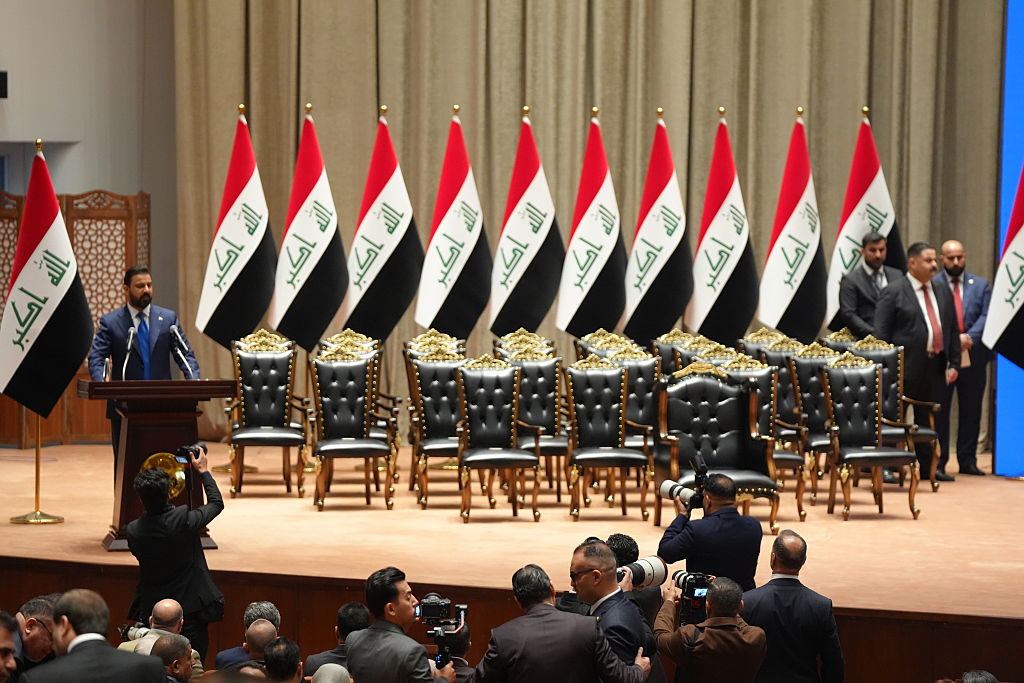
The Iraqi Parliament confirmed 11 ministers and three deputy prime ministers on October 15, nearly completing Prime Minister Ali al Zaidi’s cabinet. “Within five months of the formation of the government, the ministerial lineup has been completed, and we have filled the vacant portfolios,” Zaidi said on X. The prime minister was confirmed on May 14, but only 14 of 23 ministers were approved at that time. Out of the 11 ministers in the second round of cabinet selection, two are heading new ministries, and one is a minister of state—a cabinet minister who does not lead a specific government department. Despite Zaidi’s declaration that “the ministerial lineup has been completed,” the position of minister of migration and displacement, contested by different Christian factions, and a fourth deputy prime minister were not selected. The deputy prime ministers Laith al Khazali: Khazali is a senior leader in Asaib Ahl al Haq (AAH), an Iran-backed, US-designated Foreign Terrorist Organization (FTO) headed by his brother, Qais al Khazali. The US also designated both Khazali brothers as Specially Designated Global Terrorists (SDGTs), as AAH “has claimed responsibility for more than 6,000 attacks against U.S. and Coalition forces,” including the execution of five American soldiers in Karbala in 2007. They are also sanctioned for serious human rights abuses in Iraq. Qais has pivoted AAH toward political and economic involvement under the political party Sadiqoun, which won 28 seats in parliament in the recent November 2025 elections, the most out of any single Shiite party. Sadiqoun is part of the Coordination Framework, a coalition of Shiite parties, many aligned with Iran, which leads the government. AAH announced on June 2 that it would hand over its weapons to the Iraqi government. Disarmament of the Iran-backed militias in Iraq is a priority for Washington. Zaidi reportedly convinced the Trump administration not to object to Laith’s selection on the grounds that it would help Zaidi in the militia-disarmament campaign. Washington previously rejected any cabinet roles for politicians affiliated with Iran-backed terror groups, but that appears to have shifted with AAH’s announcement of disarmament. Laith has also played a key role in AAH’s illicit oil smuggling and other business schemes. Muhsin al Mandalawi: Mandalawi, appointed deputy prime minister for energy affairs, is a Shiite Feyli Kurd who leads the Al Asas Coalition, a small party in the Coordination Framework. In the previous parliamentary session, he was elected first deputy speaker of parliament in September 2022 and then served as acting speaker of parliament from November 2023 until the end of October 2024. In September 2026, the US Treasury sanctioned two Iraqi businessmen for facilitating Iranian sanctions evasion. Iraqi media identified the men as Mandalawi’s brothers. Mohammed Ali Tamim: In addition to being confirmed as deputy prime minister, Tamim is also head of the Ministerial Council for Economy. He previously served as deputy prime minister and minister of planning. He is from the Sunni Qiyada bloc. Cabinet ministers Minister of Interior Yasser al Maliki: Maliki is a member of the State of Law Coalition, a major Shiite party in the Coordination Framework led by his father-in-law, former Prime Minister Nouri al Maliki, whom the Trump administration rejected earlier in the year for another term as prime minister. The Interior Ministry and the Defense Ministry were the two remaining vacant “sovereign” ministries—major power centers in the Iraqi government. Minister of Defense Naif al Shammari: Shammari is a Sunni politician from Nineveh and part of the Al Hasm al Watani Alliance, which is led by Defense Minister Thabit al Abbasi. Shammari served in the Iraqi military before running for parliament in 2014. Minister of Planning Qutaiba Ghazi Hamid: Hamid is a Sunni politician from the Azm Alliance. Minister of Higher Education and Scientific Research Haider Bahaa: Bahaa is an academic from the State of Law Coalition. Minister of Culture Yassin al Ithawi: Ithawi is a Sunni politician from the Azm Alliance. Minister of Construction, Housing, and Municipalities Rebaz Hamlan: Hamlan is a Kurdish politician and the former Iraqi deputy finance minister. He was nominated by the Kurdistan Democratic Party. Minister of Labor and Social Affairs Mohammed al Mousawi: Mousawi is from Sadiqoun, AAH’s political party. Minister of Youth and Sports Safaa al Kinani: Kinani is from the Hikmah Movement, a Shiite political party led by Ammar al Hakim that is part of the Coordination Framework. Minister of Digital Economy, Governance, Science, and Technology Mohammed al Daraji: Daraji is from the Khadamat Alliance, which is associated with Kataib al Imam Ali (KIA), another Iran-backed, US-designated Foreign Terrorist Organization. KIA offered to disarm in June, like AAH. He heads a new ministry. Minister of Tourism and Antiquities Ali al Dakhili: Dakhili is from the Muntasirun bloc, which is associated with Kataib Sayyid al Shuhada (KSS), another Iran-backed, US-designated Foreign Terrorist Organization. KSS refuses to disarm unless a series of conditions are met. This ministry was broken off from the Ministry of Culture. Minister of State Mohammed (Mehmet) Seman: Seman leads the Iraqi Turkmen Front and served as governor of Kirkuk. Bridget Toomey is a research analyst at the Foundation for Defense of Democracies focusing on Iranian proxies, specifically Iraqi militias and the Houthis.
Iraqi parliament approves most remaining cabinet appointments, including Iran-backed militia figures
Full Article
Original Source
Read the full article at Fdd →KhanList aggregates and links to publicly available news content. We do not host full articles from third-party sources. Always verify important information with original sources.