
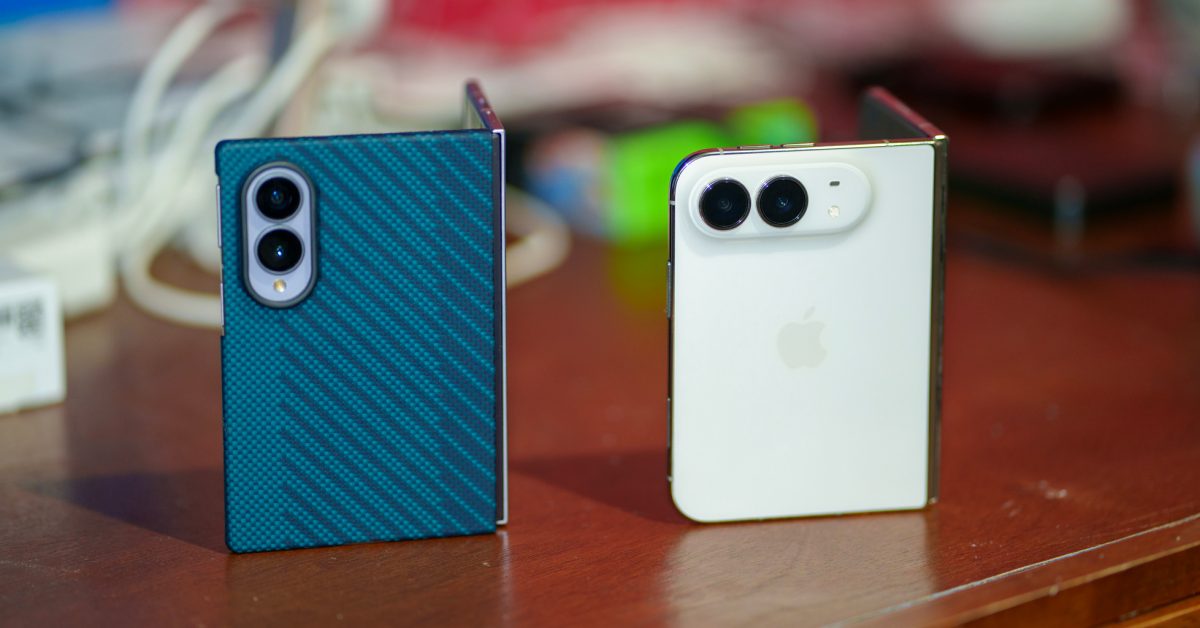
I’ve been a loving user of the iPhone Duo since it launched just over a month ago. That said, it isn’t perfect. Over the same period of time, I’ve also had the opportunity to try out the Galaxy Z Fold 8, and while I’m certainly not a fan of OneUI, there’s a lot this phone does well that’s worth appreciating. Lightness The absolute first thing you’ll notice about the Z Fold8 is that it’s lighter, by a decent margin. It comes in at 201 grams, vs the 254 grams of iPhone Duo and the 211 grams of iPhone 18 Pro. That means the Z Fold8 is just about as light as a normal sized smartphone, and this absolutely makes a difference. The weight of iPhone Duo isn’t a deal-breaker, and I certainly appreciate having a titanium device again (vs aluminum on iPhone 17 Pro where I was consistently worried about denting it, especially with the aluminum extending to the camera bar) – but I’m sure the Z Fold8 being aluminum contributes a fair bit to how light it is. Aspect Ratio The width of iPhone Duo feels just about perfect, but from the first day I’ve felt that it could be a little bit taller, just so you can fit slightly more content on your screen without your keyboard cutting it off. Z Fold8 is pretty much exactly what I’d like to see with a future iteration of iPhone Duo. It’s still easy to reach the top of the screen without any hand gymnastics, and you would theoretically be able to see more content above the keyboard height. That said, because of a difference in software design (OneUI using opaque navigation bars vs iOS keeping them transparent), you actually end up having about the same amount of readable content on both devices – even when you disable the additional keyboard toolbars and shrink the default font on OneUI. What iPhone Duo still gets right First and foremost, I do appreciate the rounded corners on iPhone Duo. While it does cause for some extra padding and wasted space at times (and creates reachability challenges for left-handed users), it feels much nicer to hold a phone without a sharp corner digging into your hand. Granted, if you’re a leftie with an iPhone Duo, you’ll still feel the sharp corner on the outer screen. While a much smaller point, iPhone Duo’s horizontal rear camera layout also makes a big difference. It means you can easily rest your finger underneath the camera bar, wheres on the Z Fold8 it feels hard to hold without the camera being in the way of your finger. Lastly, I do appreciate Apple’s decision to go with an under display selfie camera on the inner display. Does this mean the inner camera takes rather bad photos in unideal conditions? Yes. That said, if you’re actually interested in taking a photo, the iPhone Duo offers two much better ways of taking selfies, so I don’t really take a major issue with this. The fact that your actual content experience is uninterrupted is a big difference maker, and this isn’t something I thought I’d really care for at first, but it’s proven to be worthwhile. It does come with one compromise: iPhone Duo can’t offer Face Unlock on the inner screen because of the lower quality, but I’m hopeful this can be improved in later hardware iterations. Crease visibility Another major point is creases. With iPhone Duo, Apple implemented a nano texture display layer to reduce crease visibility. Frankly though, after a month of usage, I’m not convinced this is actually necessary. On the Samsung, I never really see the crease while looking at the display head on, which is the same situation for iPhone Duo. On both devices, it’s only really visible off-axis. Ultimately, we don’t know what an iPhone Duo without a nano texture would look like (unless you remove your nano texture layer, which you should not do) – so it’s possible that would’ve creased far worse than with the nano texture. That said, given how the Samsung crease looks with a glossy display, I think it’s possible that Apple can ship an iPhone Duo without a nano texture layer in the future. Wrap up All in all, these phones are both excellent displays of the engineering talents at both companies. Obviously, Samsung has been making folding phones for nearly 8 years now, while the iPhone Duo is Apple’s first foldable. Future iterations of iPhone Duo will likely get lighter, and maybe even a bit taller. There likely isn’t much cross shopping going on between these two devices, so I won’t be making an outright verdict here. Ultimately, OS is a bigger factor than most of the hardware differences. If I had to sum it up though, I’d say my most optimal device would be a combination of the two: ideally iPhone Duo would be similarly thin and light to the Galaxy Z Fold8, while being a little bit taller and retaining its rounded corners. However, if you had to ask me to pick between a Galaxy Z Fold8 running iOS and an iPhone Duo, I do think I would likely pick the Z Fold8. While I’d miss the rounded corners, the uninterrupted inner display experience, and a hinge that can hold itself in any position – having a lighter phone to carry around is an advantage, and the thinness makes a notable difference when you’re holding the phone closed. Some of my favorite Apple accessory recommendations: Anker Ultra-Slim MagSafe Battery Pack Anker Nano 45W Fast Charger with Smart Display Logitech MX Master 4 Mouse for Mac AirTag 2 4-pack (50% improved Precision Finding!) PopSocket Low Pro MagSafe Kickstand (Great for iPhone Duo!) Follow Michael: X/Twitter, Bluesky, Instagram FTC: We use income earning auto affiliate links. More.
iPhone Duo vs Samsung Galaxy Z Fold 8: Here’s what each phone does better
Full Article
Original Source
Read the full article at 9to5mac →KhanList aggregates and links to publicly available news content. We do not host full articles from third-party sources. Always verify important information with original sources.