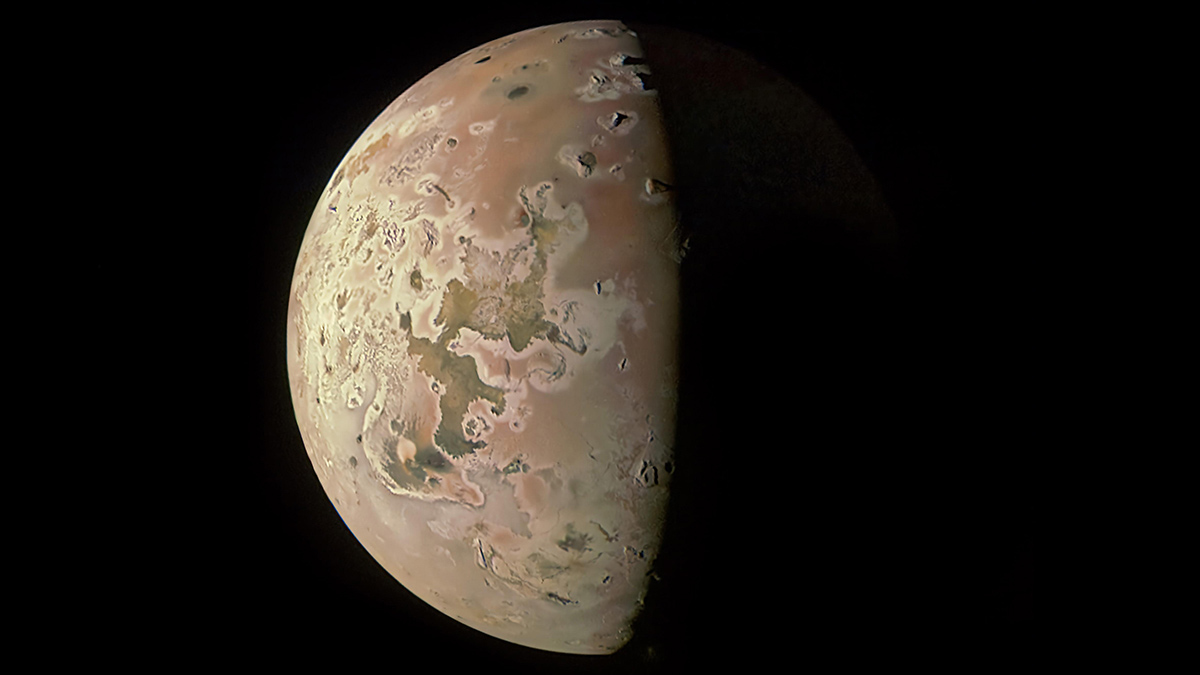
Juno captured this image of the north polar region of Io on 15 October 2023. Credit: NASA/JPL-Caltech/SwRI/MSSS - Image processing by Ted Stryk Source: Journal of Geophysical Research: Planets Io—Jupiter’s third-largest moon—is constantly kneaded and deformed by the gravitational pull of Jupiter and two of its other moons, Europa and Ganymede. The resulting friction inside Io generates extreme internal heat, fueling volcanoes that erupt all over its surface. In fact, Io is more volcanically active than any other world in our solar system. Nearly all prior observations of Io’s heat have relied on infrared measurements that could detect temperatures only at the moon’s very outermost “skin.” Now, Brown et al. have taken Io’s internal temperature for the first time. The researchers used data captured by the Microwave Radiometer instrument aboard NASA’s Juno spacecraft—which has orbited Jupiter since 2016—during close flybys of Io in December 2023 and February 2024. These data revealed Io’s thermal emissions at microwave wavelengths, which are longer than infrared, enabling the researchers to peer beneath the surface for tens of meters. Their analysis involved identifying and removing portions of the data representing reflections of the sky on the moon’s surface. The goal was to be left with observations truly representative of Io’s characteristics. These observations showed that the upper tens of meters of Io’s surface are strongly heated by internal processes. Two possible explanations that fit the data are that heat may rise steadily through a conductive layer near the surface and that heat from recent lava flows or hot vents may escape to the surface through thin patches of cooling crust, with the latter being more likely on the basis of the existence of tall mountains. Further analysis of the microwave observations revealed more about Io. The data suggest that Io has a relatively smooth surface, similar to Earth’s plains. They also suggest that Io has an upper layer with a lower density than solid rock, perhaps similar to volcanic ash or pumice, which likely lies atop denser material several meters below. These findings and further analysis of Juno’s Microwave Radiometer data could lead to a deeper understanding of Io, particularly the mechanisms by which it loses internal heat and how heat flow patterns may differ across its surface. This work could also help to inform the design of microwave-detecting instrumentation for future missions to Io or other rocky and icy worlds. (Journal of Geophysical Research: Planets, https://doi.org/10.1029/2025JE009622, 2026) —Sarah Stanley, Science Writer Citation: Stanley, S. (2026), Io’s hidden heat revealed for the first time, Eos, 107, https://doi.org/10.1029/2026EO260234. Published on 24 July 2026. Text © 2026. AGU. CC BY-NC-ND 3.0Except where otherwise noted, images are subject to copyright. Any reuse without express permission from the copyright owner is prohibited.
Io’s Hidden Heat Revealed for the First Time
Full Article
Original Source
Read the full article at Eos →KhanList aggregates and links to publicly available news content. We do not host full articles from third-party sources. Always verify important information with original sources.