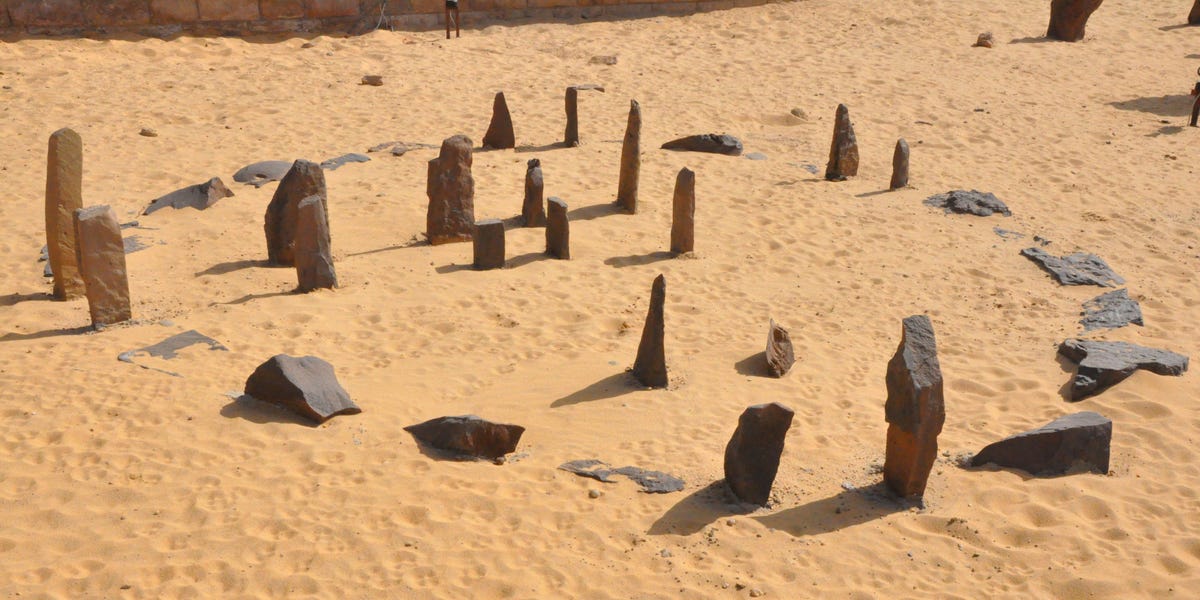
4 min readHere’s what you’ll learn when you read this story:A monolithic structure on the dry lakebed of Nabta Playa, Egypt suggests humans inhabited an area that was much greener in ancient times than it is now.The structure was built by the nomadic Ru’at El Baquar people, who worshipped cattle and would sometimes sacrifice the animals in a desperate plea for rain.Nabta Playa’s stones cast their reflections in the water, aligning with the stars above, and the positions of the stars could serve as guides.Before the sarsens of Stonehenge were arranged, another sacred circle of megaliths towered over prehistoric Egypt. The stones of Nabta Playa are so ancient that the pyramids of Giza weren’t even a vision in a pharaoh’s dream when they rose more than 7,000 years ago.Egypt may now be mostly an expanse of rippling sands, but during the Neolithic period, it was far lusher and greener—more of a savanna than a desert. Predynastic Egyptian culture was incubated in verdant valleys where hunter-gatherers had at least partly turned into farmers. After the melting of the last Ice Age, the region had become much more habitable.Archaeologist Fred Wendorf and his research team trekked into the Sahara during the 1960s in search of the prehistoric origins of Pharaonic Egypt. Over time, he kept returning to document the age of rock layers and any signs that humans had lived in the area. Eventually, evidence of human habitation began to appear, including stone tools, pottery, fragments of decorated eggshells, beads, splinters of animal bones, and the charred remains of edible plants. Burnt remnants of wood were found in a primitive hearth, suggesting cooking fires. These artifacts were taken for radiocarbon dating, but still left many open questions.“Neolithic settlement in the Western Desert of Egypt extends back to the earliest part of the Holocene, and lasted until around 3000 BCE, when increasing aridity forced the general abandonment of the desert,” Wendorf and archaeologist Romuald Schild said in a 2004 study published in ArcheoNil. “During much of that time […] people in the desert were domesticating cattle, making fine, decorated pottery and learning how to live in the desert year-round.”In 1973, the team’s Bedouin guide led Wendorf to a site 60 miles from the banks of the Nile, where what appeared to be the remains of a megalithic structure stood in a desiccated lakebed. Wendorf initially thought the rocks were natural formations, but eventually realized that if that were the case, the water—now no more than a phantom lake—would have eroded them away. They had to have been positioned in that arrangement by humans. Later, during an excavation he and Schild led in the early 1990s, they unearthed a circle of stones suspected to have had astronomical significance.It took Wendorf seven more years until he had a revelation and called J. McKim Malville, whose expertise was in archaeoastronomy of the American Southwest. Malville noticed that the megalithic structure was not only designed to line up with the brightest stars visible from Earth, but that several of them covered a tumulus, or raised burial mound. The monolithic stones of Nabta Playa radiate outwards and form a circle that was probably meant to align with astronomical events (such as the solstices) and particular stars, not unlike Stonehenge. It’s now recognized as the oldest known astronomical observatory on Earth.By 1998, the mystical circle of stones had been dubbed “Stonehenge of the Sahara.” It was created from upright slabs—two sets aligned from north to south, and the other two sets positioned to create a direct line of sight towards the horizon during the summer solstice. Stars have shifted in the sky since then, but the archaeologists found that the structure was supposed to align with the positions of the stars Arcturus and Sirius, as well as the Alpha Centauri star system and the Orion’s Belt constellation. Without a visible North Star as a guide, people relied on the positions of the stars reflected in the lake to guide them across swaths of land, and to have an idea of when the sacred rains would begin.Nabta Playa’s monoliths were left behind by the Ru’at El Baquar, an ancient nomadic cult that worshiped cattle. More tumuli were eventually found at the site, along with a huge rock that appeared to have been carved to resemble a cow. While no human remains surfaced, cattle bones were found in the graves, and one tomb revealed a fully articulated skeleton of a cow that must have been sacrificed to the gods (every blood sacrifice meant the loss of an important resource). The Ru’at El Baquar would have likely only offered their most precious possession at times of great desperation, especially when the land was parched from a lack of rain.As the Sun beat down hotter and hotter, ultimately drying out the region by 5,000 years ago, its people most likely traveled to the Nile Delta in search of water. This leads to questions about the assumption that ancient Egyptian culture was inspired by older Levantine civilizations. While there’s evidence of communication, trade, and war between the Egyptians and groups like the Assyrians, artifacts resembling the stones of Nabta Playa imply that there may have also been significant cultural exchange within ancient Egypt. Egyptian astronomy might be descended from these methods of observation.“The full meaning of the complex structures and the presence of the buried table rocks remains elusive,” Malville admitted in a 2015 study published in Handbook of Archaeoastronomy and Ethnoastronomy. “The table rock […] coupled with the alignments radiating outward to the stars, may reveal an early belief in shamanic-like movement from the underworld to the heavens.”Elizabeth Rayne is a creature who writes. Her work has appeared in Popular Mechanics, Ars Technica, SYFY WIRE, Space.com, Live Science, Den of Geek, Forbidden Futures and Collective Tales. She lurks right outside New York City with her parrot, Lestat. When not writing, she can be found drawing, playing the piano or shapeshifting.
A Mysterious 7,000-Year-Old Stone Circle Is the Stonehenge of the Sahara
Full Article
Original Source
Read the full article at Popularmechanics →KhanList aggregates and links to publicly available news content. We do not host full articles from third-party sources. Always verify important information with original sources.