
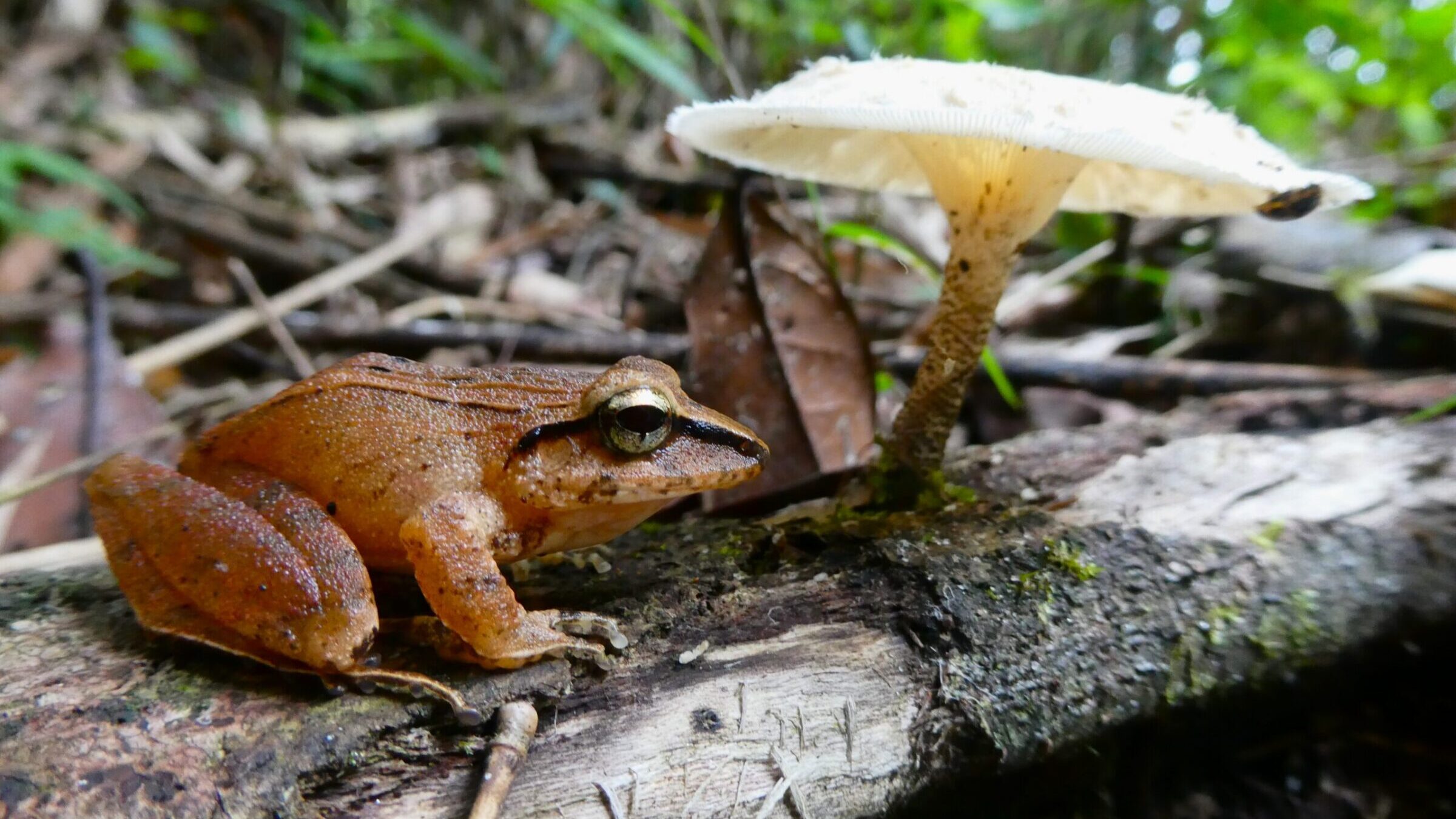
Historic amphibian declines in Brazil’s Atlantic Forest during the 1970s and ’80s has long been the source of scientific debate. Some point to climatic shifts and extreme weather as the cause.With new research, some researchers now believe that the chytrid fungus — which causes a highly contagious, deadly disease — is the culprit behind this “cold case.”By sampling specimens taken before and after the declines, the team found widespread presence of chytrid.Their findings offer a new explanation, which could help anticipate future outbreaks of amphibian disease and reveals a method for historical research into wildlife declines caused by disease. In the 1970s and ’80s, frogs in Brazil’s Atlantic Forest began dying off. Researchers have proposed various causes, from severe cold snaps to acid rain. Now, scientists believe they have solved this decade-old amphibian “cold case.” The culprit, it seems, may be the highly contagious pathogen Batrachochytrium dendrobatidis (Bd). It causes a deadly infectious skin disease, chytrid, in amphibians. The investigation was recently published in the journal Molecular Ecology. Researchers from the U.S. and Brazil studied specimens collected from Boracéia research station in the Atlantic Forest. William Ronald Heyer, a former curator at the Smithsonian in the U.S., had gathered and preserved 370 frogs from 17 species for scientific study during the 1970s and ’80s. But no one collected the amphibians from 1979 to 1982 — a period when there was a drastic decline in frogs. “There’s a gap right when the decline happened,” said Jack Boyette, who is first author on this new study, a Smithsonian graduate fellow and Pennsylvania State University Ph.D. candidate. “So, we have this really amazing temporal collection before and after the decline.” When the team analyzed the specimens, they found no trace of Bd in 1978. But from 1983 onwards, it was widespread, indicating a “really rapid expansion,” Boyette said. In science, there’s sometimes a “detection lag” — and this was one of those cases. Though the pathogen wasn’t described until 1999, it began devastating populations in the 1970s after emerging in Asia. Bd/chytrid has driven declines in more than 500 species across the globe. It attacks amphibians’ skin, affecting their oxygen intake as well as water, salt, and mineral regulation. Infected frogs can suffer from damage to the skin — such as reddening, excessive shedding or ulcers — as well neurological and behavioral changes. “The appearance of Bd coincides with these declines, which is about as strong a link as we could possibly get in these inferential historical data sets,” Boyette added. Researcher Jack Boyette sampling museum specimens at the Smithsonian National Museum of History collection. Image courtesy of Jack Boyette. This study offers the latest example of how the collection and preservation of animal specimens can benefit conservation-linked research even decades later, Amadeus Plewnia told Mongabay in an email. He’s a biogeographer and ecologist at Belgium’s Ghent University who wasn’t involved in this study. “Of course, it is never really possible to [prove] a causal relationship from such historic data,” he added. “But I think the causal link of Bd in driving these declines becomes extremely likely from the data that the team uncovered.” Cracking the ‘cold case’ “Amphibian declines in some of Brazil’s most pristine rainforests have remained a mystery for decades,” Gui Beker, a study co-author and associate professor at Pennsylvania State University in the U.S. wrote in an email. “Museum collections are essentially biological time capsules, and our study shows how powerful museum collections can be for investigating emerging diseases long after an outbreak has occurred.” To crack the case, the team used a suite of tests on the collected frog specimens, creating a protocol, they say that could form a toolkit for other cold case-style research. First, they ran a PCR test — a standard laboratory DNA technique that can detect the presence of a viral or bacterial pathogen — to identify whether the frogs had Bd, Boyette said. They also genotyped the pathogen, analyzing its DNA to identify the strain. The result: These frogs were first infected with a global strain (known as Bd-GPL), followed later by another less-virulent strain known as Bd-Brazil. Some frog species, such as Cuvier’s foam froglet pictured here, showed no decline in the region from chytrid. Image courtesy of Renato Martins. The team then scrutinized samples of the frogs’ skin for the telltale lesions caused by Bd infection to confirm that chytrid had affected the frogs. Since DNA “gets really messed up” by the preservation method when frogs are kept in formalin and ethanol, the researchers used molecular analysis to test DNA quality. “What we were able to show is that … degradation … didn’t explain the pattern of no Bd — and then lots of Bd,” Boyette explained. As another control, the team swabbed the specimen jars themselves to check if any free-floating Bd DNA was present and — could have caused contamination. They ruled that out. “I think this study highlights how we can overcome this issue of detection lag and we can harness historical DNA from natural history collections to reconstruct these early undetectable stages of wildlife disease emergence,” Boyette said. “I think that’s really exciting.” There were some surprising results. For example, species that suffered the most dramatic declines had no detectable infections. Species that didn’t suffer declines, on the other hand, were highly infected. This “counterintuitive” finding may be because susceptible frogs might have died before Heyer could collect them, or some of them may have acquired immunity to the disease, Boyette said. However, some aren’t convinced that Bd is in fact the cause of the declines. “The paper documents an increase in Batrachochytrium dendrobatidis (Bd) infections at Boracéia, but it does not demonstrate that Bd caused the historical amphibian declines,” wrote Lucas Ferrante in an email; he’s a researcher at Brazil’s University of Sao Paulo and wasn’t involved in the study. Rather, he believes Bd acts as an “opportunistic” pathogen, and the primary reason behind the amphibian declines lies with climatic disturbances, including changing climate and extreme weather events. “Detecting a pathogen after a population decline is not equivalent to demonstrating that it caused the decline,” he wrote. “The molecular methods are valuable for detecting historical Bd infections, but the epidemiological design is insufficient to establish causality.” A view of the Boracéia Biological Station. Recent research suggests a decline in amphibians in the vicinity of the station is linked to the deadly chytrid fungus. Image courtesy of Jack Boyette. Resilience and insights The team noted that their findings can’t be extrapolated across the whole of the Atlantic Forest. Yet, for Boyette, the story of the Boracéia research station is fundamentally one of resilience that offers hope amidst ongoing declines caused by chytrid. The team conducted field research at the site in 2022 and 2024. They discovered that some of the species that died in large numbers back in the 1980s have recovered. “If you go back to Boracéia today, a lot of those species [that declined] are again some of the most abundant species on the landscape,” Boyette said. “We know that a lot of these populations have demonstrated pretty remarkable resilience.” However, it seems that up to five of the 17 species collected by Heyer have disappeared entirely from the area, including the Rio spinythumb frog (Crossodactylus dispar) and the flattened waterfall frog (Cycloramphus boraceiensis). The flattened waterfall frog and several other species disappeared entirely from the area around the Boracéia Research Station during the 1980s. Image courtesy of Renato Martins. Surveys conducted there this year have also found numerous dead frogs from the same species that declined in the 1970s. The team will run PCR tests in the next few weeks to investigate. While Bd is yet to be confirmed as the cause, “seeing these patterns again reinforces the need to closely monitor amphibian populations in seemingly pristine tropical forests,” Renato Martins, a study author and ecologist at Sao Paulo State University, told Mongabay in an email. Beyond offering a possible explanation for the region’s historic amphibian declines, the team believes that understanding outbreaks of the past can also help conservationists prepare for other disease outbreaks. Boyette points to Batrachochytrium salamandrivorans, (Bsal), an infectious chytrid fungus so deadly to salamanders (and newts) that it was dubbed the “salamander plague”: It digests their skin. It has decimated European populations in recent years and fears are high that it may soon cross the Atlantic Ocean, with potentially devastating consequences. “Understanding the past, what happened historically with fungal pathogens and amphibian biodiversity loss, helps us understand how these fungi spread, how these pathogens spread, and how they behave in communities,” Boyette said. “It can allow us to anticipate what’s going to happen, for instance, when Bsal arrives in North America.” Other natural history museum specimens may reveal insights into the development of wildlife diseases. The team is currently investigating a small collection of frogs from Costa Rica that was collected prior to a decline in the Monteverde region. “My hope is that together, these efforts will fill gaps in our understanding of Bd’s history, clarify its toll on biodiversity, and help us anticipate future impacts in a world where emerging fungal pathogens, like Bsal, remain a major threat,” Boyette said. In Panama, poison dart frog move brings hope amid amphibians’ fight with fungus Endangered Chilean frogs thrive in London while waiting out deadly fungus Frog ‘saunas’ may help threatened frogs fight off deadly fungus Citations: Boyette, J. L., Carvalho, T., Rodriguez, D., Neely, W. J., Medina, D., Martins, R. A., … Becker, C. G. (2026). Overcoming detection lag in a cryptic Panzootic: Chytrid invasion linked to historically enigmatic amphibian declines in the Brazilian Atlantic Forest. Molecular Ecology, 35(19), e70573. doi:10.1111/mec.70573 Heyer, W. R., Rand, A. S., da Cruz, C. A. G., & Peixoto, O. L. (1988). Decimations, extinctions, and colonizations of frog populations in southeast Brazil and their evolutionary implications. Biotropica, 230-235. doi:10.2307/2388238 Ferrante, L., Baccaro, F. B., Kaefer, I. L., Diele‐Viegas, L. M., Getirana, A., Haddad, C. F. B., … & Fearnside, P. M. (2025). Effects of climate change and El Niño anomalies on historical declines, extinctions, and disease emergence in Brazilian amphibians. Conservation Biology, 39(4), e70024. doi:10.1111/cobi.70024 Van Rooij, P., Martel, A., Haesebrouck, F., & Pasmans, F. (2015). Amphibian chytridiomycosis: A review with focus on fungus-host interactions. Veterinary Research, 46(1), 137. doi:10.1186/s13567-015-0266-0 FEEDBACK: Use this form to send a message to the author or editor of this post. If you’d like to post a public comment, you can do so at the bottom of the page. Credits Topics
Investigation: Fungus may have killed Atlantic Forest amphibians in the 1970s and ’80s
Full Article
Original Source
Read the full article at News →KhanList aggregates and links to publicly available news content. We do not host full articles from third-party sources. Always verify important information with original sources.