
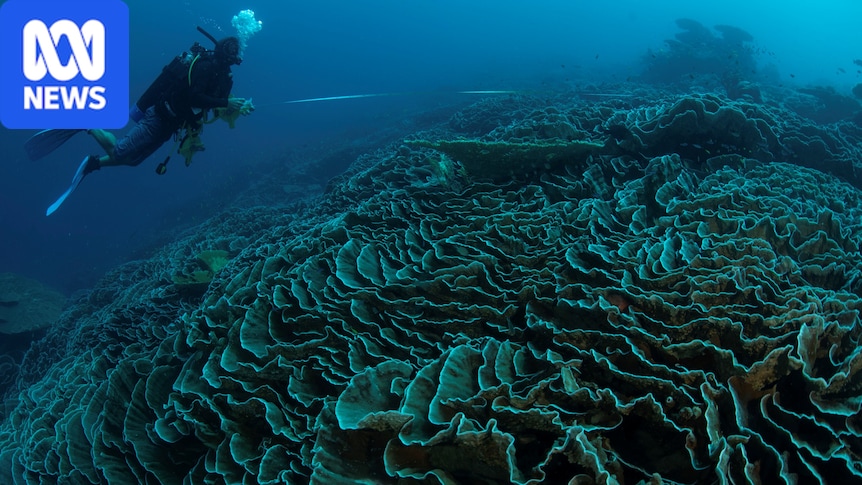
A kilometre-long coral formation thriving in waters off Australia's most remote inhabited territory is one of the largest ever recorded.The 1.56km rose coral colony was discovered off the coast of the Cocos (Keeling) Islands.For comparison, the colony covers the equivalent of approximately 100 buses laid end to end and an area three times the size of the Melbourne Cricket Ground.Local divers have seen parts of the colony over decades, but a team of researchers formally mapped and examined the formation only in recent months.The rose coral colony is thriving in the remote waters. (Supplied: Justin Gilligan)Adelaide University marine biologist JP Hobbs said the research team initially began with a tape measure, before switching to GPS tracking when the colony's size became apparent."We first started running out measuring tapes and measuring it centimetre by centimetre," he said."Then we realised after a few dives that we were running out of air before we could get to the end of the coral."'You can't see the end of it'Dr Hobbs was alerted to the mega coral by Cocos-based dive operator Dieter Gerhard."He had seen this coral at a few of his dive sites," he said."And when we had conversations about it, he would tell me 'yeah, you can't see the end of it.'"Diver Dieter Gerhard alerted researchers to the colony. (Supplied: CKITA/Edges of Earth Expeditions)Dr Hobbs said the dive sites were around 600 metres apart, and he wondered if the coral could be connected."It actually went further than his dive sites and kept going."It took 12 dives to finally map the full extent of the colony.Mr Gerhard first spotted the coral expanse more than 30 years ago, but said he had no concept of how big it was."What a lot of people perhaps didn't realise was the size of it and how far it actually went," he said.A tape measure was used before researchers realised the scale of the coral colony. (Supplied: Justin Gilligan)Global insightsWorking with researchers from Queensland Museum and James Cook University, the team is now conducting genetic testing to determine the colony's make-up."We've collected about 50 samples along the coral and then we'll do the genetics that will tell us whether it's one individual or many," Dr Hobbs said.Understanding why the rose coral is thriving in deeper waters could also prove helpful for other coral species."It gives insights into whether deep water areas can act like a refuge for shallow water corals that get smashed by a bleaching event or a cyclone," he said.Genetic testing will be used to determine if the colony is made up of one coral or many individuals. (Supplied: Justin Gilligan)After spending years exploring the underwater landscape around Cocos, Mr Gerhard believes there is still more to be discovered."We are currently seeing a greater interest since both Cocos Islands and Christmas Island have been declared as marine parks," he said."The scientific community are looking to do a lot more research."The waters around the Cocos Islands were declared marine parks in 2022, attracting more researchers. (ABC News: Chris Lewis)Dr Hobbs said the islands were special because of their isolated position "in the middle of nowhere in the Indian Ocean"."These unique aspects provide insights for researchers to answer questions that apply around the world," he said."But can only be done when you have a special place like Cocos."
Coral colony the size of three MCGs thriving off remote Australian island
Full Article
Original Source
Read the full article at Abc →KhanList aggregates and links to publicly available news content. We do not host full articles from third-party sources. Always verify important information with original sources.