
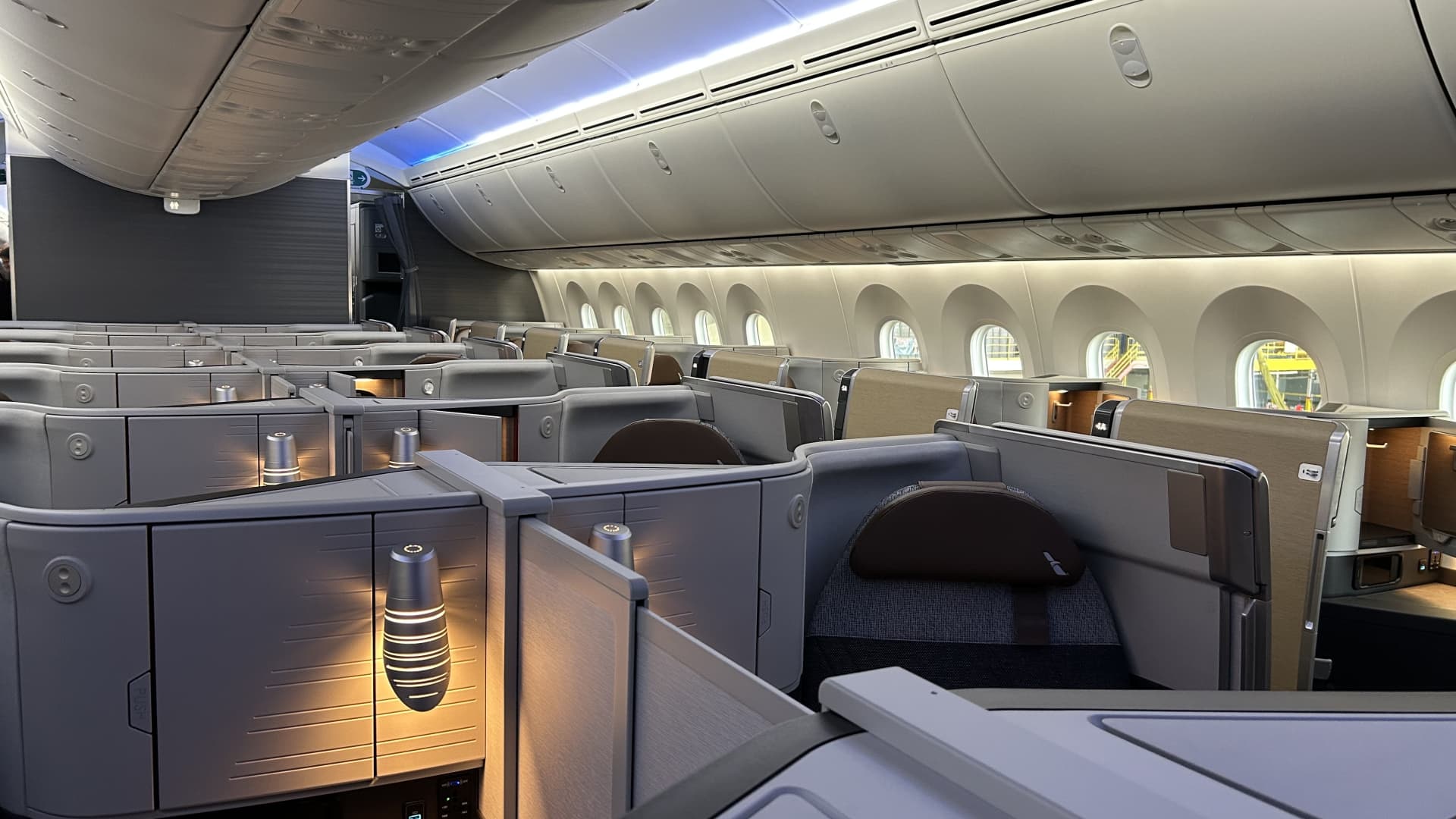
A Pan American (Pan Am) air hostess serving champagne in the first class cabin of a Boeing 747 jumbo jet on Jan. 12, 1970.Tim Graham | Getty ImagesThe era of U.S. airlines' long-haul, international first class ended this week when American Airlines' last flight with its eight-suite section landed. In its place will be a massive business-class cabin with room for 70 passengers.U.S. airlines have been ditching international first-class cabins for a new top tier: larger and souped-up business classes, featuring suites with sliding doors, the design du jour. Delta Air Lines and United Airlines have already taken this step. American was the last of the U.S. airlines to still have first class on long-haul international routes. Many travelers might not notice the difference. That's because of airlines' investments into business class: new suites, bigger screens, better technology like device-charging pads, and improved bedding.It's part of airlines' big bet on mass luxury. Consumers have been willing to shell out more to fly comfortably, which is helping to boost airline revenue. That's all the more important as costs of everything from fuel to airport landing fees have been rising, soaking up more of the industry's profits.Passengers enjoy a meal inside a mock-up of the Boeing 707 Stratoliner. Development of the Stratoliner began in the 1950s with the race to capture the commercial airline market. The plane boasted all the latest luxuries, such as reading lights, flight attendant call buttons, and emergency oxygen masks.Bettmann | Getty ImagesThe retirement of first class ends a more-than-six-decade stretch of the jet age that in the early days included service like seat-side carving of chateaubriand and meals served on fine bone china.A few decades ago, business class was much smaller, with two-by-two seats in some configurations, and recliners, not the lie-flat seats that dominate those cabins now."When you've got individual pods in biz class, and you've got a comfortable enough seat and bedding and decent wine, for a lot of people this is good enough," said Henry Harteveldt, founder of travel consulting firm Atmosphere Research Group and a former airline executive. The over-the-top dining of the early days of international first class was a form of entertainment, long before laptops, personal seat-back screens and in-flight Wi-Fi, or even the promise of sleep on lie-flat beds, but customers still eat lots on board, Harteveldt said."People say they want to sleep but then they stay up and they eat every morsel," he said. "They're hypocrites."There was still a hefty price gap between first and business.A flight between Los Angeles and London on American's Boeing 777-300ER this week went for $12,994 in business class for a one-way ticket and $15,669 for a first-class seat.American's last flight with international first class departed Friday morning local time in Sydney, bound for Los Angeles.Its new cabin on its Boeing 777-300ERs will feature 70 business-class suites, the most of any U.S. airline. Pre-overhaul, the cabins had been operating with eight first-class suites and 52 pods in business, though the remodeling is ongoing. American is also flying a subfleet of 787-9 Dreamliners that have 51 business-class suites. (United is putting 64 new suites on that aircraft.)Part of the allure is that some companies allow employees to book business-class tickets, but not first class.American Airlines told CNBC it's growing its business-class cabins across the fleet. It's evaluating increasing the number of suites on its smaller long-haul jets, the Boeing 787-8 Dreamliners, from 20 currently to somewhere in the 30s."You don't have enough seats to make the seat cost competitive," Nat Pieper, American's chief commercial officer, said in an interview this month. "So what you need to do to make that airplane work is it's got to be a yield play. You need more business-class seats."No soup, no olivesDifferences between first and business classes on American lately came down to details.On American's first-class long-haul section, passengers got olives with warm nuts to accompany their beverage early in the flight, while there were no olives for business class. First class got a soup; business did not. First class got a warm dessert served a la mode in addition to the cold dessert or fruit and cheese plate both cabins were offered. And there was no memory foam lumbar pillow for business class like there was in first, American said. But otherwise, the experiences were fairly similar for passengers. They still got better food options and service than economy passengers, along with their bigger seats, early boarding and lounge access."It's not like the bed can go any flatter than 180 degrees," Harteveldt said. "The bedding can be thicker, and the food nicer."Delta and United have already replaced international, long-haul first class with dozens of their Delta One and Polaris business lie-flat suites, respectively, each of which is getting upgrades now. American will continue offering a separate lie-flat first class on its Airbus A321T subfleet it uses for domestic cross-country flying until early 2027. But then that goes away, too.Meanwhile, airlines over the past decade have added a premium economy section, which sits between business class and economy. It features recliner seats similar to those in domestic first class, often with foot rests, meals served on actual plates, larger seat-back screens than economy and earlier boarding.Carving up business classAirlines are now cutting up business class into different segments, something they've done for more than a decade with the coach cabin's basic economy, standard and extra legroom seats.United and Delta this year each announced their most expensive cabins will be sold with basic options, which are more restrictive and don't include things like the ability to pick your seat ahead of time or get access to a special airport lounge.American Airlines 787-9P has more business class suites than previous configurations.Leslie Josephs/CNBCThere are also a few seats in some of the business-class cabins that are roomier, like American's Flagship Suite Preferred and United's Polaris Studio. Even the guest seating in the United suite varies with "standard and companion ottomans," the latter including a seatbelt so you can ask "another Polaris passenger to visit you between takeoff and landing for a drink, chat or game," the airline says.There's more to come."I don't think we found the limit on segmentation," United CFO Mike Leskinen told CNBC on Thursday. "We have a few things on the drawing board. We're not done."First class still flies globallyThe presentation of Air France-KLM new La Premiere first-class suite in Paris, France, on Tuesday, March 18, 2025. Benjamin Girette | Bloomberg | Getty ImagesAlthough U.S. carriers are moving away from the designation, first class is far from dead. Singapore Airlines, Germany's Lufthansa, British Airways and Air France have unveiled updated first-class cabins and other service improvements like food. British Airways last month said it will build a record 106-suite business class on its Airbus A380 aircraft, the world's largest passenger airplane, but it's also upgrading its first class on board.Meanwhile, smaller airlines like JetBlue Airways, Frontier Airlines and Allegiant Air are introducing domestic or short-haul first-class seats."We're going to be able to do that at a really low price comparatively to what you're used to out there in the marketplace," Frontier Chief Commercial Officer Bobby Schroeter said last month.Read more CNBC airline newsJetBlue stock surges as company outlook calms investorsWhy popular airplanes are getting scrapped years earlyFewer people are flying as airfare soars. Here’s why airlines aren’t worriedBudget airline king Bill Franke warms to premium upgradesCompanies spurn airlines’ cheapest business class ticketsRecord heat, crowds drive offseason boom in international travel
International first class is over for U.S. airlines. Enter the mega business-class cabin
Full Article
Original Source
Read the full article at Cnbc →KhanList aggregates and links to publicly available news content. We do not host full articles from third-party sources. Always verify important information with original sources.