
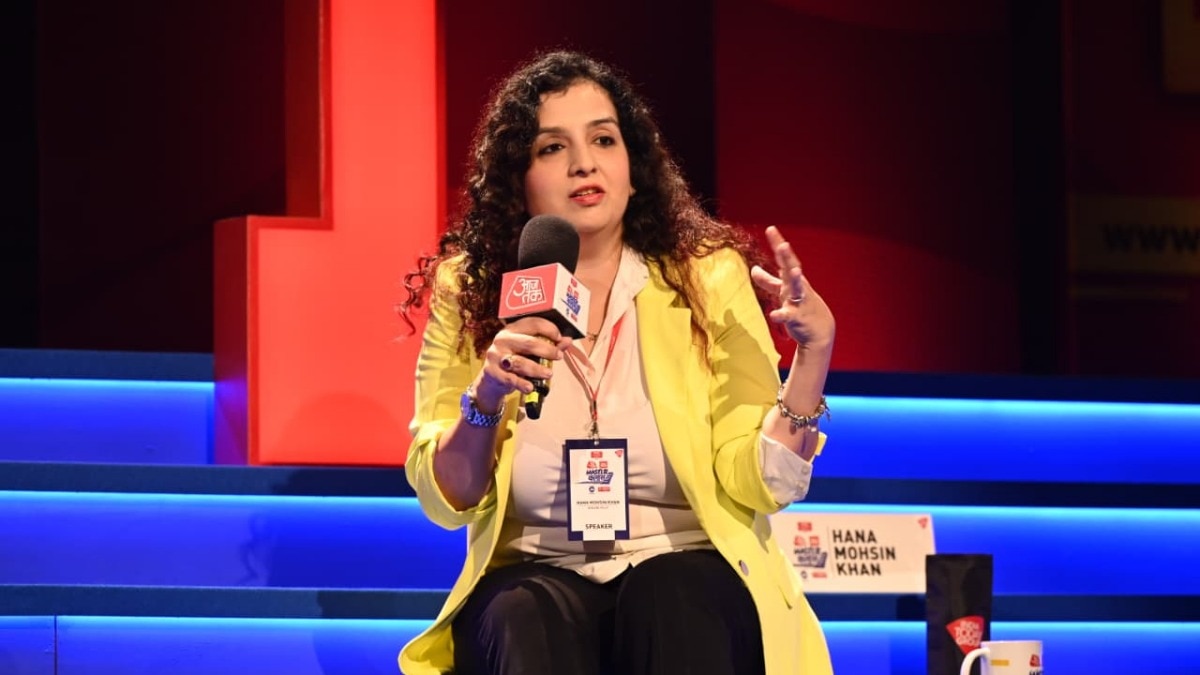
From starting out as a journalist to flying commercial aircraft, Hana Mohsin Khan has taken an unconventional career path. Speaking at Aaj Tak Masterclass 2026 during the session 'Naukri ki Udaan', she shared advice on becoming a pilot, changing professions and finding work that one genuinely loves.From starting out as a journalist to flying commercial aircraft, Hana Mohsin Khan has taken an unconventional career path. New Delhi,Nov 21, 2026 18:06 ISTA career in aviation may look glamorous from the outside, but life inside a cockpit involves much more than flying an aircraft and travelling to different destinations. It demands years of training, long working hours, discipline and the ability to stay alert when hundreds of passengers depend on you.Commercial pilot Hana Mohsin Khan knows this from experience. Her own journey into aviation was far from conventional. She began as a journalist, moved into event management and eventually found her calling in the cockpit.Speaking at Aaj Tak Masterclass 2026, during the session 'Naukri ki Udaan', Khan spoke about her career switch, the process of becoming a commercial pilot, the challenges of the profession and why young people should not be afraid of exploring different career options.Her advice to students was straightforward: do not choose a profession simply because it looks attractive. Find something you genuinely enjoy doing. FROM NEWSROOMS TO THE COCKPIT: AN UNEXPECTED CAREER SWITCHKhan's journey into aviation began with an unexpected conversation during an event in Thiruvananthapuram. She met a few pilots who started talking about flying. Their conversation fascinated her so much that she called her mother at around 11 pm and announced that she wanted to become a pilot.Her mother's first response was to ask her to go to sleep. After all, Khan had already changed professions once. But the idea stayed with her the following morning. She began exploring aviation and eventually decided to pursue it.She was already in her thirties when she started working towards becoming a pilot, an age when many people feel pressured to settle into one profession.However, Khan believes there is no fixed age for changing careers."I believe that you can change your career at any point in life," she told students.She explained that she first pursued journalism because she loved writing. Later, she moved into event management because she wanted to do something more creative. Her meeting with pilots eventually introduced her to aviation."If you truly love something, you will definitely find a way to do it," she said, encouraging students not to restrict themselves to one career choice.WANT TO BECOME A PILOT? HERE IS WHERE YOU STARTFor students interested in aviation, Khan also explained the basic steps involved in becoming a commercial pilot.She said candidates need to have studied Physics and Mathematics in Classes 10 and 12. Those who did not take these subjects in school can complete them through an open board before applying for pilot training.The next step involves obtaining a computer number from the Directorate General of Civil Aviation (DGCA) and appearing for its examinations.She identified Navigation, Meteorology, Air Regulations and Technical as the subjects candidates need to prepare for.Navigation covers how aircraft travel between destinations, while Meteorology deals with weather systems, clouds and atmospheric conditions. Air Regulations introduces candidates to aviation laws and operating rules, while Technical focuses on the aircraft being operated.Khan said she completed her examinations within six months and advised students to clear them before beginning flying training.Her reason was practical. Students can become so excited about flying that they postpone their examinations, leaving themselves with limited time to complete them after returning from training.She also stressed the importance of completing the medical examination before committing to the training process.Addressing a common question about eyesight, she clarified that wearing spectacles does not automatically disqualify someone from becoming a commercial pilot. The medical examination assesses overall health and fitness to fly.Candidates must then complete 200 flying hours. Khan undertook her initial flying training in Florida, the US, where it took her around a year. She said training in India can take approximately one-and-a-half to two years.THE JOB IS MORE THAN JUST THE GLAMOURWhile the image of a pilot's uniform and the opportunity to travel can make aviation an attractive career, Khan cautioned students against entering the profession for its glamorous side alone."You need to love flying. You need to love the sound of the engine. You need to love the way an aircraft moves through the air," she said.She explained that pilots often have to report for duty at two or three in the morning, work through demanding schedules and remain alert even when they are physically exhausted.The responsibility is also significant, as hundreds of passengers depend on the crew to operate the aircraft safely.Khan said the profession can also make maintaining a work-life balance difficult. Pilots may miss festivals, family occasions and important moments at home because of their schedules.She recalled that this year was the first time in three years that she had been home for Diwali.For her, the demands of the job are something aspiring pilots must understand before choosing aviation as a career.'EXPLORE, MAKE MISTAKES': HER ADVICE TO STUDENTSDuring the interaction, Khan also addressed a student who was worried about exploring several career options instead of settling on one.Her response was to encourage exploration rather than rush into a decision."This is the time to make mistakes. This is the time when you should make mistakes, and it is absolutely fine," she said.She added that students should not create limitations for themselves by believing that choosing one subject or profession means they cannot pursue something else later.To explain her point, she shared that she knew a pilot who had previously completed a medical degree and worked as a doctor.Khan also spoke about her own setbacks. When she appeared for her first aviation entrance examination, several of her friends cleared it, but she did not.She said nervousness affected her performance, making it one of the most difficult moments of her career journey.Determined to clear the examination, she began studying for 18 hours a day for three months.Recalling the experience, she said she even kept a mattress in her study room and spent most of her time preparing.Her message was that pursuing a career change requires commitment, particularly when the journey becomes difficult.'WHEN I WEAR MY UNIFORM, I BECOME A DIFFERENT PERSON'Khan also spoke about the discipline and mental preparedness required in aviation.She explained that pilots are trained from their first solo flight to handle emergency situations through repeated practice and simulator sessions.During her training in Greece, her instructor would create emergency scenarios, including engine failures, and expect her to respond and land the aircraft.One exercise involved imagining that her family members were seated among the passengers. The instructor wanted her to understand the responsibility involved in bringing everyone back safely.She said this training teaches pilots to put aside personal distractions and focus entirely on their duties."When I put on my uniform, I feel like I become a different person," she said, adding that the responsibility automatically makes her more serious and focused.Khan also encouraged more women to consider aviation as a career. She said India has close to 5,000 women pilots and that women account for around 12 per cent of pilots in the country's aviation industry.However, she wants to see that proportion increase further.Her message to students was clear: a career need not follow a straight line, and choosing a different path is not necessarily a mistake.- Ends
You can change your career at any point: Pilot Hana Mohsin Khan to students
Full Article
Original Source
Read the full article at Indiatoday →KhanList aggregates and links to publicly available news content. We do not host full articles from third-party sources. Always verify important information with original sources.