
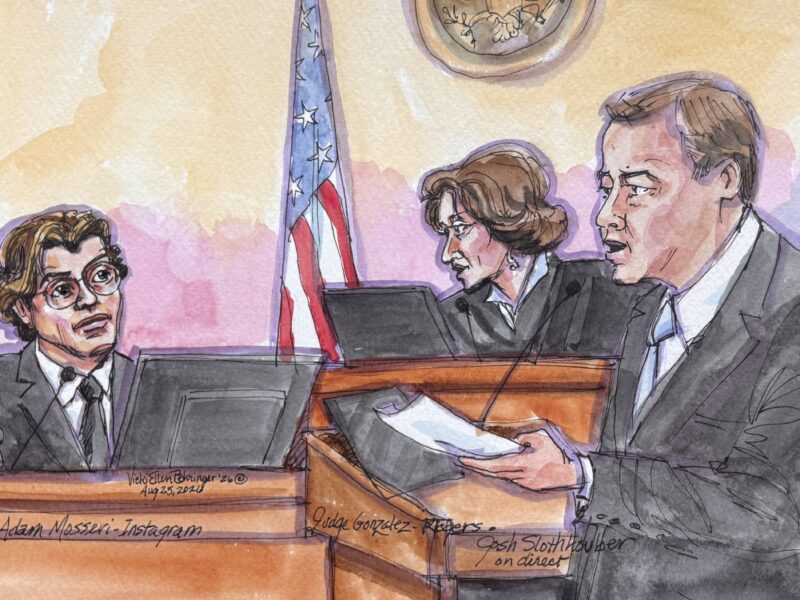
During the fourth day of trial between four states and Meta, several witnesses testified about internal company documents about safety features for teens.OAKLAND, Calif. (CN) — The head of Instagram denied on the stand Tuesday he had knowledge the app’s “well-being” team intentionally kept internal usage about teen users’ data from him to mitigate litigation risk.“That would surprise me,” Adam Mosseri testified Tuesday at the trial between four states and Instagram parent company Meta over teen mental health harms. “I am not trying to encourage my team to hide anything.”Mosseri, one of the tech giant’s most senior executives, later said that data and research at Meta was always vouched for “at the highest level of rigor.”“We are careful about what we produce because we don’t want it taken out of context,” he said.Mosseri was the last witness called on the fourth day of the high-profile trial — the first in the multidistrict litigation of more than 3,000 active cases — pitting the parent company of Facebook and Instagram against California, Colorado, Kentucky and New Jersey. Another 25 states that sued Meta in 2023 will head to trial later.Wearing a black suit with a black tie and gold framed glasses, Mosseri was mostly soft-spoken while explaining, under questioning by Colorado’s chief trial counsel Jason Slothouber, how Instagram develops and tests thousands of features, with only some related to teen safety, and not all of them succeed.“There are no silver bullets for problems like this,” Mosseri said about improving Instagram’s safety features for teens.When asked about the very low adoption rate — 1.8% — of the teen safety feature called “take a break,” a pop-up notification that reminds the user to take time away from the app, Mosseri reiterated the company’s continuous work and commitment to designing and developing tools for safety, which led to the feature becoming a default on teen accounts.Teen accounts were launched in October 2024, after the states’ lawsuit was filed, Slothouber noted.For much of the day, both the states and Meta questioned Instagram’s Director of Product Design Francesco Fogu. Slothouber asked Fogu pointedly about chats he had with other employees on Instagram’s “well-being” team, where data in slides prepared for a presentation for leadership on teen safety tools was taken out or hyperlinked only in the final version.Lawyers removed data that included statistics showing teens saw harmful content, like that about suicide, self-harm and eating disorders, at higher rates than other users. From the back-and-forth of the chat, it appeared Meta’s attorneys were aware of the litigation risk if the statistics were published or leaked to the public.“They don’t want to have a paper trail tracing this back to information visually presented to leaders that may have to testify,” Fogu’s colleague said in a chat about Meta’s in-house counsel.In response to a question about having to change slides to present to leadership, Fogu said he “never had to hide data from leadership.”Fogu, who has worked for Meta for over ten years, said he couldn’t remember some of the data related to safety features designed to manage time on the apps, such a “take a break” and “quiet mode.” The data showed adoption rates at very low percentages. Slothouber asked Fogu if the low adoption rates were very low due to the feature being an opt-in choice.Former Meta data scientist George Volichenko also reiterated in his testimony that he and the “well-being” team were committed to “making a safe space for teens” but that wasn’t how it played out.The adoption rates for the safety tools “take a break” and “quiet mode” were “very low, it was disappointing to me personally,” he said.Volichenko said the “well-being” team wasn’t allowed to test the feature as an opt-out option because it may have had adverse effects on the app’s ecosystem. He testified that one of the main reasons the team existed was to protect the company from future lawsuits.“And is that written on this slide,” California Deputy Attorney General Megan O’Neill asked about a slide on the team’s guiding principles.“No,” answered Volichenko, with a slight laugh.The states claim Meta violated the Children’s Online Privacy Protection Act, a federal law requiring online companies to obtain verifiable parental consent for users under 13. Additionally, the lead states claim Meta leadership made deceptive statements about its platforms that likely misled the public and violated consumer protection laws.The jury is hearing the case and will give an advisory verdict to Chief U.S. District Judge Yvonne Gonzalez Rogers. The Barack Obama appointee will decide the case and any possible penalties. If Meta is found liable, penalties could reach up to $200 billion and change how Meta manages teen accounts. The trial is expected to last six to eight weeks, with Meta CEO Mark Zuckerberg slated to testify.Mosseri’s testimony continues Wednesday.If you are having thoughts of suicide, call or text 988, or call the National Suicide Prevention Lifeline at 1-800-273-8255 (TALK). Visit SpeakingOfSuicide.com/resources for a list of additional resources.Subscribe to our free newslettersOur weekly newsletter Closing Arguments offers the latest about ongoing trials, major litigation and rulings in courthouses around the U.S. and the world, while the monthly Under the Lights dishes the legal dirt from Hollywood, sports, Big Tech and the arts.Additional Reads
Instagram exec testifies ‘no silver bullet’ for teen safety
Full Article
Original Source
Read the full article at Courthousenews →KhanList aggregates and links to publicly available news content. We do not host full articles from third-party sources. Always verify important information with original sources.