
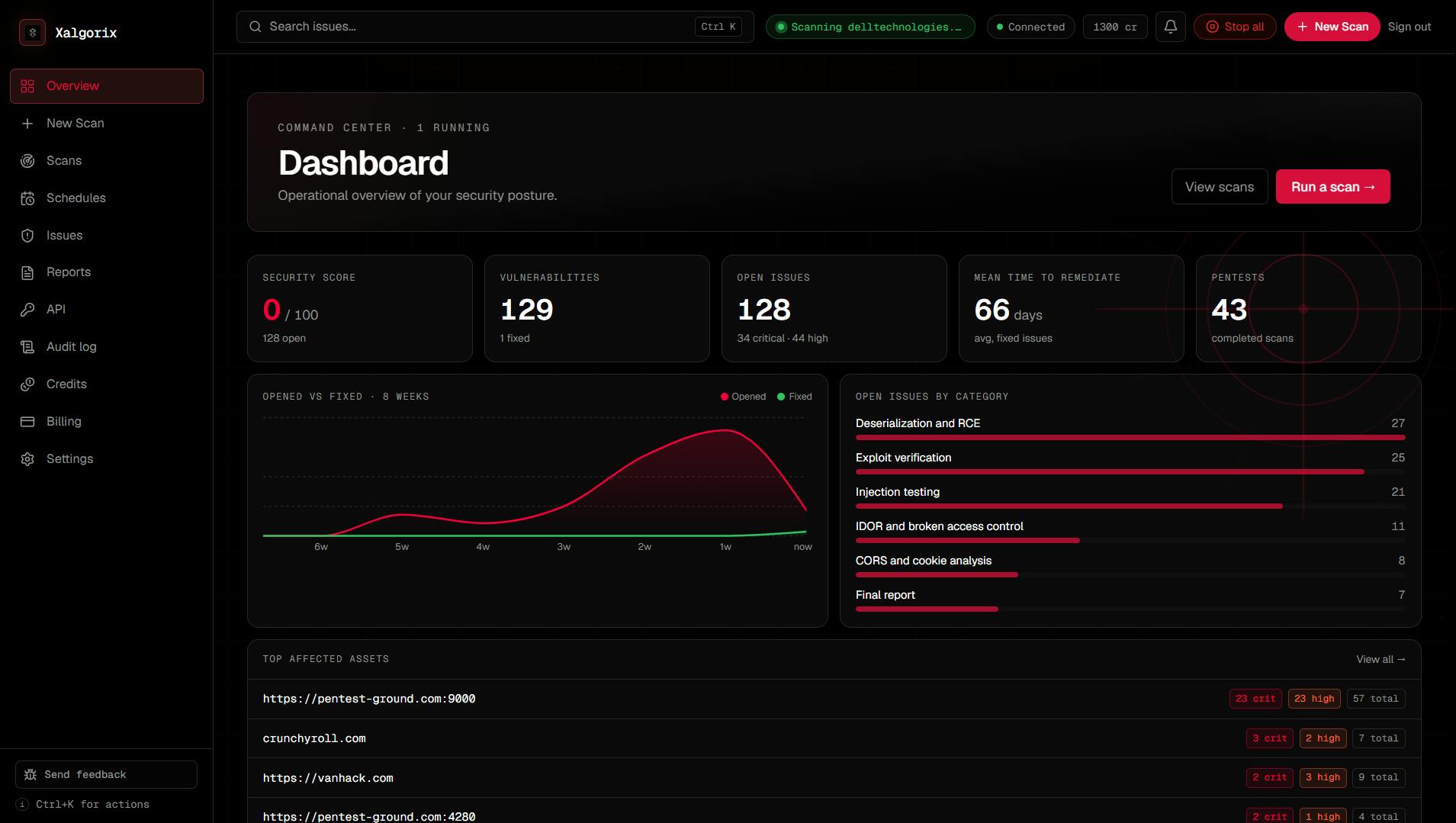
AI security tools have a credibility problem: finding something that looks vulnerable is not the same as proving that it is exploitable. Traditional scanners are good at matching signatures, crawling endpoints, and flagging suspicious behavior. Large language models add useful reasoning around authentication flows, business logic, and chained attacks. But either approach can still leave a security team with the same expensive question: Is this real? That question shaped Xalgorix, an Apache-2.0 open-source autonomous AI pentester. The project is built around a simple rule: a candidate vulnerability should not become a confirmed finding merely because an agent produced a convincing explanation. A separate verifier must reproduce it. Why exploit verification matters A plausible security report can be surprisingly costly. Engineers have to recreate the environment, identify the exact request sequence, determine whether an authorization boundary was actually crossed, and decide whether the reported impact is possible. When a scanner produces a long list of maybes, the tool has shifted work rather than removed it. Xalgorix separates discovery from verification. The primary agent works through a structured 22-phase testing methodology against an authorized target. Candidate findings then go to an independent verifier, which attempts to re-exploit them. Confirmed results retain evidence; inconclusive results are not dressed up as certainty. This does not make automated security testing infallible, but it makes the confidence boundary explicit. An agent, not a template engine Template scanners remain excellent for known patterns and broad coverage. Xalgorix is aimed at the reasoning-heavy space around them: understanding an application’s state, following multi-step workflows, comparing privileges, and testing hypotheses that depend on context. The agent can orchestrate offensive-security tools including nmap, nuclei, httpx, subfinder, katana, ffuf, sqlmap, masscan, and others. Browser-assisted DAST lets it work through JavaScript applications, forms, and authenticated flows. The goal is not to replace every specialist tool. It is to give those tools a reasoning and evidence layer that can adapt the next step to what the previous step revealed. Open source and self-hosted by design Penetration tests involve some of the most sensitive data an engineering team owns: target details, credentials, source code, raw HTTP traffic, and unpatched findings. Xalgorix therefore runs on your own machine and supports bring-your-own-LLM configuration. You choose the provider, model, reasoning effort, rate limits, and proxy settings. Supported options include OpenAI, Anthropic, Gemini, DeepSeek, Groq, Ollama, MiniMax, and OpenAI-compatible gateways. With local infrastructure and a local model, the testing workflow can remain inside your environment. The local dashboard is the command center for scans, live tool calls, findings, CVSS-scored results, and branded PDF reports. The core is built in Go, with a TypeScript interface, so teams can inspect the engine instead of treating the pentest process as a black box. From install to first scan For Linux, the quickest install is: curl -sSL https://www.xalgorix.com/install | bash xalgorix --setup The setup wizard lets you choose an LLM provider and stores the key in a private local configuration file. Start the dashboard with: xalgorix --web A Docker image is also available with the security toolchain preinstalled. Because several low-level tools need network and tracing capabilities, treat the container as a disposable, network-isolated scanning sandbox. Never expose its dashboard publicly without authentication. To build directly from source: git clone https://github.com/xalgorix/xalgorix.git cd xalgorix make build What belongs in the hosted layer The open-source CLI is the foundation. A hosted workflow is optional for teams that prefer managed scans, schedules, webhooks, CI gating, shared workspaces, REST APIs, and branded reports. A free GitHub App can also review pull-request diffs for common security risks when invoked with “@xalgorix review”. Keeping the layers separate matters. Researchers and engineering teams can inspect, self-host, extend, and contribute to the pentesting engine without being forced into a cloud-only security model. Organizations that need operational convenience can add it without changing the open-source core’s role. The tradeoffs are real Autonomous pentesting is powerful and potentially disruptive. It should only be used against systems you own or have explicit permission to test. Model quality, context size, rate limits, and the target environment all affect results. Smaller or local models may need more supervision during long scans. Verification lowers the false-positive burden, but it does not eliminate the need for professional judgment. That is exactly why open development is useful here. Methodologies, prompts, tool orchestration, safety boundaries, and verification behavior should be inspectable and debatable—not hidden behind a black box. Xalgorix is available at https://github.com/xalgorix/xalgorix. Issues, testing feedback, and contributions are welcome. Disclosure: I am the founder of Xalgorix.
Inside Xalgorix: An AI Pentester Built Around Exploit Verification
Full Article
Original Source
Read the full article at Hackernoon →KhanList aggregates and links to publicly available news content. We do not host full articles from third-party sources. Always verify important information with original sources.