
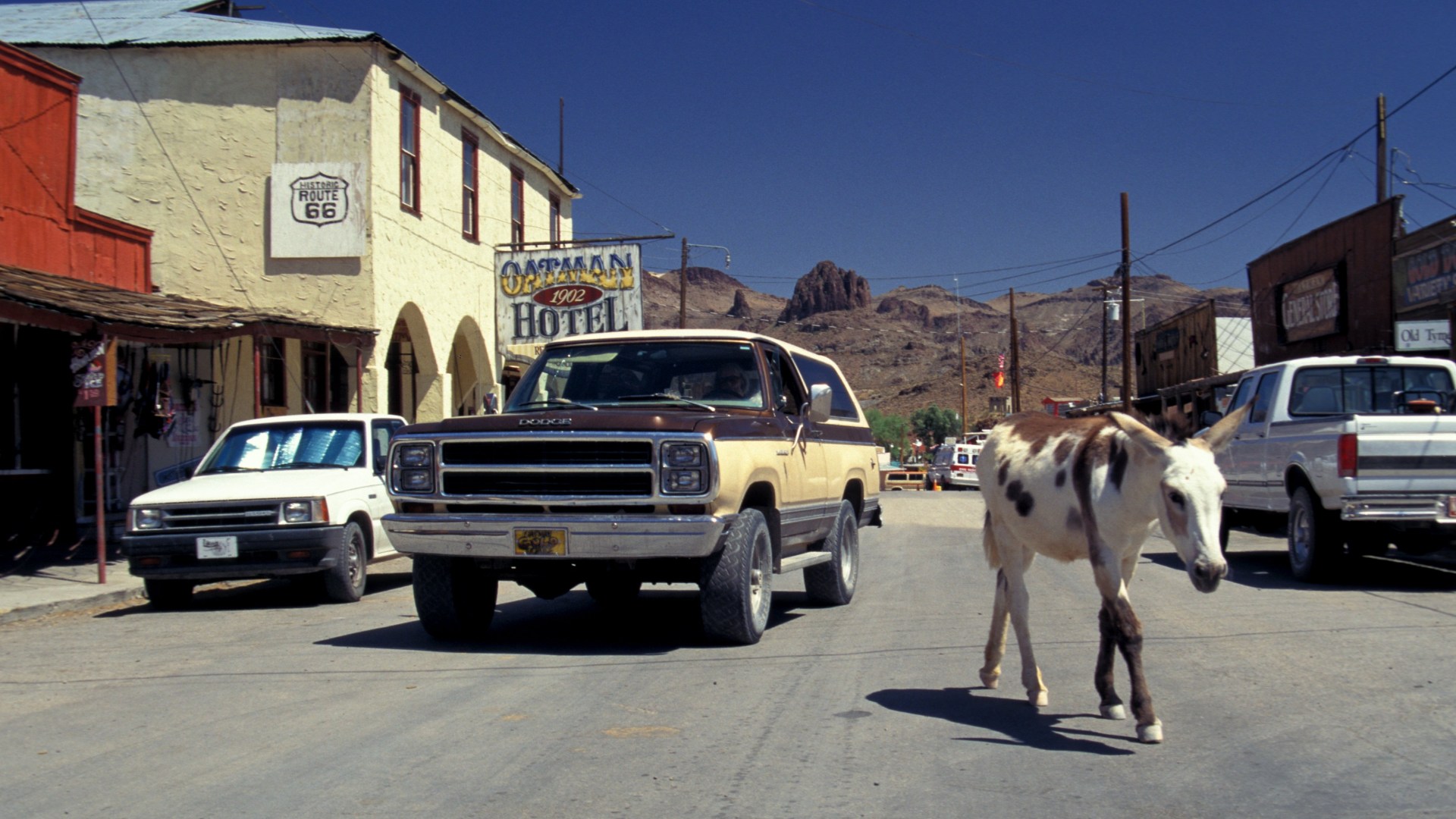
ROUTE 66 is one of the most famous highways in the world but more than 100 years on from its grand opening, the road is now home to dozens of ghost towns and rotting relics. Rotting wooden signs, rusting roofs, collapsing buildings and abandoned motels all untouched for decades can be found littered across the 2,448-mile stretch of road. Route 66 was first opened on November 11, 1926, and over the decades became an icon of Americana Credit: Getty After being decommissioned to make way for the Interstate system, the historic road is now littered with abandoned towns that seem to be frozen in time Credit: Dax Ward The shell of the abandoned and graffiti-covered Twin Arrows Trading Post in Arizona Credit: Dax Ward A collapsed roof in a derelict building in the Route 66 ghost town of Cuervo, New Mexico Credit: Dax Ward Hundreds of once-thriving towns sitting along Route 66 have since been left abandoned and unused for decades, when the arrival of the Interstate crippled towns relying on traffic from the iconic highway. The road stretched all the way from Illinois to California and crossed over eight states. Sign up for The Sun newsletter Thank you! It would take a whopping 40 hours to drive from one end to the other in a single sitting and for most roadtrippers can last for up to three weeks. First opened up on November 11, 1926, Route 66 was given the iconic nickname the Mother Road, but has since been split into fragments after being decommissioned in 1985 for modern interstate highways. One of the most dramatic downfalls along Route 66 is Eldorado Canyon, in Nelson, Nevada, a nearly-deserted relic of the Gold Rush era. The sacred grounds once epitomized America’s Wild West with the area plagued by greed, murder, and untold lost riches. Sat just an hour from the extravagant and always packed out Las Vegas Strip, the canyon is far from its former glory today. Tires are scattered around the dusty lands, and rusting old cars nestled away inside wooden garages have replaced people in the area, with census data from 2020 revealing that just 22 people live in Nelson. Most read in The Sun The mining town of Eldorado Canyon in Nelson, Nevada, is a time-capsule of the booming industry that was once there, with rusted structures left behind Credit: Dax Ward Now, Eldorado Canyon is used as a pit stop for roadtrippers, an unusual wedding destination, or as a backdrop for films Credit: Dax Ward At the heart of the canyon is the abandoned Techatticup Mine which closed in the mid-1940s, but is being revived by a couple who are breathing new life into these historical sites. Their stretch of the canyon road is now a pit-stop for filming crews, roadtrippers, content creators, and wedding parties looking for an alternative venue. Tony Werley and his wife Bobby, bought the land in the 1990s and moved in with their children. “It may be wild, but it’s our home,” Tony told travel writer Toby Skinner. Around two hours south of Eldorado Canyon lies another town that is frozen in time and still pays homage to its wild west roots. The town of Oatman, found in the Black Mountains of Mohave County, Arizona, is yet another once-booming mining town that went bust and was deserted by those who thought they would make their fortune. Now, it’s a classic tourist stop with daily Wild West gunfight shows, authentic saloons, and hundreds of burros, or wild donkeys, that roam the streets of the town and outnumber people roughly 10 to 1. They are living reminders of Oatman’s history, as the burros arrived with prospectors of the town to help with the mining. Oatman, Arizona, boomed and then went bust, and now pays homage to its Wild West roots with authentic saloons and the descendents of the wild donkeys brought in for mining Credit: Getty The graffiti-ed ruins of the Twin Arrows Trading Post where just one arrow is left standing Credit: Dax Ward However, when mining was stopped in 1942, the burros were abandoned, but unlike the people, they kept Oatman as their home. Over 200 miles east are the ruins of the Twin Arrows Trading Post and the ghost town of Two Guns, Arizona. After opening in the 1940s, the Twin Arrows Trading Post was a popular stop along the Mother Road with two gigantic arrows directing drivers to the rest stop for gas, food, and the souvenir shop. Now, the buildings are collapsing, only one arrow remains, and the area is covered in graffiti, much of it pointing to conflict with the Indigenous community, with phrases like “stolen land” and “land back” daubed on what is left of the place. Just 11 minutes from there is the abandoned town of Two Guns which is said to be a hub of paranormal activity, and a place where treasure was once buried. It was a thriving stop along Route 66, popular with visitors for not only its gas and food, but also its small zoo that once stood there. Now, you can see the ruins of the mountain lions enclosure, the skeleton of the burned-down gas station, and a crumbling “welcome” sign that epitomises the town’s demise. Also in Arizona along the historic road is the abandoned Truxton Canyon Training School, also known as the Valentine Indian School, which was built in 1903 to force Native American children to assimilate. It closed down in 1937 and you can still see the abandoned brick schoolhouse, its decrepit basketball court and rusted merry-go-round. The officially-registered Historic Place is now owned by the Hualapai Indian Nation which plans to rehabilitate it as a community center and tribal offices. Meanwhile, a seven-hour drive east will take you to Cuervo, New Mexico, a town founded in 1901 that was killed off when it was literally split in two by the I-40 which replaced Route 66. Crumbling and abandoned homes and businesses on either side of the highway, a small church, and a gas station are all that is left of the once-busy railroad and cattle stop. A roof collapse at one of the abandoned structures at the Twin Arrows Trading Post Credit: Dax Ward The derelict trading post is covered in graffiti, much of it pointing to conflict with the Indigenous community Credit: Dax Ward The ruins of the mountain lions enclosure as the Two Guns roadside zoo, where visitors will also see the skeleton of the burned-down gas station, and a crumbling ‘welcome’ sign Credit: Alamy The abandoned merry-go-round at the former Truxton Canyon Training School in Arizona Credit: Dax Ward Just 80 miles down the road, is the next ghost town of Glenrio which straddles the New Mexico/Texas border which was once packed with filling stations, motels, and cafes until the I-40 diverted the traffic away in the 1970s. Unlike the other abandoned parts of Route 66, Glenrio is one of the few where many of the buildings are still intact and give more of an impression of what it would have once been like. In 2007 it was put on the National Register of Historic Places featuring 17 abandoned buildings, and the old Route 66 roadbed. According to visitors, the sound of the nearby Interstate traffic only highlights the eerie silence of the abandoned town. If you keep going east on the I-40 for about 180 miles, you will end up in Texola, Oklahoma. This living ghost town on the Texas/Oklahoma border has a population of around 40, and you can still see the abandoned historic stone jail with just one roo, and a 1930 Magnolia Gas Station among the derelict buildings. Many of these shells are left scattered with retro cars and advertisements. In the 1930s, The Great Depression and the Dust Bowl left the town largely deserted, as farmers fled to other regions, but Route 66 helped keep it alive. Glenrio straddles the New Mexico/Texas border which was once packed with filling stations, motels, and cafes until the I-40 diverted the traffic away in the 1970s Credit: Dax Ward Interior view of an abandoned wooden cabin in the ghost town of Texola near the Texas state line Credit: Alamy A rusting diesel fuel pump and a canopy covering other pumps stand at an abandoned gas station in Texola Credit: Alamy Cuervo in New Mexico was killed off when it was literally split in two by the I-40 which replaced Route 66 Credit: Dax Ward However, once again, the arrival of the I-40 was the final nail in the coffin for the tiny town. The iconic Mother Road that endures as a lasting icon of Americana celebrates its centennial on November 11 with a slew of activities taking place nationwide to celebrate the historic road. Comment now
Inside the ghost towns of Route 66 with rotting relics 100 years after historic highway opened
Full Article
Original Source
Read the full article at Thesun →KhanList aggregates and links to publicly available news content. We do not host full articles from third-party sources. Always verify important information with original sources.