
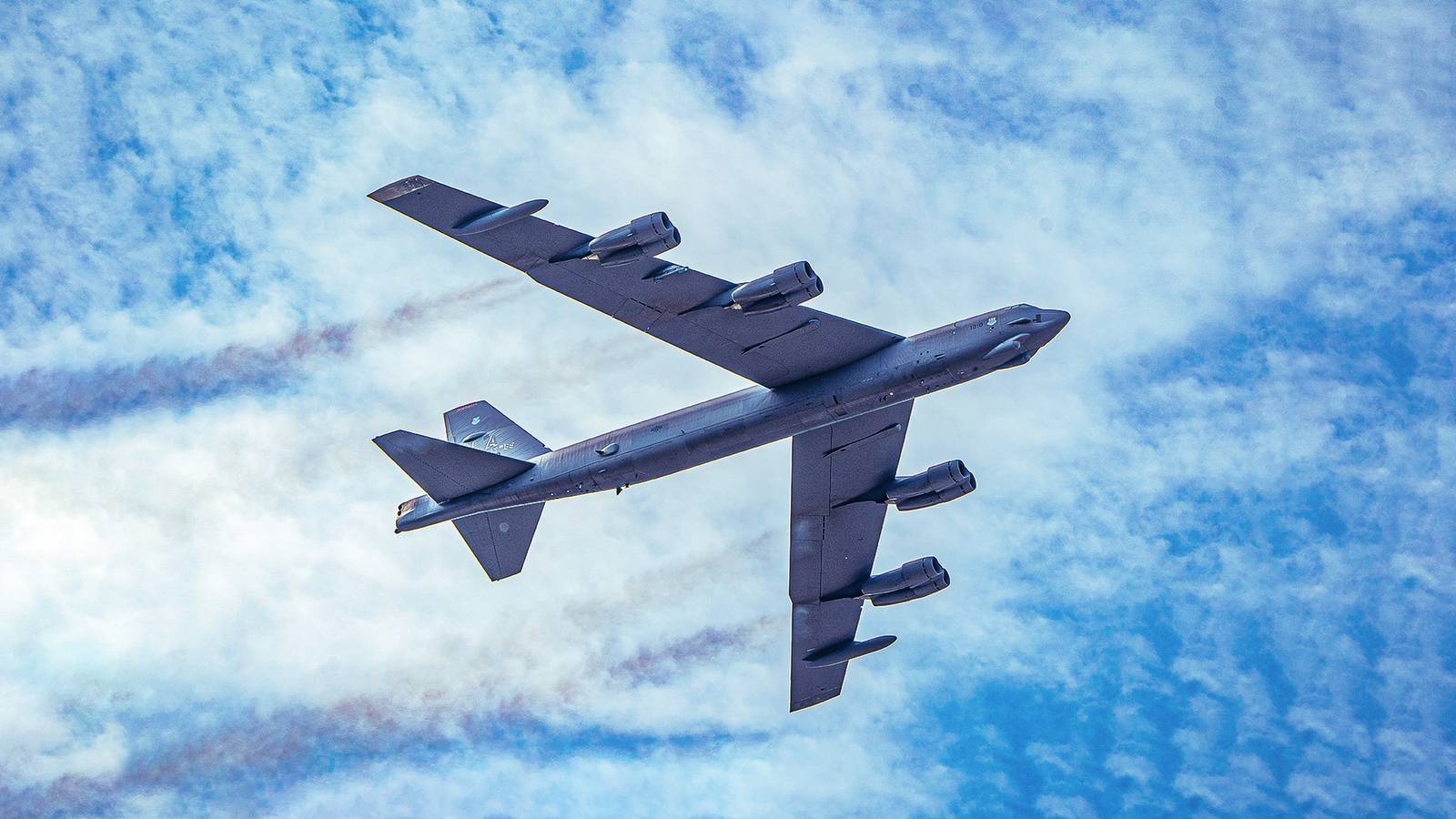
Published Sep 12, 2026, 1:00 PM EDT Luke Diaz is a freelance military writer with experience with active duty experience in the US Navy as well as defense and industrial engineering. He is a former Naval Flight Officer who performed tactical air control on the carrier-based E-2 Hawkeye. The US Air Force (USAF) is undertaking one of the most ambitious aircraft modernization programs in the history of defense aerospace. Air Force Global Strike Command aims to transform its fleet of 76 Eisenhower-era Boeing B-52 Stratofortress bombers into 21st century missile trucks. Along with a host of upgrades to the airframe and avionics, the headline improvements will be new Rolls-Royce engines and a state-of-the-art Raytheon radar system. Unfortunately for the Department of Defense, before the first aircraft has even entered the hangar, the budget is skyrocketing and the timeline keeps sliding to the right. Both the commercial engine replacement program and the radar upgrade have experienced significant budget increases and delays. The radar specifically has increased by 30%, or about $3 billion. On August 25, the Pentagon awarded over $600 million more to Raytheon, the radar provider, and an additional $160 million to Boeing as well, as the prime contractor on the project. The big ugly fat fellow (BUFF), as the B-52 is endearingly referred to, is slated to become one of the most powerful missile-launching platforms and flying data centers in the world when all of this work is done. The trouble is that the Air Force is having a very hard time getting the ball rolling. What The Latest $603 Million Contract Actually Buys Credit: US Air Force The Air Force Life Cycle Management Center at Wright-Patterson Air Force Base awarded Raytheon an indefinite-delivery/indefinite-quantity contract with a ceiling of $603 million in last week's award cycle. This amount is for production and sustainment of the AN/APQ-188 radar, which will replace the mechanically scanned array on the B-52 with an active electronically scanned array (AESA). This will represent a quantum leap over the vintage sensor currently in the nose of the BUFF. The problem raised by this new award for the El Segundo, California, branch of RTX is that it keeps getting more funding for a product that is being scaled back and slowed down. The radar portion of the B-52 modernization project increased so much in cost that it was legally required for review by Congress under what's called the Nunn-McCurdy Act. In order to scale back the overrun, the Air Force agreed with recommendations from the Government Accountability Office to reduce the scope. Yet it's still throwing money at Raytheon. The fighter jet-derived radar array will dramatically enhance the combat effectiveness of the B-52 and is a necessary evolution in order for it to remain relevant on the battlefield of tomorrow. There is no debating the technical or tactical necessity of the system, but the Air Force is pushing ahead with a test and developing a program that introduces additional risk when it's already facing serious programmatic deficiencies. The Radar Modernization Program Behind The Contract Credit: US Air Force The AN/APQ-188 is an AESA radar, derived largely from the AN/APG-79 used on the Navy's F/A-18E/F Super Hornet and adapted with a larger antenna for the B-52. It replaces the Northrop Grumman AN/APQ-166, a mechanically scanned array radar whose last major digital update dates to the early 1990s and whose physically rotating antenna makes it more failure-prone, easier to jam, and weaker at ground-target imaging than a solid-state AESA design with no moving parts. The GAO attributed the budget overrun to significant design changes, contractor performance issues, and installation complexity greater than planned. The GAO found that the Air Force had also quietly reduced the program's original requirements from 25 down to 20 in an effort to hold costs down to something resembling a minimum viable product. Still, planned production has slipped by more than two years, and initial operational capability, originally expected in fiscal 2024, has moved to the third quarter of fiscal 2030. A radar program running three-plus years late and 30% over budget is not simply a hardware upgrade anymore. It is a program under formal oversight that will become more pointed once the radar itself is examined next to what it is replacing. Why The USAF Judged The Price Worthy Of The Capability Credit: US Air Force The BUFF has effectively been flying marathon combat missions with a broken radar for years, according to the Air Force. But not only does it represent a major combat deficiency, but a genuine hazard to the safety of flight. The AN/APQ-188 is intended to close that gap with improved all-weather navigation, high-resolution ground mapping, and enhanced detection and tracking of moving air and surface targets, while also giving the radar an electronic-warfare function through its individual transmit/receive modules. Tragically, the RMP development was set back further on June 15. One of just two test aircraft crashed in the deadliest Stratofortress accident since 1982, when B-52H tail number 60-0061 went down. It was the first fatal crash of a BUFF since 2008. The jet had been freshly ferried from Boeing's San Antonio modification facility that December, and it was flying a routine radar test mission when it crashed shortly after takeoff from Edwards Air Force Base, killing all eight people aboard. The crew that sadly lost their lives were a combination of uniformed Air Force personnel, government civilians, and contractors, including two Boeing employees. Limited flight-tracking data showed the bomber banking sharply and nearly completing a 180-degree turn before falling at a rate approaching a mile a minute. No initial mishap investigation data have been publicly shared, but investigators said determining a cause will likely take months. In addition to the terrible loss of life, Air Force top brass acknowledged the loss of one of only two test airframes would likely cause further delays to a program that was already years behind schedule. The setback will force the service to continue radar testing on the sole remaining modified aircraft until a replacement can be outfitted. The heavily encumbered bomber recapitalization program is now forced to absorb the loss of half its dedicated test fleet, along with the human toll, without slowing down a clock the Pentagon insists it cannot afford to stop. Why The Air Force Won't Slow Down: The B-52J Deadline Credit: US Air Force The radar is one piece of a wider transformation into the B-52J, the designation the Air Force formally assigned in its fiscal 2024 budget documents to any B-52H fitted with new commercial engines and their associated subsystems. Alongside the AN/APQ-188, the B-52J package includes roughly 650 Rolls-Royce F130 engines replacing the Pratt & Whitney TF33s that have powered the bomber since the early 1960s, plus new communications, avionics, and crew-compartment upgrades, all aimed at keeping the fleet's 76 active B-52Hs flying into the 2050s alongside the incoming B-21 Raider. The total B-52 modernization, engines, radar, avionics, and communications combined, is projected at roughly $48.6 billion across the program's life, of which GAO estimates the engine and radar efforts alone account for about 88%, or more than $18 billion, of a $21 billion total modernization bill. GAO's July 2026 report found ten of the program's 13 modernization efforts experiencing cost growth, schedule delay, or performance shortfalls, with the engine and radar programs uniquely suffering all three simultaneously. That scale of investment in a nearly 75-year-old airframe design has itself become the program's central political vulnerability. The Institutional Fight Over The BUFF's Radar Credit: US Air Force The B-52J's rising costs have sharpened a long-running debate over whether the Air Force is over-investing in a non-stealth bomber at the moment its stealthy successor is entering service. Critics argue that money sunk into extending a Cold War airframe would be better spent on Northrop Grumman B-21 Raiders. Bolstering that argument is the fact that the DOD has funded a 25% budget increase to ramp up B-21 production and is considering increasing the total fleet size. That AFGSC's original stated plan calls for only 100 B-21s in a fleet mix supported by the 76 B-52J Stratofortress bombers after they have been upgraded. However, the B-21 program has performed nearly flawlessly in terms of cost and schedule. That has encouraged senior leaders to champion raising the total fleet size, with some advocating for 145. Going above and beyond, US Strategic Command commander Admiral Anthony Cotton has even said the value of the B-21 is so great that the Pentagon should procure 145. Air Force Chief of Staff General David Allvin told the Senate Armed Services Committee bluntly that if the B-52 modernization effort "goes worse than we hoped, then we would need more money for B-21s," according to Air & Space Forces Magazine. The Air Force's counter-case is operational rather than budgetary. The service's doctrine pairs the B-52J as a stand-off missile truck and even a kind of mothership for collaborative combat aircraft. It is a much more rugged, lower cost per flight hour, and rapidly deployable platform even though it cannot penetrate the most contested airspace. The upgraded B-52J would not need to penetrate integrated air defense systems because it can sit hundreds of miles away launching cruise missiles. Part of its improvement program, and much of the money awarded to Boeing, is going towards new bomb racks. The standard JASSM and the anti-ship LRASM have a range of nearly 250 miles (400 km), while JASSM-ER can be fired from nearly 600 miles (960 km) away from the target. That stunning range gives the BUFF an immensely powerful 'punch' that it can hurl at enemies from so far away that it is essentially immune to threat. The advanced electronics will also give it the capability to target and contest electronic warfare environments, a crucial upgrade for the 21st century. All of that, combined with its nuclear weapons capability, makes it an irreplaceable platform even now, and it is likely to reach a century of service before it is finally retired by the USAF.
Inside The $603 Million Contract Giving B-52 Bombers A New AESA Radar
Full Article
Original Source
Read the full article at Simpleflying →KhanList aggregates and links to publicly available news content. We do not host full articles from third-party sources. Always verify important information with original sources.