
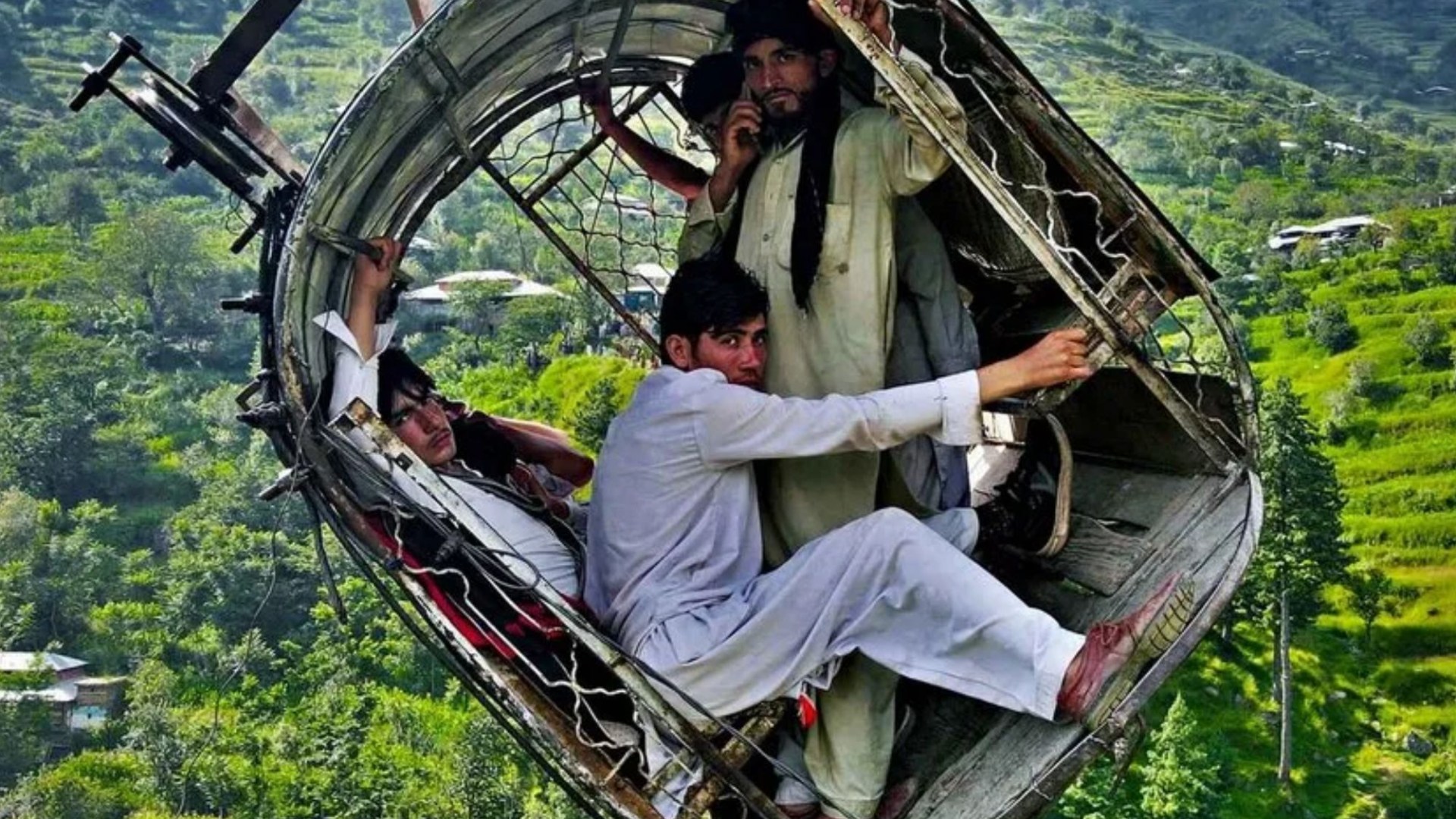
CRAMMED into a makeshift cable car no bigger than the back of a small van, six schoolboys and two adults faced almost certain death as they hung by a single frayed wire over a 900ft drop. News channels across the world covered the dramatic rescue attempt in the foothills of the Himalayas in 2023, with the boys and their relatives all believing they would die. Amazing drone footage showed the eight passengers dangled 900ft above a valley in Pakistan in a DIY cable car Credit: Supplied ‘I closed my eyes and thought I would die’ – the moment Irfan Khan is plucked from the stranded cable car Credit: UMEED SAHAR via REUTERS Dramatic drone footage revealed the petrified faces of the passengers trapped inside what was little more than a cage. Seeing the poor condition of the one remaining wire, the authorities feared it could snap at any moment. Sign up for The Sun newsletter Thank you! That did not stop four brave men making their way across the cable swaying over the Jhangri River in Northern Pakistan in a bid to save the stranded pupils. Now Louis Theroux‘s production company has made a documentary called Hanging By A Wire about the rescue effort. The scale of the rescue with the cable car just hanging on as a helicopter hovers overhead Credit: Netflix Amazing drone footage captured the men inside before the rescue Credit: Netflix It took four death defying attempts to get the boys back in the 14 hour long operation. An army helicopter only managed to save one, a local used a pulley to grab another, two zip wire experts saved three more and a member of the special forces grabbed the rest. Three years on, there is still no safe route for the children to get to school and many in the region take their lives in the hands when using similar DIY cable cars. One of the survivors of the terror in the skies tells The Sun how he thought he was going to die. Most read in The Sun Irfan Khan, who was 15 at the time of the accident, says: “I heard a very loud sound when the cable broke. The cable car was suddenly hanging. “We were really high, we looked down the ground. “This was the first time I saw death was very near to me. “There was nothing to think about, all we could do was shout very loudly so the people heard us.” Irfan Khan relives the terrifying experience in a new Netflix documentary Credit: SUPPLIED A military commando dropping down from the first helicopter trying to reach the cable car but the downdraft almost sent the cable car tumbling to disaster Credit: PAKISTAN ARMY/UNPIXS The mountainous region around the town of Battagram in the Khyber Pakhtunkhwa is incredibly beautiful. But these remote communities have travel options that are not to be envied. The choice faced by the pupils on one side of the valley wishing to reach school on the other is the hair-raising 30 second long cable car ride or a two-and-a-half hour trek on foot. Many prefer to walk because there have been deaths on similar systems in the area. It is not just students taking their lives in their hands. Anyone needing to reach the closest medical clinic quickly, needs to travel by the wires. Irfan says: “I do not take the cable car very often, but unfortunately that day I did need it to get to school.” The systems are run by locals without authorisation and are built with old parts. Hanging By a Wire’s director Mohammed Ali Naqvi travelled on one of the makeshift cable cars in order to understand what it is like. He explains: “I have a marginal fear of heights. It was terrifying. You say a prayer and keep your fingers crossed.” Irfan was not worried when he climbed on board at around 7.30am on a sunny day on August 22, 2023. That soon changed. When the chairlift was about half way across the huge ravine two of the cables snapped, the weight too much for these rusty wires to bear. Only one remained, meaning the flimsy contraption tipped onto one side. Fortunately, unlike the two ends of the car this was not open to elements. The screams could not be heard from below and they were left dangling, helpless. Irfan recalls: “We had no hope that we would get our life back. At first there were no network services in the cable car, but later we were able to speak to the villagers by mobile phone. The rescue attempt was covered by news channels across the world Credit: Sky News.. Crowds gathered to watch across the valley Credit: Getty / Prateek Kumar “They told us there was a rescue helicopter on the way.” They had no food or water to sustain them in the sweltering heat. Irfan says: “Four of us were standing and four of us were sitting. We couldn’t move and were in the same position from the start to the finish.” It was until noon that the first military helicopter arrived to assess the situation. A soldier came down on a rope, but had to retreat when the downdraft from the hovering craft made the cable car rock wildly. Irfan says: “As the helicopter got near the pressure from the blades made the cable car move.” It would be another two nerve shredding hours before a second helicopter arrived. This time a rescuer reached the stranded travellers, gave them some water and handed over a harness to tie to a rope. A second, smaller helicopter joined the rescue Credit: AP Pakistan military helicopter pilots had to use all their skills to stop the downdraft from dislodging the dangling cable car Credit: Unknown A Pakistani army soldier making the final rescue run Credit: EPA Three of the rescued youngsters after returning to safety Credit: AP Bravely, Irfan, who was one of the youngest in the car, volunteered to go first. Irfan, who is now 20-years old and a first year student at university in Rawalpindi city, says: “He returned back to the helicopter and I wore the jacket and tied it to the rope. “I was at the bottom of the rope. I closed my eyes and thought I would die. “My eyes were closed and I was confused. After a while I felt a hand reach out and grab me. “I opened my eyes and saw the rescuer.” Waiting on the ground was his father Umraiz. He remembers: “I was connected to Irfan by mobile phone and I was aware he was the first person who was going to be rescued by helicopter. “I told Irfan you try your best and hopefully God will help us. But as he jumped I looked towards the ground and closed my eyes. “I opened my eyes when the crowd cheered and I thanked to God.” The ordeal was not over for the other seven. The next attempt at an extraction resulted in the rope tangling with the wire and it had to be aborted. At sunset it was too dark for the chopper team to try again, but waiting until morning was also too risky. From one side of the canyon an official rescue attempt was made by zipline entrepreneur Ali Swati and his colleague Muhammed Ilyas. Ali said: “When I checked the condition of the wire it was finished. It could break at any moment.” From the other side, unbeknownst to the authorities, ‘sky pirate’ Sahib Khan was already on his way with a pulley system. Sahib, who had rescued stranded cable cars before, said: “I was terrified when I was making my way across. There were strong winds.” He managed to send back 17-year-old Niaz to safety, but was ordered by the police not to continue and found himself stranded on the cable car. The authorities insisted that only the official rescue team should traverse the wires in the dark. Ali, though, admitted: “The sound of the pulley on the rusty cable filled me with dread.” He collected three of the passengers, Rizwan, 13, Gul, 21, and Sher, 20, and started to make his way back. It was chaotic. The rope got stuck in the trees, leaving the incredibly fit Ali to try to pull the three children along by himself. After one and a half hours, having travelled 400ft, he was too exhausted to go on. Ali says: “I let go.” That sent the four of them hurtling back to the cable car, with him fearing they were going to hit it. Fortunately, the trees proved to be a braking system. Once the rope was untangled from the trees, a huge group of locals and military men pulled them back towards safety. Ali’s hand was injured by having the rope tied around it and he could not return. This time a special forces commander, with a walkie-talkie, collected Ataullah, 17, Usama, 15, and fellow rescuer Muhammed. Sahib made his way back on his own. When Umraiz was reunited with Irfan in hospital it was emotional. He admits: “We both cried a lot.” The stranded cable car still hangs by the solitary wire, a warning to others about the dangers of crossing the valley from the air. Little has changed. The director hopes that his documentary, which is in cinemas from Friday, might finally force the authorities to provide a bridge or suitable roads. Mohammed concludes: “The people are isolated and ignored. They don’t have basic infrastructure. They have to improvise. “They need more attention. They need help.” Hanging By A Wire is in cinemas from August 28. Comment now
Inside nightmare 14-hour rescue after cable car wire SNAPPED leaving terrified schoolboys dangling over 900ft drop
Full Article
Original Source
Read the full article at Thesun →KhanList aggregates and links to publicly available news content. We do not host full articles from third-party sources. Always verify important information with original sources.