
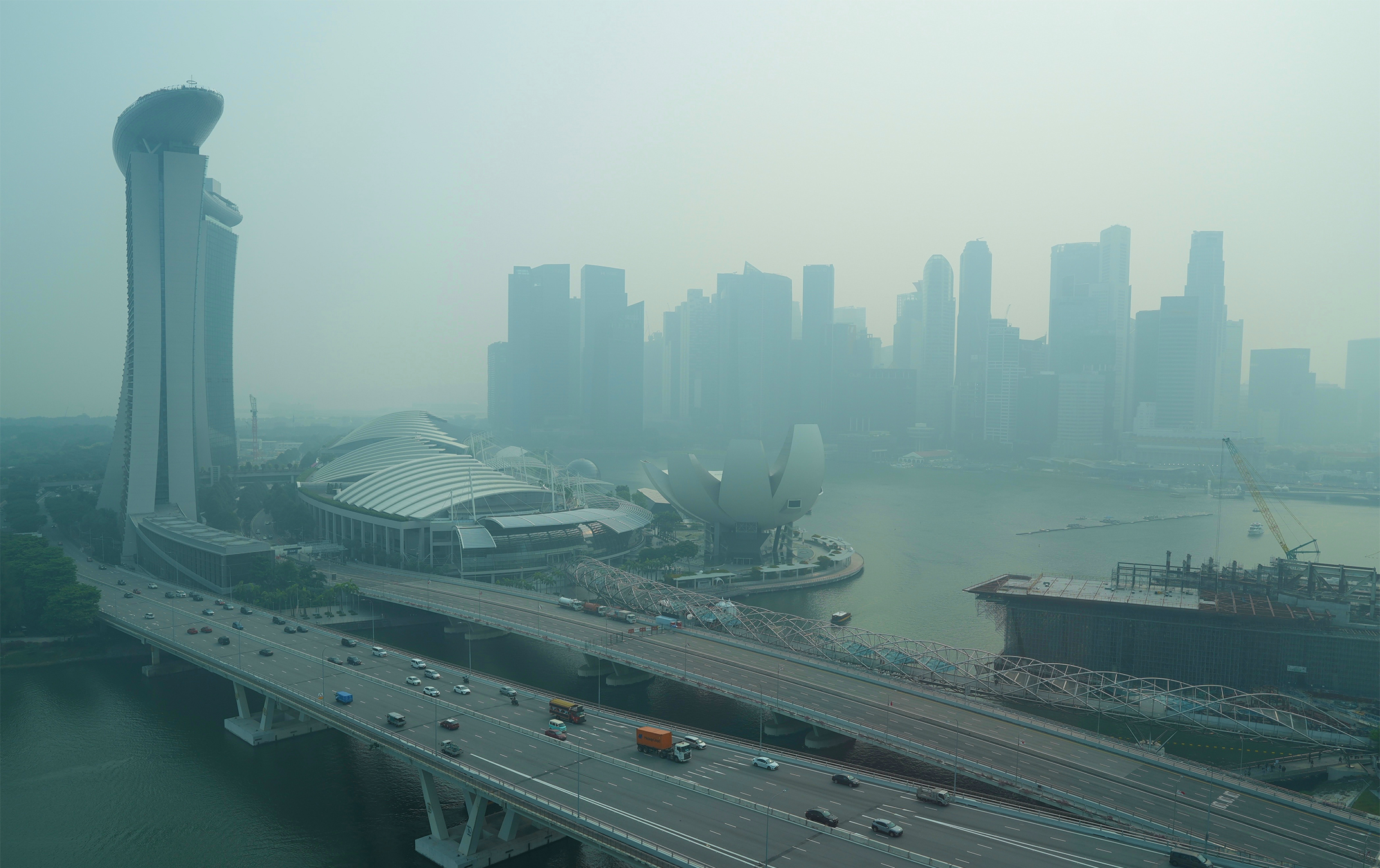
Singapore became the first Asean country to pass a law allowing it to punish firms responsible for unhealthy air quality within its borders over a decade ago.But no charges have been brought to date, spurring legal experts and advocacy groups to call for updates to the act.Mongabay spoke with experts about what legal options regulators and civil society groups have against haze-causing companies. SINGAPORE — As Singapore comes off its longest streak of unhealthy air since the 2015 Southeast Asian haze crisis, authorities have served notices to 20 firms linked to Indonesia’s fires, but have stopped short of taking further legal action. Half of the notices were sent to concession holders in Sumatra and Kalimantan where the fires originated, while the other half went to Singapore-based entities with ties to them. Of the 10 Indonesian plantation companies identified, three of them — PT Bumi Andalas Permai, PT Bumi Mekar Hijau and PT SBA Wood Industries — have had separate investigations open against them by Singaporean authorities since 2015, with no public outcome. All three are tied to the Asia Pulp & Paper (APP) conglomerate, as is PT Buana Megatama Jaya, which was also issued a notice to extinguish fires in its concession. The other six companies issued the notices requiring them to act against fires are PT Paramitra Mulia Langgeng, PT Sumatera Alam Anugerah, PT Hutan Lestari Raya, PT Bangkanesia, PT Mananjung Hayak and PT Baratama Putra Perkasa. A spokesperson from Singapore’s National Environmental Agency told Mongabay by email it could not disclose further details into existing investigations. The agency did not respond to questions as to whether it would escalate against repeat offenders. Based on the government’s current investigations, Singapore-headquartered APP, Singapore-listed First Resources and Bumitama Agri, and privately held First Borneo Plantations, whose ownership is tied to Singapore, already appear to be linked to the haze-causing fires in Indonesia, Singapore’s senior minister K Shanmugam said on Oct. 19. APP’s green label — reinstated in 2019 after being suspended during the 2015 haze episode — was temporarily restricted by the Singapore Environment Council on Oct. 18, raising the possibility that its products could be pulled from supermarket shelves, as happened in 2015. APP, First Resources and Bumitama Agri are among the 10 Singapore-registered firms that have been asked by NEA to provide more information on their links to the fires – a first since the city-state enacted its anti-haze law. The others are APP’s Chinese subsidiary, Golden Agri International, Indofood Agri, Kencana Agri, TSH Global Plantation, TSH Oversea and Wilmar International. Shanmugam shared that the government plans to investigate the owners, buyers and financiers of the named concession holders, regardless of whether they have a presence in Singapore. The Ministry of Law has since set up a specialist panel of legal, audit and investigative firms to aid in its probe, with further updates expected this week. “Companies cannot play hide and seek with different corporate structures. Nor should they hope that because the evidence and actions are in Indonesia, they can escape responsibility in Singapore,” he said. “Our agencies are considering legal, regulatory, and economic measures that can be taken against these companies.” Haze in Serangoon, Singapore, on Oct. 5. Image by Gabrielle See for Mongabay. No prosecutions to date In 2014, Singapore became the first country in the world to pass a law allowing it to punish foreign entities for causing cross-border air pollution. Under the Transboundary Haze Pollution Act (THPA), companies found guilty of causing or condoning fires that affect Singapore’s air quality can be fined up to 100,000 Singapore dollars ($77,951) a day, capped at 2 million Singapore dollars ($1.6 million). But despite several major fire episodes blanketing the city-state with haze since 2015, it has yet to bring any charges or impose any penalties under the act. The law is aimed at Indonesia’s near-annual wildfires, which burn across huge areas of desiccated peatland that have been drained and dried for agriculture, mostly by palm oil and pulpwood companies owned by tycoons from Indonesia, Malaysia and Singapore. This year’s fires have raged for two months and are some of the worst in recent memory. Helena Varkkey, associate professor of political ecology at the Department of International and Strategic Studies at the University of Malaya, said the difficulty of enforcing Singapore’s anti-haze law “reflects the limits of operating extraterritorially within an [Association of Southeast Asian Nations] that prioritizes non-interference.” “The picture is one of influence without enforcement, rather than straightforward failure,” Varkkey wrote in an email. But even if Singapore’s law does get enforced in its current state, Kiu Jia Yaw, co-chair of the Malaysian Bar Council’s Environment and Climate Change Committee, said it was limited in addressing the more systemic issue of supply chains responding to market demands contributing to fire risks. “This is a state of organized irresponsibility. So it’s not one villain who is causing haze,” Kiu told Mongabay. “It’s a map of relationships that we are after.” The Haze Elimination Action Team (HEAT), a Singapore volunteer-led group formed in 2007, had previously explored a civil lawsuit against companies responsible for the severe 2015 haze, with three plaintiffs: A tennis coach, a football competition organizer and the Singapore Swimming Association (SSA). Haze in Singapore in September 2026 due to Indonesia’s wildfires. Image courtesy of Sally Chng. While discussions with SSA — which had publicly declared its intention to sue companies linked to the haze due to the investments foregone in preparing for the canceled swimming World Cup finals — never progressed beyond the preliminary stage, the other two plaintiffs had documented their economic losses and were “ready to go,” according to HEAT’s co-founder Ang Peng Hwa. “However, nothing happened out of that,” Ang, who is also a professor at Nanyang Technological University of Singapore’s Wee Kim Wee School of Communication and Information, said in an interview. Although the act provides for civil lawsuits, they largely depend on the government first obtaining cross-border evidence to move forward, Ang said. “There was no criminal suit and we don’t have the resources to go to the ground to prove those cases, so we couldn’t follow up.” Beyond Singapore’s law, HEAT is exploring other legal avenues, including U.S. class action lawsuits over share-price losses — which some Singapore-listed palm oil producers experienced on Oct. 16 after the country began probing haze links — and investment treaty claims by cross-border investors. Ang cautioned that both are “more complicated” routes. According to the legal firms he has spoken to, class actions generally require damages of at least $25 million, while investment treaty claims against Indonesia require similarly sizeable losses. Linda Yanti Sulistiawati, a senior research fellow at the National University of Singapore’s Asia-Pacific Centre for Environmental Law (APCEL), said in an interview that legal action could also be pursued internationally, such as at the U.N.’s International Court of Justice, for advocacy purposes. Partial legal progress can have advocacy value even without actual victory, said Sulistiawati, citing how a Swiss court admitting a lawsuit from Indonesian islanders against Swiss cement giant Holcim over its carbon emissions was already a win. She added that many routes can be pursued outside Singapore as legal imagination widens, including class action lawsuits with cross-border plaintiffs, which could be possible in Indonesia or potentially even Malaysia if it enacts its own transboundary haze law, which activists have recently renewed calls for. “But Singaporeans might have very different aspirations,” Linda said. “In terms of going to court, the culture is very different in Indonesia, Malaysia and Singapore, even though we are facing the same haze.” Haze in Kuala Lumpur, Malaysia, on Oct. 17, 2026, due to Indonesian wildfires. Image by Philip Jacobson/Mongabay. Shrouded in corporate secrecy Corporate opacity surrounding fire-prone concessions has been stark in the case of PT Mayawana Persada, whose pulpwood concession in the west of Borneo island spans roughly 136,710 hectares (338,000 acres), almost twice the size of Singapore. Based on environmental NGO Walhi’s analysis, the concession ranked fourth in the number of hotspots detected among forestry permit holders between January and August 2026. However, its ultimate owner has been murky as its ownership structure ends in the British Virgin Islands and Samoa — both well-known secrecy jurisdictions. Several independent investigations have indicated the company is secretly controlled by Indonesian billionaire Sukanto Tanoto’s Royal Golden Eagle (RGE) conglomerate, though RGE has denied it. In May, however, Mayawana was added to the supplier list of APRIL, an arm of RGE. Holly Yang, a professor of accounting at Singapore Management University who, together with a student, has traced the financing, ownership and supply chain links of fire-affected concessions named in Greenpeace’s latest report, told Mongabay that several of the concessions have changed hands in the past three years — in some cases shortly before or after a fire season. “Several sit under layered holding companies that end in a jurisdiction where the owners are not public,” Yang wrote in an email. “By the time a report is published, the owner it names may no longer be the owner.” On the back of the recent NGO reports flagging Singapore’s substantial affiliations to high-risk concessions, Singapore Exchange Regulation (SGX RegCo) has questioned seven listed conglomerates — Golden Agri-Resources, Wilmar International, First Resources, Kencana Agri, Bumitama Agri, Indofood Agri Resources and TSH Resources — on their possible links to the haze. All have responded publicly to the queries from SGX RegCo, which is the independent regulatory arm of Singapore’s stock exchange. Shanmugam has stressed, however, that companies will also need to supplement statements reiterating their fire mitigation measures and zero-burning policies with evidence to clear their names. A woman with her face mask pulled down rests on a bench beside a lily pond as thick haze obscures the skyline behind the Marina Bay Sands shopping pavilions in Singapore, Oct. 9, 2026. Image by AP Photo/David Hu. Yang said that SGX RegCo’s inquiries could have been more specific so companies that already publish statistics on hotspots and actual fires in their annual sustainability reports have to indicate those numbers during the haze period. First Resources, for example, reported detecting 207 hotspots and 155 actual fires in its 2025 sustainability report, but its response to SGX RegCo did not disclose those figures for the period in question. In cases involving multiple layers of secrecy, corporate accountability “has to attach to things that do not move,” Yang said. She added that Indonesia’s tying of sealing and permit freezes this year to land concessions, rather than shareholders, is a good example, as it ensures that enforcement consequences arrive regardless of who owns the burning concession. Some of the gaps can also be filled by beneficial-ownership registers, which Indonesia has maintained since 2018 and Singapore’s Accounting and Corporate Regulatory Authority (ACRA) also keeps. But Singapore’s register is not publicly accessible, while Indonesia’s is often questionable in terms of the accuracy of the data submitted by companies. “The gap there is access and verification rather than existence,” Yang said. “Enforcement agencies matter most precisely in these cases because they are the only party that can compel the information the market cannot see.” Haze is seen over Singapore on Oct. 17. Image by Gabrielle See for Mongabay. Calls to update existing law Earlier this month, Singapore civil society groups PM.Haze and SG Climate Rally launched a joint petition calling for the government to strengthen its haze law to enable prosecutions and civil claims. “In its current form, we do not think THPA can be readily and effectively wielded by individual persons or businesses. As such, our plan is to propose amendments to THPA in the hopes that group action against companies can be taken easily in the future,” Low Ying Hui, president of PM.Haze, said in an email. Among their demands are for the 2 million Singapore dollar cap to be removed or raised substantially, with fines directed toward financial relief to vulnerable groups in the city-state and long-term haze prevention solutions. They are also urging for the act to cover conduct creating the dry conditions that increase fire risk, such as the illegal draining of peatlands. While Shanmugam has said Singapore “will amend current legislation or introduce new laws” where necessary to ensure further cooperation, he has not provided an explicit timeline. Kiu agreed that it is an opportune time to consider amending the act to align with broader sustainability reporting rules that have kicked in since its inception. The haze offers a “good litmus test” of whether sustainability reporting actually translates into real life sustainable development outcomes “when the rubber hits the road,” he told Mongabay. Importantly, the amendments should reflect a better understanding of how fires start and spread, experts said. Based on its analysis of high-confidence hotspot data over the past two years, Trend Asia has found a pattern of unevenly distributed hotspots, with nearly 80% concentrated in 10 provinces closely associated with agribusiness and extractive industries. This is not a picture of the country burning evenly due to drier conditions brought about by El Niño, which some Singapore-listed companies have attributed fires to, said Alfa Arifia Setiawan, a policy researcher at the Indonesian environmental advocacy group. Instead, the concentration of hotspots within mining, forestry and palm oil concessions suggests that fire risks are tied not only to individual acts of burning, but the way land is allocated and used. Kiu similarly argued that the current framing of haze as the work of a few slash-and-burn operators under Singapore’s law is far too narrow. Instead, companies should be made to disclose how their activities — including land use change on concessions — increase fire risks. Under Singapore’s reporting regulations, financiers can be mandated to ask companies due diligence questions around how their activities contribute to fire risks. This improves access to information for other stakeholders beyond the enforcement agency, allowing consumers, lenders, employees and NGOs to exercise their varying levels of influence over commodity production. Yang added that companies served with a notice under the act should be required to disclose it in their sustainability reports, with lenders also required to disclose their exposure to such entities. “That turns an enforcement action into information that the market and the banks’ own risk committees must act on,” Yang said. However, she warned that this approach only works where ownership is traceable. “In this sector, the entities that burn most are often the ones furthest away from any listed parent, so a reporting rule reaches the companies that already disclose and misses the ones that do not.” Additional provisions might also be needed to address the cooperation gap between law enforcement authorities in Indonesia and Singapore, said Adam Putra Firdaus, acting head of the forestry and biodiversity division at the Indonesian Centre for Environmental Law. “This is one of the reasons why law enforcement measures have stopped at preventive measure notices so far,” Adam said. “There aren’t enough follow up actions by law enforcers in Indonesia from the notices.” In the interim, Trend Asia called for major importers of Indonesian commodities, including China, Japan, India, Vietnam and Malaysia, to use their market leverage to press Jakarta to extinguish fires. “Only the state has that much resources to put out fires this big,” Setiawan said. “Civil society organizations can only do so much. In the end, it’s the government that can put out the fires.” Banner image: A thick haze obscures the skyline behind the Central Business District area in Singapore, Oct. 9, 2026. Image by AP Photo/David Hu. Indonesians allege social media posts on wildfires and haze are being censored Credits Topics
‘Influence without enforcement’: Indonesia’s fires test Singapore’s anti-haze law
Full Article
Original Source
Read the full article at News →KhanList aggregates and links to publicly available news content. We do not host full articles from third-party sources. Always verify important information with original sources.