
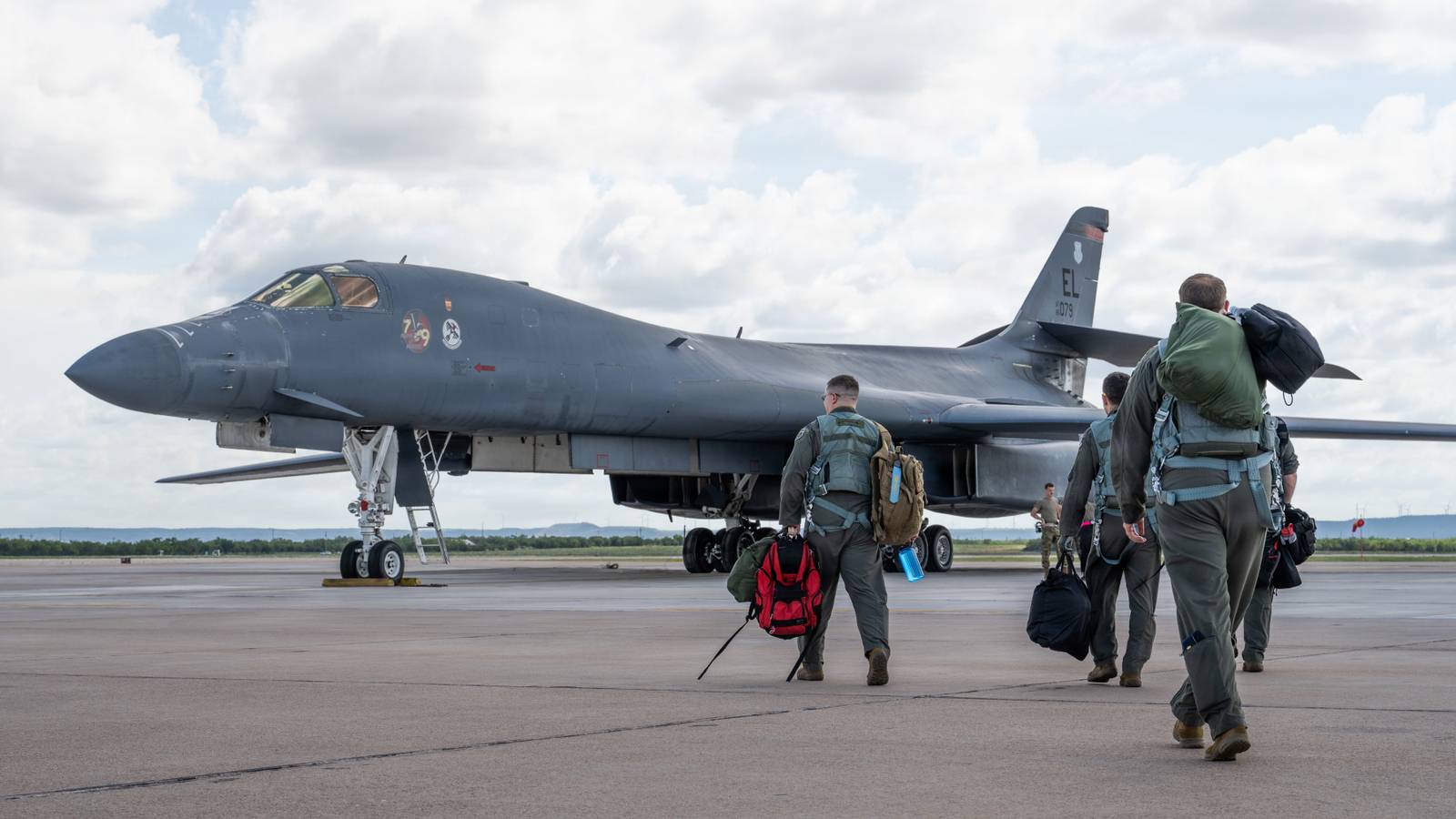
Published Sep 4, 2026, 4:00 AM EDT Aaron is an aviation enthusiast and world traveler with a deep interest in aerospace history and technology. He has traveled around the world numerous times, often incorporating visits to aviation museums and historic aircraft collections into his journeys. A native of New Zealand, he is an expert in aviation and maintains a broad interest in a variety of other subjects. Deception is as old as war itself and is a core part of modern doctrine. In Roman times, Spartacus tied weapons and armor to stakes, with fires lit around the camp to trick Roman sentries into thinking his entire army remained in place while he slipped away. The Allies built a whole fake army led by General Patton in WWII to deceive the Germans about where the D-Day landings would come. Today, deception and decoys are key components for protecting aircraft on the ground, as other defenses are not expected to be sufficient. Besides decoys, another area where the United States Air Force (USAF) is planning to keep its aircraft protected is in dispersal as part of its Agile Combat Employment (ACE) doctrine. As part of this, the US military is restoring various disused WWII airstrips in the East Pacific in Guam, the Northern Mariana Islands, Palau, the Federated States of Micronesia (the island state of Yap in particular), and even Australia. Decoys: An Evolutionary Arms Race Credit: Department of Defense Early in the 2022 Ukraine conflict, many of the decoys could be very crude mannequins dressed up like soldiers or relatively crude inflatable tank or aircraft decoys. Even aircraft painted on the ground, which was a tactic used by the US in Afghanistan before Russia famously did it in 2023. But conflict is an evolutionary arms race, and quickly the opponent 'gets wise' as cameras on drones improve, and what deceived the enemy one month will not work the next. Decoys are then forced to become more elaborate. These can finally be wooden mock-ups, complete with fake, highly elaborate rotating radars, elaborate trackways, electronic emitters, and even a reasonable amount of camouflage to make it appear as though the system is being hidden, while also being exposed just enough to be found. But these sorts of decoys would become increasingly difficult for aircraft to detect in a theoretical conflict between the US and China. Both sides would be expected to possess extensive ISR capabilities, combining satellites, signals intelligence, reconnaissance aircraft, and drones. Space-based systems could provide repeated surveillance of major airfields, including through synthetic aperture radar (SAR), which can operate at night and through clouds. This means that not only is it increasingly easy for adversaries to see targets, but they also have more tools (e.g., SAR, thermal imaging) to determine if they are decoys. Retired Airframes Can Be The Best Decoy Credit: Shutterstock It is unclear how useful inflatable decoys would be in the US context. These have been seen in Ukraine. Perhaps most famously, the prominent Czech company, Inflatech, manufactures high-end inflatable military decoys. The firm produces over 30 life-sized fake military assets—including tanks, armored vehicles, aircraft like the F-16, and HIMARS rocket launchers. But it's unclear how practical these have been, and China is not Russia, as it has much greater access to space-based surveillance and potentially longer-range sensing. That said, it is worth noting that these decoys can be elaborate and much more than just 'balloons.' They are designed to deceive enemy multispectral sensors using optical, radar, and infrared (thermal) signatures. Despite the large volume of publicly released satellite imagery of Russian, Iranian, Israeli, and US airbases during recent conflicts, there is relatively little publicly identifiable evidence of inflatable aircraft decoys being deployed at those bases. This includes released footage from one-way attack drones. Perhaps the most reliable decoy is the real thing. Ukraine has repeatedly released footage showing its attacks on Russian aircraft on the ground, only for analysts to identify these aircraft as retired old airframes now used as decoys. The Ukrainian attack on two retired Tu-142s in 2026 is one illustration. For the US, one issue is that most of that inventory is physically concentrated at the Davis-Monthan boneyard. It's unclear if the US has any plan to transport dead airframes to the Asia-Pacific in the event of a conflict to serve as decoys. Dispersal: The Agile Combat Employment Credit: Department of Defense As part of the USAF's Agile Combat Employment (ACE) doctrine, the US is exercising at a wide range of airports and airfields across numerous islands. The idea is that the aircraft would disperse from Guam's Andersen Air Force Base and operate from many airfields. These aircraft would be mobile and would not sit idle on the same patch of tarmac for hours. ACE is not just flying to different airfields; it's also being towed to other parts of the tarmac every few hours or so. Many of the airbases remain crude and would pose logistical challenges, but this is an issue the Air Force must work out. The most obvious backup to Andersen is the restoration of the airfields on Tinian just to the north in the Northern Mariana Islands. Parking space is being dramatically expanded at Andersen. One of the biggest problems is that airfields are just a known and fixed target — they are where to find aircraft. They are inherently vulnerable. This is why the US is working to reduce its reliance on forward airfields by deploying a range of autonomous VTOL aircraft to provide the 'last mile' of resupply, long-range munitions, and other measures that reduce reliance on forward bases. Why Fixed Defenses Are Insufficient Credit: The U.S. National Archives One criticism is that the US does not seem to be building reinforced hangars in Guam. But there is a reason for this. A hangar is fixed, easy to target, and can not realistically withstand a direct hit from a bunker-busting munition, although they do provide protection against fragmentation, perhaps airburst munitions, and small FPV-type munitions. During the Gulf War and Operation Epic Fury, the US systematically targeted the hardened hangars containing Iraqi and Iranian aircraft. The hangar can create a targeting dilemma, with the enemy not knowing which hangars have aircraft parked in them, but they also do the opposite by providing the precise targeting coordinates for where aircraft are likely to be. For a country like Iran, it is simply infeasible for it to build more hangars than the US has JDAMs and other munitions. Potentially useful airfields for US ACE operations in the Eastern Pacific (per US budget documents, etc.) Guam Andersen AFB, Northwest Field, Orote Airfield, Guam International Airport Northern Mariana Islands Tinian International Airport/North Field, Saipan International Airport, Rota International Airport Micronesia (Yap, eastern part) Yap International Airport, Ulithi Airport Palau Palau International Airport, Peleliu Airfield, Angaur Airstrip The USAF may feel that, no matter how many hangars it builds, China could systematically target each of them. Another option is to build deep aircraft storage sites in mountainous regions, as Switzerland, Taiwan, and Iran do. In the case of Iran, some estimates suggest that around two-thirds of its air force may have survived thanks to this. However, the entrances can be easily sealed, and while the aircraft may survive the conflict, they may be stuck and unable to participate. Not Just The United States Credit: PLAAF It's important to keep in mind that this is not just a US problem. Japan and Taiwan face similar problems and must develop solutions to protect their own aircraft. Many analysts assume Taiwan's fleet would not be able to survive a large-scale assault. That may be true, although it's worth noting that many analysts also thought Ukraine's fleet would not survive in 2022. While Ukraine's fleet is heavily attrited, it survives and is now rebuilding with new deliveries. Taiwan is geographically smaller, and China has vastly more capabilities than Russia, although Taiwan has been planning for this scenario for decades. After all, much of the Iranian air force appears to have survived intense US and Israeli campaigns, even if it was mostly grounded during the conflict. It's also worth noting that China faces its own problem-solving. China may benefit from massive strategic depth and the ability to disperse its aircraft easily, but it is also assumed to be on the offensive. This means those aircraft must be forward-deployed, something made worse by the country's lack of a large fleet of refueling aircraft. The US, Taiwan, and Japan may concentrate on area denial, but they are also extremely capable of hitting China's forward airbases. Unless some actors are overconfident, it is reasonable to assume all are intensively pursuing elaborate decoy, deception, and dispersion strategies. Range: The Other Defense Credit: US Air Force In addition to decoys, dispersal, and mobility to protect aircraft on the ground, one of the key areas to defend aircraft is range. All else being equal, the more forward the airfield is, the more vulnerable it becomes. The further away it is, the less vulnerable it is, with an adversary having to rely on a declining suite of more expensive, longer-range systems with greater flight times and higher risks of interception. In a future high-end conflict, it may be infeasible to fully defend a forward base from massed attack, but the calculus can flip if the base is far away. This is where bases like those in Australia (RAAF Darwin, Tindal, Amberley) become especially useful. Guam is likely too forward for bombers to be safely based, but the bases in Australia are much further away and more defensible. At the same time, they are much closer than mainland US or Hawaiian bases, enabling them to generate larger sortie rates. The push for range as a defense is seen in ongoing USAF, Navy, and Marine Corps programs. The upcoming USAF's F-47 is expected to have an enormous combat radius of 1,000+ nautical miles, while CCAs are to have a 700+ nautical mile range. New stealth tanks for the F-22 and F-35A also boost range. A core requirement for the Navy's F/A-XX is that it has significantly more range than the Super Hornet, while the Marines retired the last of their AV-8B Harrier IIs in 2026. Those Harriers were seen as having woefully insufficient range, while the F-35B offers a dramatic improvement.
Inflatable Decoys & Dispersal: How Air Forces Now Protect Parked Aircraft
Full Article
Original Source
Read the full article at Simpleflying →KhanList aggregates and links to publicly available news content. We do not host full articles from third-party sources. Always verify important information with original sources.