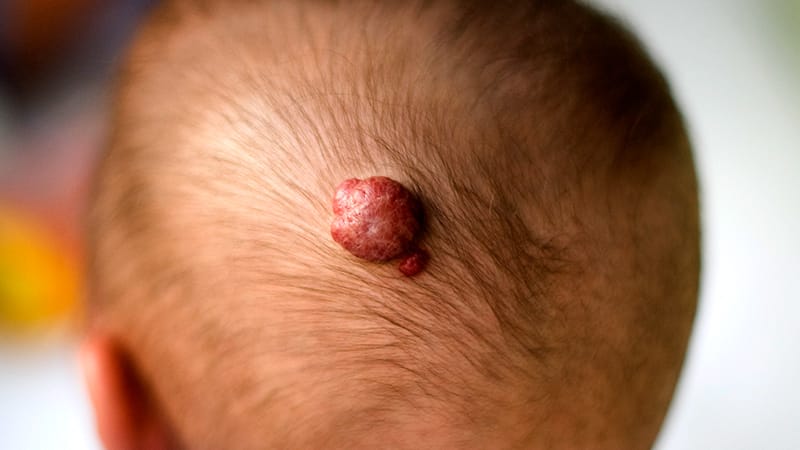
MINNEAPOLIS — Addressing challenges with common clinical dilemmas, an expert in infantile hemangiomas provided current guidance for PHACE testing, the best approaches to ulcerated hemangiomas, and the opportunity for benefit even with late treatment. Because of the small but measurable risk for PHACE, an acronym for underlying arterial abnormalities that accompany hemangiomas, a workup should be considered standard for any segmental lesion appearing on the face, according to Sarah L. Chamlin, MD, professor of dermatology and pediatrics at the Northwestern University Feinberg School of Medicine in Chicago.Although the risk for PHACE is substantially increased when more than one of the four face segments (frontotemporal, maxillary, mandibular, and frontonasal) is involved and is further increased with larger-sized lesions, Chamlin cited data from two studies that indicate risk is not zero even in the absence of these features.PHACE Must Be Considered for Facial InvolvementThe message is that clinicians should “perform a PHACE evaluation for segmental or large infantile hemangiomas involving any facial segment,” Chamlin said at the Society for Pediatric Dermatology (SPD) 2026 Annual Meeting.The acronym PHACE stands for posterior fossa malformations, hemangioma of the cervicofacial region, arterial anomalies, cardiac anomalies, eye anomalies, and sternal or abdominal clefting or ectopia cordis. The major components of a workup involve a careful physical examination, an echocardiogram, and MRI of the head and neck, but Chamlin said the approach is individualized by age and severity.Risk factors to consider include the number and location of facial segments involved, the size of the lesion, and its thickness, according to Chamlin.For example, she said she would consider recommending low-dose propranolol (1 mg/kg) in advance of a PHACE workup in a neonate with a segment 2 (maxillary) superficial segmental lesion, delaying MRI until the child is about 6 months of age. Although she prefers the risk-benefit ratio of this to a more aggressive approach, it involves shared decision-making. She would advise parents that the risk for stroke, although small, cannot be ruled out during this delay.Conversely, presented with a case of a 2-week-old infant with a segment 2 (maxillary) hemangioma threatening the eye, she said she would be inclined to move aggressively, admitting the patient and promptly ordering both an echocardiogram and MRI. In addition to the greater risk for PHACE associated with this presentation, she mentioned the risk for eyelid ptosis.When the presentation is later in infancy, such as 6 weeks of age or greater, she might move more slowly in the absence of lesions with high-risk PHACE features. Despite the propranolol-associated risks for bradycardia and hypotension and the inability to exclude risk for stroke, she cautiously considers this approach more often than she once did because of the advantages of delaying MRI past the neonatal period.“So far there have been no reported adverse neurologic events in PHACE patients treated with propranolol,” but the absence of reported events does not fully rule out the risk, she said. Yet, the challenge with PHACE is assessing and weighing acute risks against the potential for better long-term outcomes.Most Ulcerated Hemangiomas Need Combo TherapyAs a single recommendation for ulcerated hemangiomas, Chamlin again advocated for the principle of individualized care based on the size of the lesion, location, and depth. Even if most patients will eventually be on a combination therapy, she supported rationally adding therapies as needed.“Approach ulcerated hemangiomas with a stepwise rather than a kitchen-sink approach,” she said. She typically starts with a moderate dose of steroids before adding propranolol, which is promptly discontinued if the lesion gets worse. Wound care that includes mupirocin with occlusive dressings and metronidazole in the case of diaper-area involvement is also commonly needed to flatten the lesion and support healing.Antibiotics, such as cephalexin or topical gentamicin, are typically indicated for infection prophylaxis along with periodic cultures of lesions.In addition, “do not forget about pain control, which is too often an afterthought,” Chamlin said. Cautioning that live vaccines should not be given when caring for ulcerated hemangiomas, Chamlin said that there are many additional steps to consider when lesions need additional care. Of laser therapies, the Nd:YAG laser is the best studied, but she warned that this intervention can be quite painful.In rare cases, excision of the hemangioma might be appropriate, and Chamlin noted that there have been case reports of a good response to oral sirolimus for severe ulceration, although she has no personal experience with this treatment.Late Hemangioma Treatment Still Has BenefitFor infantile hemangiomas, early treatment is the goal, but Chamlin reported benefit from treatment offered to the “horse-is-out-of-the-barn” lesions that she sometimes encounters. One example is hemangiomas on the scalp that threaten hair growth. In a specific case she cited, 1.5 mg/kg of propranolol substantially shrank a lesion that was already well established.“I have treated children at 6 months or even later and still get very good hair growth” at the site of the hemangioma, said Chamlin, who said that she considers higher doses of propranolol when needed to improve response. She advised taking photos to document the response over time.As an overall principle, “the earlier the better” is a motto in neonatal hemangioma, according to Chamlin, who advised timely intensification of therapy, such as switching from timolol to propranolol, when lesions do not adequately respond.Although most hemangiomas are benign, clinicians share parental anxiety, particularly due to the risk for complications such as PHACE, according to Luke Johnson, MD, assistant professor of dermatology at the University of Utah School of Medicine, Salt Lake City.At the meeting, Johnson called Chamlin’s case-based overview “very helpful” for his own practice. For difficult clinical scenarios, he explained that clinical pearls can provide meaningful out-of-the-textbook guidance for optimizing outcomes. Chamlin and Johnson reported having no potential conflicts of interest.Ted Bosworth, a career medical writer based in New York City, has been covering advances in clinical medicine, including dermatology and oncology, for several decades.
Infantile Hemangiomas: When Is a PHACE Workup Warranted?
Full Article
Original Source
Read the full article at Medscape →KhanList aggregates and links to publicly available news content. We do not host full articles from third-party sources. Always verify important information with original sources.