
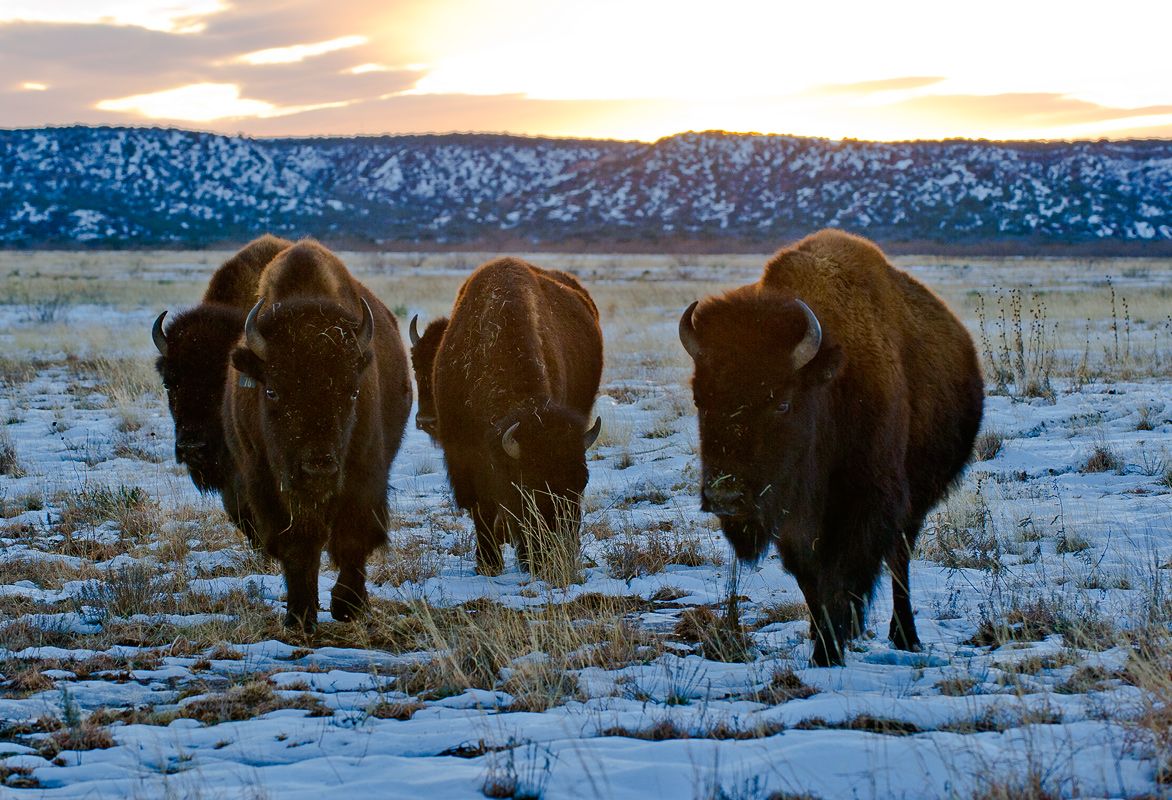
Two science teachers were hiking when they stumbled on hundreds of ancient buffalo bones in Caprock Canyons State Park, which is today home to the Texas State Bison Herd November 25, 2026 8:10 a.m. Today, Caprock Canyons State Park is home to the Texas State Bison Herd, which officials say is made up of the descendants of the tens of millions of Southern Plains bison that used to roam the land. Texas Parks and Wildlife Department For thousands of years, Indigenous communities in what is now Texas hunted bison by herding them toward the edge of a high cliff, sending the large animals plunging to their deaths below. That’s the conclusion archaeologists have reached after discovering bison bones, chipped stone tools and arrowheads beneath a 65-foot-tall cliff. Some of the bones bear cut marks suggesting prehistoric butchery, while many others have compression fractures indicating they fell from a great height. Together, the evidence pointed to the discovery of a “bison jump,” researchers report in a paper published earlier this month in the journal American Antiquity. Archaeologists have found numerous bison jumps across the northern Great Plains, a vast region that stretches from Nebraska to Alberta. But, until now, only one such site had been found in the southern Great Plains, which includes Texas. The newly discovered bison jump, called Nighthawk, suggests the Indigenous practice of herding bison off cliffs may have been more widespread than previously thought. “The fact that we found this site is pretty incredible,” Tamra Walter, an archaeologist at Texas Tech University, told Texas Parks & Wildlife Magazine’s Eva Frederick in 2023. “It’s a once-in-a-lifetime kind of site. It’s so incredibly rare.” Nighthawk is located in Caprock Canyons State Park, a roughly 17,500-acre protected area in Briscoe County, situated between Amarillo and Lubbock in the Texas Panhandle. Today, the park is home to the Texas State Bison Herd, which officials say is made up of the descendants of the tens of millions of Southern Plains bison that used to roam the land. In November 2021, Rick and Susan Day—science teachers at nearby Lockney Junior High School—were out hiking in the park when they spotted hundreds of bones jutting out from a cliff side, Texas Parks & Wildlife Magazine reported. The bones were discovered by hikers in 2021. Rice University Archaeologists spent months excavating the site, ultimately determining that it was the first bison jump discovered in Texas in more than six decades. The only other known bison jump in the state is called Bonfire Shelter. It’s located in Val Verde County, close to the Mexico border, and was discovered in the 1960s. Radiocarbon dating revealed that at least seven mass bison kills took place at Nighthawk over a roughly 3,000-year period, as far back as 3,500 years ago. The kill events took place every 500 years, on average. “The simplest explanation for long-lived jump facilities is that these techniques were passed down over long time spans rather than revived again and again,” the researchers write in the paper. At other bison jump sites, researchers think Indigenous hunters likely herded bison into a stampede toward a surprise fall off the edge of a cliff. Nighthawk, however, probably operated “more like ‘walking the plank,’” the researchers write in the paper, with Indigenous hunters taking advantage of the cliff’s natural spur shape to guide the massive animals to their deaths. Scientists aren’t sure what Indigenous hunters did with all the bison meat they obtained from these mass kill events. In the northern Plains, bison jumps are thought to have been used primarily in the fall, to help Indigenous communities stock up on pemmican, a long-lasting concoction made of dried meat and rendered fat, for the impending winter. But Texas was probably too warm for pemmican, as the high temperatures would have caused the fat to melt and, eventually, go rancid. Did you know? Pemmican Dense in protein and calories, pemmican was also eaten by fur traders in the North American wilderness, as well as Antarctic explorers, who combined it with sledging biscuits and water to make a concoction known as “hoosh.” This leads the archaeologists to posit that, in the south, bison jumps may have been less about food and more about “social or political ambitions,” as they write in the paper. The mass kill events may have brought communities together for ceremonies, trade, celebrations and other events that helped strengthen relationships. Whatever the explanation, bison jumping was a large-scale operation that required extensive planning and cooperation among multiple groups of people. “It’s a community activity,” lead author August “Gus” Costa, an anthropologist at Rice University, says in a statement. “They require a large group of people working together to be successful.” The Nighthawk jump site, with arrows indicating bison bone deposits Costa et al. / American Antiquity Moving forward, researchers hope to compare ancient DNA from the bison remains found at Nighthawk to the herd that is roaming around the park today. “The unique lineage of the Southern Plains bison that live in the park, how far back can we chase that?” Costa tells KFDA’s Canion Cavazos. You Might Also Like Get the latest stories in your inbox every weekday. More about: American History Animals Archaeology Bones Ecology Food Food History History Indigenous Peoples Native American History Texas Wildlife
Indigenous Hunters Drove Bison Off This Tall Cliff for 3,000 Years. It's Only the Second Buffalo Jump Ever Discovered in Texas
Full Article
Original Source
Read the full article at Smithsonianmag →KhanList aggregates and links to publicly available news content. We do not host full articles from third-party sources. Always verify important information with original sources.