
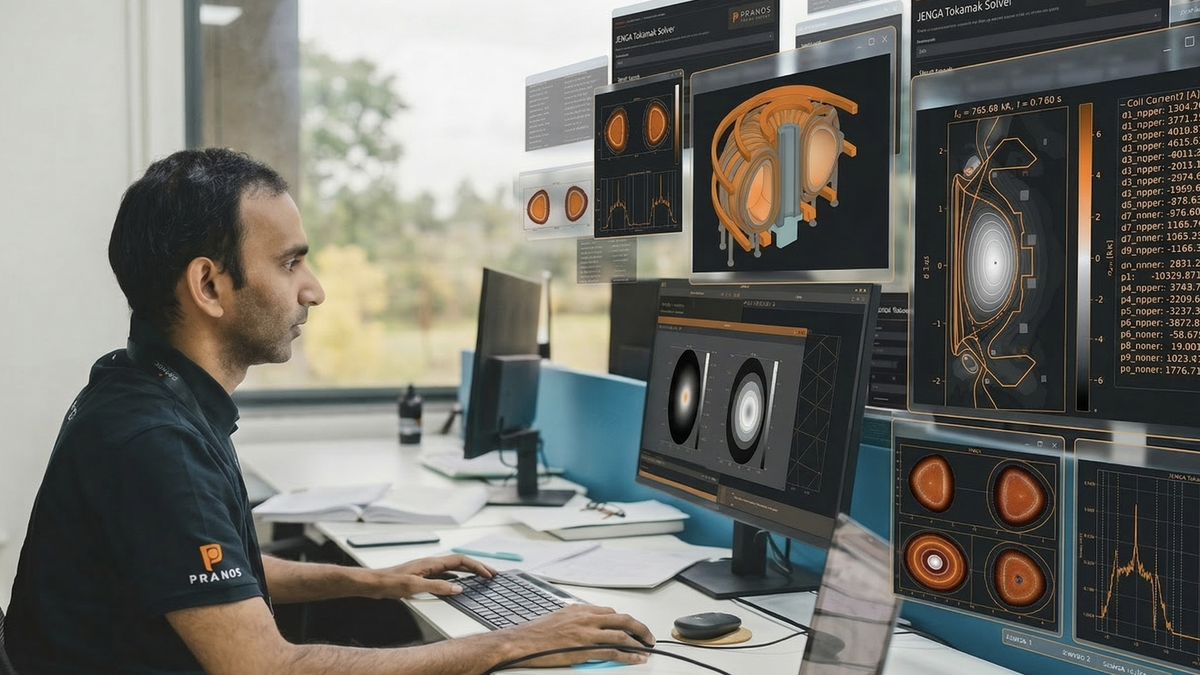
If all goes to plan, India may see designs for the first privately built tokamak, a nuclear reactor that uses fusion to produce energy, firmed up in 2027.Bengaluru-based startup Pranos Fusion has built PRAGYA, a small doughnut shaped tokamak, to test plasma control and superconducting magnets. This is a gateway to building PRANIK, a much larger tokomak that will have plasma heated up to millions of degrees — more than the interior of the Sun — necessary to fuse hydrogen atoms and create energy.“By 2027, we expect to finalise the blueprint for PRANIK and be on our way to building a practical reactor that can produce energy. To be able to actually produce electricity from fusion is a further step away,” Shaurya Kaushal, co-founder and CEO of Pranos Fusion, said.The company is currently incubated out of the Institute of Plasma Research, a body affiliated to the Department of Atomic Energy and the Jawaharlal Nehru Centre for Advanced Scientific Research (JNCASR), Bengaluru, an institute with the Department of Science and Technology.Nuclear plants everywhere employ fission — a chain reaction involving uranium nuclei to produce heat that is used to generate electricity. Fusion, on the other hand, releases energy when light atomic nuclei merge, and usually involves joining two forms of hydrogen — deuterium and tritium — into helium and a fast neutron. However, this requires the fuel to be heated to around 100 million degrees Celsius, far hotter than any solid wall could withstand. In tokamaks, powerful magnets hold this superheated plasma away from the walls, keeping it hot enough for fusion to continue. Pranos Fusion was one of the deeptech startups showcased at the Emerging Science Technology and Innovation Conclave held here last week.“Electricity from a fusion reactor is still far away and would be expensive now, however the need for any source of energy is only going to grow,” Roshan George, co-founder and a Computer Science engineer from the Manipal Institute of Technology. “Fusion’s advantage is that while [it’s] nuclear power, it doesn’t need radioactive material like uranium. India already produces plenty of deuterium. Fusion reactions are also not chain reactions, and therefore the risk of a runaway reaction [like in a fission reactor] is almost absent,” Mr. George said.The largest tokamak under construction is the International Thermonuclear Experimental Reactor in southern France, a collaboration between China, the European Union, India, Japan, Russia, South Korea, and the U.S. It is designed to produce about 10 times the heating power fed into its plasma. Bogged by delays, a 2024 revision moved the start of research operations to 2034 and full deuterium-tritium operation to 2039, adding about €5 billion to the cost. IPR manages India’s home-grown tokamak reactors, including ADITYA and the Steady State Tokamak (SST-1). It is also the nodal domestic agency to manage India’s contributions to International Thermonuclear Experimental Reactor.The cost of a private tokamak depends on scale, Mr. Kaushal, who holds a Ph.D. from JNCASR, and a mechanical engineering degree from BITS Pilani, said. A compact research machine like PRAGYA is “a comparatively modest investment”, while one designed to reach net energy gain is far larger. Private fusion companies worldwide have raised over $13 billion, he said, and the leading net-gain programmes have each raised hundreds of millions of dollars or more.Pranos Fusion says compact machines, HTS (high-temperature superconducting) magnets, and India’s manufacturing base can bring costs down substantially. It is backed by Ankur Capital, pi Ventures and Industrial47, and has raised $7.2 million. HTS electromagnets are wound from materials that carry electric current with no resistance when cooled below a critical temperature.Britain’s JET tokamak produced a record 69 megajoules of fusion energy in 2023, though less than the heating power supplied. In December 2022, the U.S. National Ignition Facility, which uses lasers rather than magnets, achieved ignition, releasing more fusion energy than the laser light delivered to the fuel. This, however, does not count the electricity needed to run the lasers. Magnets made from high-temperature superconductors (HTS) have reached fields of around 20 tesla in tests, making smaller, stronger-field machines feasible.In an email, Mr. Kaushal said the company is structured in a way its technology generates value before a power plant exists. It has two platforms — JENGA, simulation, design and control software that works as a digital twin of the machine, and MAGGA, its HTS magnet programme.
India’s first fusion power company takes key steps
Full Article
Original Source
Read the full article at Thehindu →KhanList aggregates and links to publicly available news content. We do not host full articles from third-party sources. Always verify important information with original sources.