
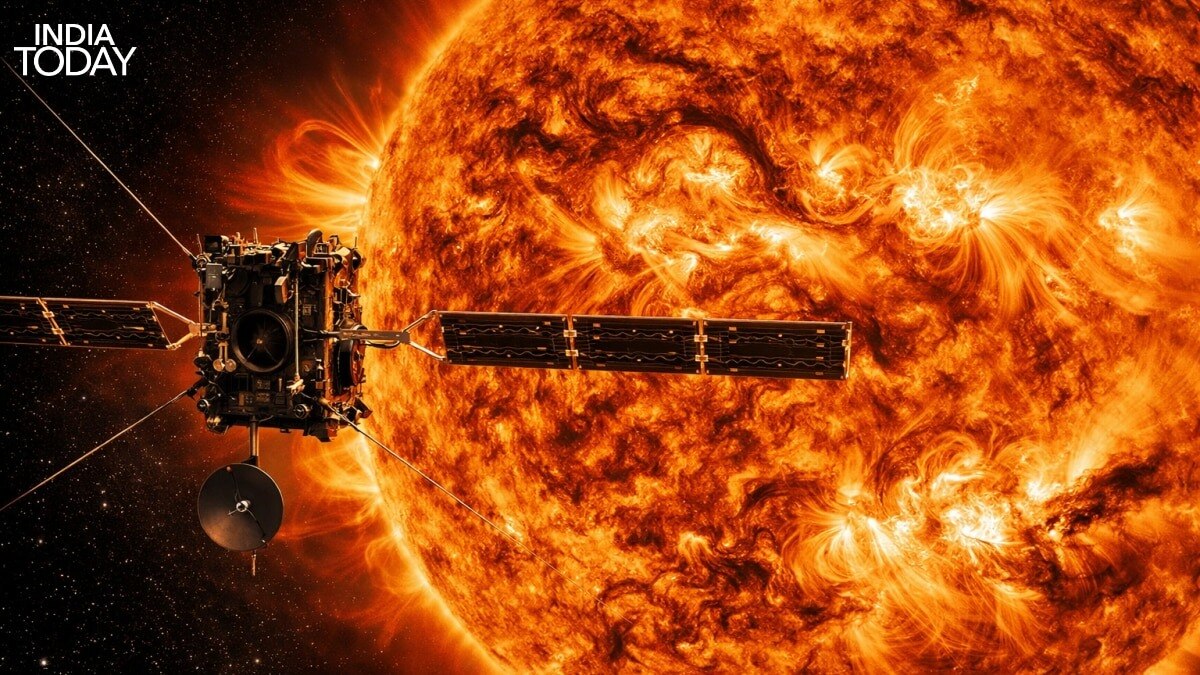
Aditya-L1 observed a 5 August 2024 solar eruption expanding unevenly and with a tilt. The finding challenges uniform bubble models and could strengthen space-weather forecasting.The Aditya-L1 spacecraft travels through space to monitor the Sun's activity and protect Earth. (Photo: India Today)New Delhi,Nov 4, 2026 11:19 ISTIndia's first space-based solar observatory, Aditya-L1, has offered new insights into how massive solar eruptions expand as they leave the Sun, revealing that they may not behave like symmetrical bubbles as previously believed.Scientists at the Indian Institute of Astrophysics (IIA), Bengaluru, an autonomous institute under the Department of Science and Technology, have found that a solar eruption observed on August 5, 2024, expanded unevenly and developed an asymmetric shape.The findings, published in The Astrophysical Journal Letters, were based on observations from the Visible Emission Line Coronagraph (VELC) onboard Aditya-L1, images captured by NASA's Solar Dynamics Observatory (SDO), and three-dimensional modelling. The discovery could improve scientists' understanding of coronal mass ejections (CMEs), powerful eruptions of hot, magnetised plasma from the Sun's outer atmosphere, or corona. When directed towards Earth, these eruptions can trigger geomagnetic disturbances, potentially affecting satellites, communication networks and other space-based infrastructure.A CLOSER LOOK AT SOLAR ERUPTIONSPredicting when a CME will reach Earth and how strongly it will affect our planet depends on understanding its speed, direction and evolution near the Sun. However, studying these eruptions in their early stages has remained challenging. Conventional coronagraphs capture the movement of CMEs across the sky but cannot directly measure how fast the plasma moves towards or away from an observer.This is where Aditya-L1's VELC instrument provides a crucial advantage.Using a technique called Doppler spectroscopy, VELC measures shifts in the wavelength of light emitted by moving plasma. Material moving towards the observer produces a blue shift, while material moving away produces a red shift.During the August 5, 2024, eruption, VELC detected two distinct Doppler-shifted emission features simultaneously, appearing on opposite sides of the regular coronal emission line. These revealed plasma moving both towards and away from the observer as the CME travelled through the corona.WHY THE DISCOVERY MATTERSTo explain these unusual observations, researchers developed a three-dimensional model of the expanding CME.They found that a symmetrical expansion could not reproduce the spectral patterns recorded by VELC. However, introducing uneven lateral expansion and a tilt produced a much closer match with the observations.The findings challenge the conventional assumption that CMEs expand uniformly like bubbles.An asymmetric shape could influence how an eruption interacts with the solar wind as it travels through space. Different levels of drag could alter its speed, making predictions of its arrival time at Earth more challenging.The study also demonstrates how Aditya-L1 can help scientists reconstruct the three-dimensional evolution of solar eruptions by combining spectroscopy with imaging observations.Further observations from VELC could help improve CME tracking and strengthen space-weather forecasting, offering better insights into the solar eruptions that can threaten modern technological infrastructure.- Ends
India's Aditya-L1 discovers a solar secret that challenges old assumptions
Full Article
Original Source
Read the full article at Indiatoday →KhanList aggregates and links to publicly available news content. We do not host full articles from third-party sources. Always verify important information with original sources.