
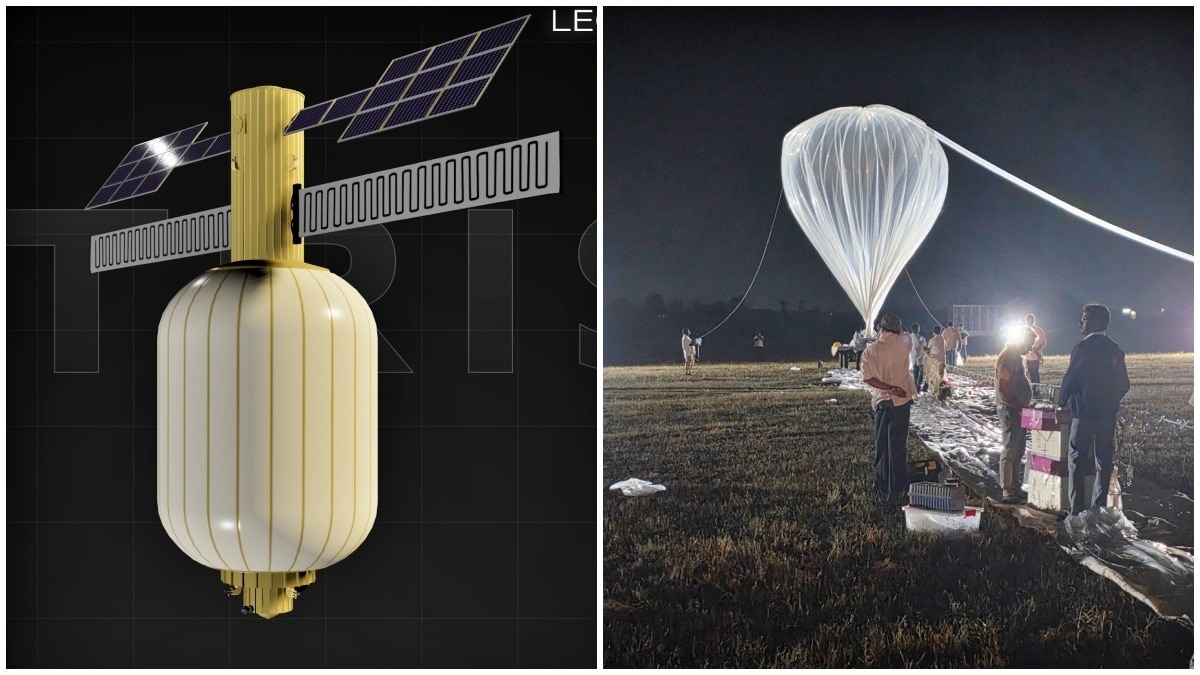
What if future space stations and factories could be packed into small volumes before expanding in orbit? An Indian experiment is exploring that possibility.Startup team is seen working on the inflatable structure. (Photo: Akashalabdhi Space)New Delhi,Nov 4, 2026 11:57 ISTAn Indian space startup has successfully tested an experimental inflatable structure at an altitude of approximately 30 km, marking an important step towards developing expandable space habitats and factories that could one day operate in orbit.Bengaluru-based Akashalabdhi Space flew a 250-litre rigidisable inflatable structure aboard a high-altitude balloon in a 25-kg experimental mission conducted through the Tata Institute of Fundamental Research's (TIFR) National Balloon Facility in Hyderabad in the early hours of Tuesday, November 3.The experiment is part of the company's ANTARIKSHAB programme, which aims to develop technologies for future orbital manufacturing facilities, commercial space stations, microgravity laboratories and expandable habitation modules. The equipment aboard the inflatable structure is seen. (Photo: Akashalabdhi Space) Unlike conventional spacecraft structures, rigidisable inflatable systems can be packed into a relatively small volume during launch and expanded after deployment. They are designed to retain their deployed shape through a rigidization process, potentially allowing much larger working spaces without requiring equally large launch vehicles. The flight tested the structure's deployment and inflation behaviour, intended rigidization, autonomous control systems, avionics, electrical power systems and telemetry. It also provided an opportunity to evaluate flight dynamics and parachute-assisted recovery technologies.MOON AND MARS CONSTRUCTION EXPERIMENT ONBOARDThe mission also carried two research payloads, including an experiment developed by the Indian Institute of Science (IISc), Bengaluru. Called the Microbial Regolith Experiment (MRX), it investigates whether microbial processes can help consolidate regolith, the loose soil and rocky material covering the surfaces of the Moon and Mars, into construction materials.The research could eventually help future lunar and planetary missions produce building materials using locally available resources rather than transporting everything from Earth. The inflatable structure is seen in the background as technicians work on its components. (Photo: Akashalabdhi Space) The experiment, developed by Professor Aloke Kumar's laboratory at IISc, was exposed to near-space conditions during the balloon flight. Scientists will assess the results after recovery. The mission did not simulate sustained microgravity.The second payload was an experimental perovskite solar-cell device developed by Switzerland-based Perovskia Solar. It was designed to assess how the photovoltaic technology responds to low atmospheric pressure, extremely low temperatures and changing solar illumination.WHY THE 30-KM-HIGH FLIGHT MATTERSAt approximately 30 km, the atmospheric pressure is just 1-2 per cent of that at sea level, while temperatures can fall to around minus 45 to minus 50 degrees Celsius.These conditions offer an intermediate testing environment for technologies intended for space, allowing engineers to study material behaviour, electronics, power systems and deployment mechanisms.However, a high-altitude balloon flight does not replicate orbital vacuum, sustained microgravity or the radiation environment of space.Akashalabdhi plans to use the flight data to refine its expandable structures and associated spacecraft technologies before progressing towards orbital demonstrations.The larger ambition is to make space infrastructure more accessible by developing structures that can be transported compactly and expanded once deployed in orbit.- Ends
In a first, Bengaluru company tests inflatable habitat for future space missions
Full Article
Original Source
Read the full article at Indiatoday →KhanList aggregates and links to publicly available news content. We do not host full articles from third-party sources. Always verify important information with original sources.