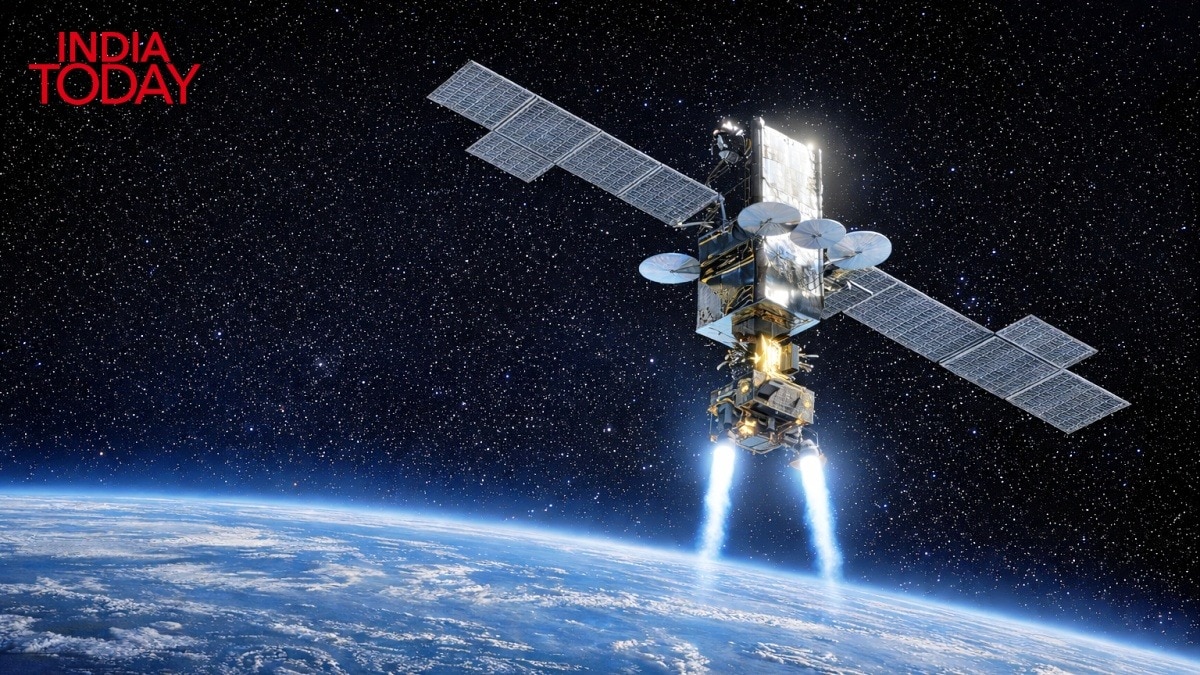
Aule Space has tested its relative guidance, navigation and control technology at Isro's Rendezvous Simulation Laboratory, reaching TRL-6. The milestone strengthens India's private push into orbital servicing for failed satellites and debris management.The startup, which recently raised $2 million in fresh funding, is building its entire docking technology stack in-house. (Photo: Generative AI by India Today)In a development that could mark a shift in how India approaches the growing problem of space debris and satellite failures, Bengaluru-based deep-tech startup Aule Space has successfully tested its relative guidance, navigation and control (GNC) technology at ISRO’s Rendezvous Simulation Laboratory (RSL), achieving Technology Readiness Level 6 (TRL-6).Aule Space says it is the first private company to access and test its technology at the facility, where its autonomous navigation system was evaluated in simulated space environments.The technology addresses one of the most difficult challenges in the emerging orbital economy: rendezvous, proximity operations and docking (RPOD).We have successfully tested our relative guidance, navigation, and control (GNC) stack at ISRO’s Rendezvous Simulation Laboratory (RSL), achieving TRL 6. We are the first private company to access and test at this facility. pic.twitter.com/kgkzUf4gMa— Aule Space (@AuleSpace) August 8, 2026WHAT IS TOW TRUCK FOR SPACE?Hundreds of active satellites currently operate in Low Earth Orbit, travelling at speeds of nearly 28,000 kmph. Many are worth hundreds of millions of dollars and provide critical services ranging from communications and navigation to agriculture, defence and Earth observation.But satellites can become unusable because of something as simple as depleted propellant, a failed thruster or a mechanical malfunction. Once a spacecraft becomes non-responsive, servicing it is extremely difficult—particularly if it was never designed to be refuelled or docked with another spacecraft. Aule Space, founded by Jay Panchal, Nithyaa Giri and Hrishit Tambi, is attempting to solve this problem by developing autonomous spacecraft that could effectively function as “tow trucks” for satellites.The company's servicing spacecraft are designed to approach and interact with non-cooperative targets, including satellites that may be tumbling or unable to communicate.Using computer vision and autonomous navigation, the spacecraft would have to determine the target's position, velocity and rotation before safely approaching it.The challenge is comparable to trying to dock with a car travelling at nearly 28,000 kmph, while operating in darkness and without conventional GPS, and with the target potentially spinning uncontrollably.Once attached, a servicing spacecraft could potentially provide propulsion to a satellite, help maintain its orbit or move a failed spacecraft away from operational orbital lanes.BIG PLANS AHEADAule Space has raised $2 million in pre-seed funding to support hardware development and eventual orbital validation of its technology.The successful TRL-6 demonstration is an important step towards that goal.If such systems eventually reach orbit, they could help extend the operational life of expensive satellites, reduce the creation of new debris and enable a future in which spacecraft are not simply abandoned after they fail.For India, the technology also signals an expansion of the country's private space ambitions, from building and launching spacecraft to servicing and maintaining them once they reach orbit.- EndsPublished By: Sibu Kumar TripathiPublished On: Aug 10, 2026 10:32 IST
Indian startup tests space tow truck to save dying satellites: What is it?
Full Article
Original Source
Read the full article at Indiatoday →KhanList aggregates and links to publicly available news content. We do not host full articles from third-party sources. Always verify important information with original sources.