
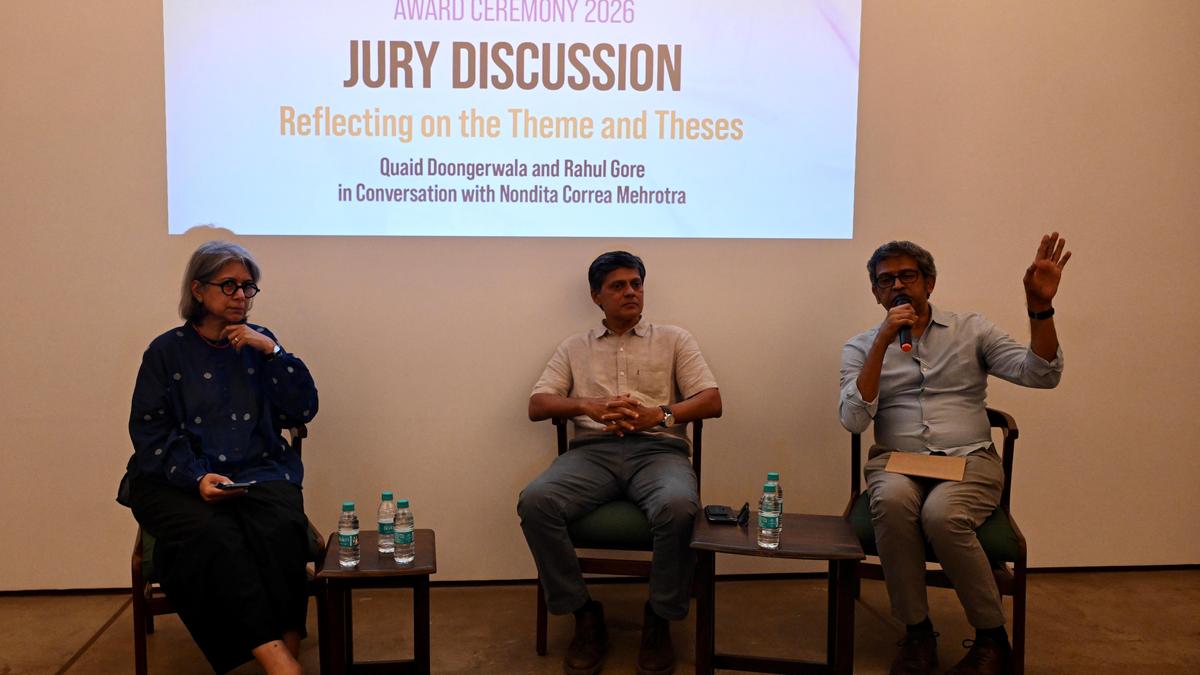
Nondita Correa Mehtrotra in conversation with Quaid Doongereala and Rahul Gore as part of the Jury Discussion during the Charles Correa Gold Medal Award Ceremony in Mumbai. | Photo Credit: Emmanual Yogini A Kochi-based student of architecture won the 28th Charles Correa Gold Medal in architecture in Mumbai on Thursday (October 22, 2026). His project, ‘Energy Commons: Reimagining energy infrastructure as a place for civic engagement,’ reimagined essential energy infrastructure as a civic resource, transforming a conventionally restricted space into a place of shared public life. Radhakrishnan M.S. is a student of Seed APJ Abdul School of Environmental Design in Kochi.The Charles Correa Gold Medal, initiated in 1998, recognises outstanding undergraduate architectural thesis projects that engage meaningfully with the challenges of the built environment. The award ceremony was held at Tarq Gallery in Mumbai ON Thursday (October 22) evening.“Through this year’s theme of ‘Equitability through Design’, young architects explored questions of access to space, shelter, infrastructure, and the commons. We hope that this theme becomes a touchstone for the students to return to throughout their career and professional lives,” Nandita Correa Mehrotra, Director of the Charles Correa Foundation, said.Book release‘The State of Architecture — Practices and Processes in India, A Research Framework’, a book on inquiry into the practice of architecture in the Indian subcontinent, was also released at the event. It led to conversations around architectural pedagogy, public engagement, and complex issues affecting architecture. The book also looks into how large-scale economic, social, cultural, political and ecological changes impact architecture. It has been published by Architecture Foundation India.Speaking about the theme of the book, co-author Ranjit Hoskote said that for architecture to be relevant, it has to correspond to the greatest good of the greatest number. “Equity and solidarity have been key themes for us in the book. There is no way to think about architecture without foregrounding these key questions of power, participation and possibility,” he said.The State of Architecture process has looked into the issues of caste, gender, environment, and equity. It also looks at how architecture meets the urgencies of the changing times, changing the ground rules. Speaking about the changing nature of architecture, co-author Rahul Mehrotra said that liberalisation was a clear marker for architecture in India. He gave insights into how coalition politics and the strengthening of regional parties led to greater pluralism and diversity in architecture.The event began with a panel discussion on the book, the thought process behind it, and its impact. It was moderated by cultural theorist Nancy Adajania. Rahul Mehrotra, Ranjit Hoskote, and Kaiwan Mehta provided a historical perspective on architecture, discussing the impact of architectural exhibitions on public engagement. This was followed by the Charles Correa Gold Medal award ceremony, where the winners presented their theses. Manu Viswam E from Trivandrum’s College of Architecture received an honourable mention for his project “Urban Scar to Social Commons.” It explored how urban fabric can be stitched together to create a more inclusive city. It grounded equality in the reclamation of a disused industrial landscape as shared civic ground. Published - October 23, 2026 04:30 am IST
‘Indian architecture has critical markers for all generations’
Full Article
Original Source
Read the full article at Thehindu →KhanList aggregates and links to publicly available news content. We do not host full articles from third-party sources. Always verify important information with original sources.