
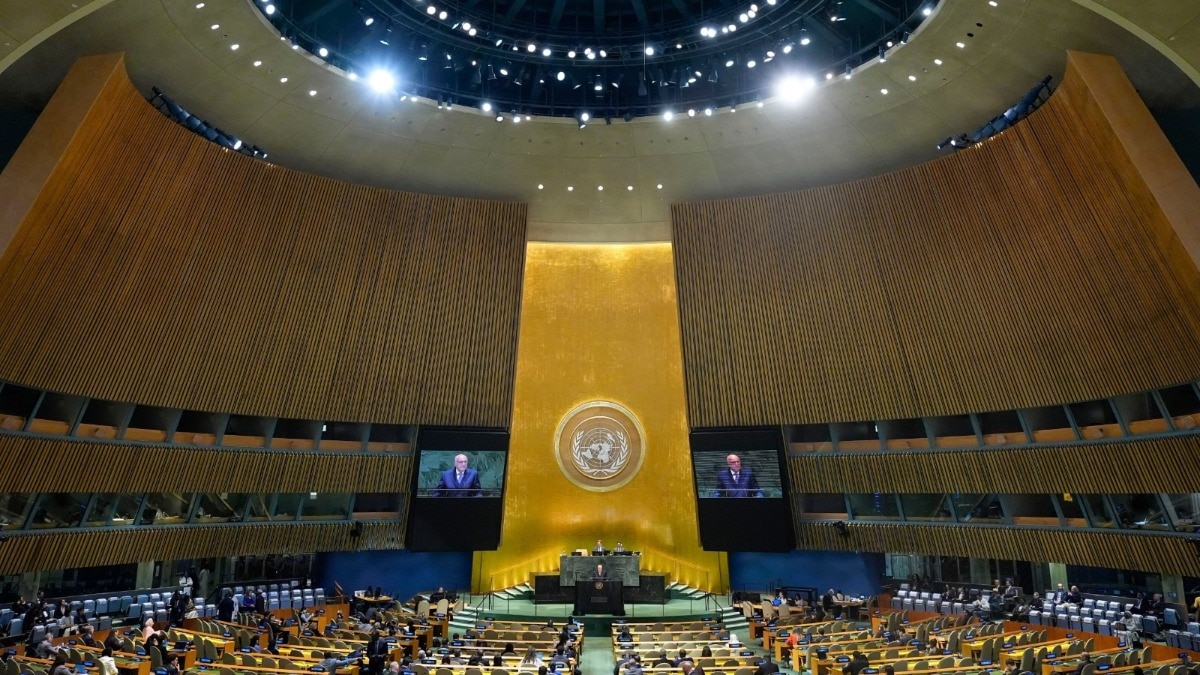
India voted against the draft resolution, which was adopted by the UN General Assembly on Monday with 112 votes in favour, six against and 39 abstentions. Armenia, Cyprus, Greece, Israel and the US also voted against it. Iraq introduced the resolution, while Turkey served as its facilitator.India Slams Turkey At UN For 'Deliberately' Excluding It From OIC Resolution Talks. (File photo: AP)United Nations,Nov 17, 2026 13:07 ISTIndia has strongly objected to Turkey’s “blatant and intentional” decision to exclude New Delhi and several other UN member states from consultations on a resolution concerning cooperation between the UN and the Organisation of Islamic Cooperation (OIC), news agency Press Trust of India reported.India voted against the draft resolution, which was adopted by the UN General Assembly on Monday with 112 votes in favour, six against and 39 abstentions. Armenia, Cyprus, Greece, Israel and the US also voted against it. Iraq introduced the resolution, while Turkey served as its facilitator.India’s Deputy Permanent Representative to the UN, Ambassador Yojna Patel, said the OIC’s Permanent Observer Mission had excluded the Indian delegation and several other countries while circulating successive drafts of the resolution, according to PTI.Explaining India’s vote, Patel criticised the working methods adopted by the facilitator and called for an investigation into the process. “My delegation has voted against this resolution not only because of its substantive aspects, but also for an even more concerning matter regarding the working methods adopted by the facilitator who convened negotiations on the same thing,” she said.Expressing “deep dismay” over the lack of inclusive negotiations, Patel said the OIC’s Permanent Observer Mission “chose to exclude not only my delegation but a number of other countries when circulating successive drafts of the resolution." “This is not only shocking but also sets a bad precedent of delegations excluding specific member states to enable their agendas,” she said.Patel said that even after some delegations raised objections in later rounds, the facilitators did not include certain countries. She added that basic procedures, including acknowledging inputs, were “blatantly disregarded, indicating that it was done by design rather than by mistake."She said it was “unfortunate that there are member states who publicly profess commitment to multilateralism and completely turn a blind eye to its core guiding principles."Patel said the UN was founded on sovereign equality, inclusivity and multilateral cooperation. Differences among member states were part of multilateral diplomacy and “cannot, in themselves, justify blatant and intentional exclusion from the consultations on matters before the General Assembly”, she added.“My delegation strongly objects to such working methods that try to hoodwink excluded delegations into believing that this was just a technical update, which it was not,” Patel said. India called on the UN General Assembly president “to investigate this and prevent its recurrence."India also questioned the substance of the resolution, which sought to expand the OIC’s role in finding solutions to other conflicts. “The rationale for seeking to extend the role of the OIC in this manner is unclear. The OIC is not a regional organisation,” Patel said.New Delhi also expressed concern over the resolution’s reference to the ninth session of the OIC Ministerial Conference on Women, held in Islamabad in July. The declaration adopted at the conference referred to Jammu and Kashmir. Patel said India rejected both the declaration and the accompanying resolution adopted at the conference.“The resolution contains reference to documents and statements that have unwarranted and factually incorrect references to my country. Such documents, unfortunately, reflect the continued misuse of the OIC platform for narrow political ends. The OIC has no locus standi to comment on India’s internal affairs,” Patel said.In an apparent reference to Pakistan, India said it regretted that the OIC had “once again allowed itself to be systematically misused by one Member State to weaponise OIC resolutions and declarations against India through false and baseless allegations”. Pakistan is a founding and prominent member of the 57-member OIC.“India calls upon the OIC to uphold the principles of objectivity, constructive dialogue, and mutual respect, and to ensure that its outcomes do not become a vehicle for the pursuit of narrow political agendas,” Patel said.She added: “India believes that sovereign member states take care of the interests of their citizens, regardless of their faith. We do not recognise that only co-religionists can protect the interests of adherents of their faith. Such regressive views have no place in today’s world, and especially at this forum.”Cyprus also expressed deep regret over the “lack of transparency and inclusivity by Turkey as the facilitator of this resolution throughout the negotiation process." Its delegate said Cyprus had repeatedly been excluded from communications and negotiations despite requests to be included.“Despite our best efforts and requests, inclusion of all UN Member States in this negotiation process is not a matter of political discretion of the facilitator, but a principle enshrined in the UN Charter,” the Cyprus delegate said.Greece raised “serious concerns” over the conduct of negotiations under Turkey’s facilitation. Its delegate said the European Union had submitted comments and amendments in good faith, but these were neither meaningfully addressed nor accompanied by substantial explanations for their rejection. Revised drafts were also circulated without adequate consultation, the delegate said.Greece also objected to its exclusion, along with some other delegations, from the circulation of draft texts. “Such practices fall short of the transparency, inclusivity and good faith expected in General Assembly negotiations. We strongly believe they are not representative of our member states,” its delegate said.The US said it hoped future versions of the OIC resolution would “eliminate excessive and redundant language and contentious issues and instead focus on direct and concrete areas of cooperation that can achieve consensus”.Ireland, speaking on behalf of the European Union, said the bloc and its member states regretted the “lack of transparency and inclusivity throughout the negotiation process”, despite requests to be included in the consultations. “The EU and several of its member states were excluded from relevant communications and were consequently not afforded a meaningful opportunity to participate in the negotiations,” it said.The resolution was ultimately adopted by the General Assembly, but India and several other countries opposed it over both its content and the way the consultations were conducted. India also asked the General Assembly president to investigate the exclusions and prevent a recurrence.- Ends
India hits out at Turkey for 'blatant and intentional' exclusion from UN talks
Full Article
Original Source
Read the full article at Indiatoday →KhanList aggregates and links to publicly available news content. We do not host full articles from third-party sources. Always verify important information with original sources.