
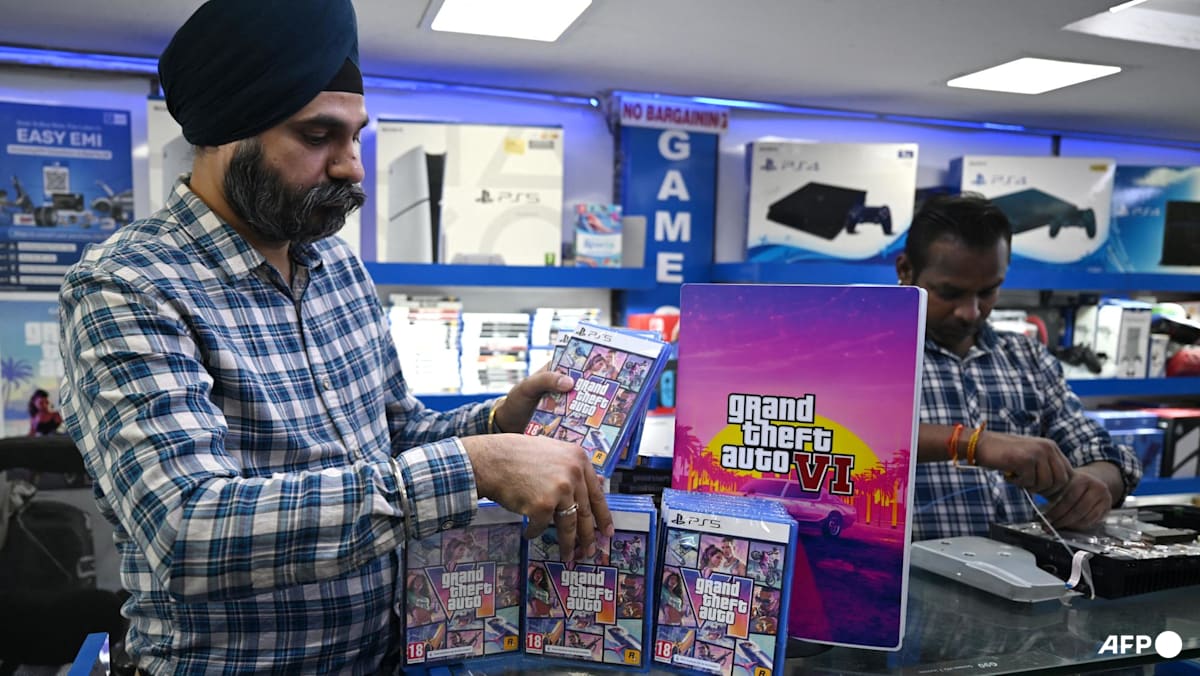
BENGALURU: So eager was 26-year-old gaming streamer Deepak Barpa to play Grand Theft Auto VI (GTA VI) that he spent around 8,200 Indian rupees (US$88) to pre-order the game months before he even owned a console.He even waited anxiously at a Delhi warehouse around 5am for two delivery trucks to be unloaded, hoping one carried his PlayStation 5 (PS5). The PS5 is among the few consoles on which GTA VI will be available to download.With his console finally in hand, Barpa is eagerly counting down to Thursday (Nov 19), when American gaming company Rockstar Games is set to release GTA VI, more than 13 years after its predecessor was launched.He has taken several days off from his job as an operations analyst to play the game at launch and stream it for his followers. “I don't want to miss a single second away from the game,” he told CNA. A still from the Grand Theft Auto VI game. (Photo: Rockstar Games) The highly anticipated game also has an Indian connection, with developer Rockstar Games' Bengaluru studio contributing to its creation alongside teams worldwide.In a LinkedIn post, Rockstar India’s studio director Daniel Smith said he was “incredibly proud to be a part of this amazing project”. However, the company has not disclosed which parts of the game were developed in India.“Global investors no longer have to be convinced that India has the talent. Rockstar India alone is reported to have more developers on GTA VI than any other Rockstar studio. But a skilled team and a hit-making company are different things,” said Anuj Tandon, global partner for emerging markets at gaming-focused venture capital firm Bitkraft Ventures.The launch highlights India's growing role in global game development, but can its studios create blockbuster franchises of their own? US studio Rockstar Games that developed the much-anticipated Grand Theft Auto VI game. (Photo: AFP/Toby Shepheard) FROM RACETRACKS TO GLOBAL GAMING HITSLong before GTA VI, Indian developers were helping create various elements of some of the world's biggest video games.Among the pioneers was Bengaluru-based Dhruva Interactive, founded by Rajesh Rao in 1997, which contributed to Microsoft's Forza Motorsport franchise and other big-budget titles, commonly known as AAA games.“We did entire cars for Forza,” Rao recalled, adding that his team also worked on racetracks, environments and characters for several major console games. A still from Microsoft's Forza Motorsport franchise, which Bengaluru-based Dhruva Interactive helped develop. (Photo: Forza Motorsport) By 2016-17, Dhruva was building entire game levels from rough layouts supplied by international clients, taking on a larger role in a process known as co-development.Rao said Dhruva's expertise attracted Rockstar Games, which acquired the company from Swedish gaming firm Starbreeze in 2019 for US$7.9 million, according to the latter's financial disclosures. “They were buying the company for the talent and nothing else,” Rao told CNA, referring to Dhruva's experienced artists, level designers and content creators. Rajesh Rao, founder of Dhruva Interactive, which helped develop major international video games before being acquired by Rockstar Games in 2019. (Photo: Rajesh Rao) Other global gaming companies have also tapped Indian expertise.Indian developers also contributed to art, animation, programming and design for gaming giant Ubisoft's Assassin's Creed Nexus virtual reality edition, the company's Mumbai production director Sashi Menon said in a 2023 interview.Artists at Indian game developer Lakshya Digital spent around six months recreating a digital version of Captain Jack Sparrow - a character played by Johnny Depp in the Pirates of the Caribbean films - for the video game Kingdom Hearts III. A digital recreation of Captain Jack Sparrow, played by Johnny Depp in the Pirates of the Caribbean films, created by Indian game developer Lakshya Digital for the video game Kingdom Hearts III. (Photo: Lakshya Digital) Mayank Rajpoot, who heads Lakshya's Pune studio, said the challenge was ensuring that the artwork could run smoothly inside the game without slowing it down.Unlike films, video games generate graphics in real time, requiring artists to balance visual detail with smooth gameplay, Rajpoot explained.“It's not about making something which is only visually appealing. It also has to fit into the artistic vision of the game,” he said.Rajpoot said Indian developers are increasingly expected to contribute creative solutions rather than simply execute instructions from overseas clients, although overall creative direction remains with international studios.A NEW GENERATION OF HOMEGROWN STUDIOSShruti Verma, CEO of the Game Developer Association of India (GDAI), said global gaming firms such as Electronic Arts, Ubisoft and Zynga helped develop a workforce in India experienced in game design, engineering and production.She cited Indian gaming companies PlaySimple, Moonfrog and Bombay Play, founded by former Zynga professionals, as examples of the country’s developers using their experience to build businesses of their own. Shruti Verma, CEO of the Game Developer Association of India. (Photo: Shruti Verma) Tandon of Bitkraft Ventures said the trend was continuing: “We're seeing senior people leave large international studios in Bengaluru, Pune and Hyderabad to start their own.”India has more than 1,900 game-development companies employing around 130,000 people, according to GDAI's GameDev Outlook 2026 report. An earlier study by consulting firm Primus Partners and think tank Egrow Foundation estimated around 900 gaming firms and start-ups in 2022. The country also had an estimated 511 million gamers in 2025, generating US$1.04 billion in revenue, the GDAI report said.The report also highlighted the emergence of new gaming studios, with more than half of those surveyed established in 2022 or later.Indian developers are increasingly creating original games for international audiences, with pitches now “more global than local”, Tandon said.Some have even found international success. Mythology-inspired adventure game Raji: An Ancient Epic, developed by Indian studio Nodding Heads Games, has reached more than two million players. Mythology-inspired adventure game Raji: An Ancient Epic, developed by Indian studio Nodding Heads Games. (Photo: Nodding Heads) Established Indian gaming companies are also expanding overseas. Indian gaming firm Nazara Technologies has acquired international businesses, including United Kingdom-based publisher Curve Games in May 2025, to strengthen its presence in the global personal computer (PC) and console market.“We bought and run studios in the United States, UK and Europe, so we have seen how global hits are made from the inside,” said Nazara founder Nitish Mittersain.He said India's advantage now extends beyond lower development costs to the experience and capabilities of its gaming workforce.CAN INDIA PRODUCE A BLOCKBUSTER LIKE GTA?GTA V has sold nearly 235 million copies worldwide, according to Rockstar's parent company, Take-Two Interactive, underscoring the scale of success that India's gaming industry has yet to replicate. A billboard for Rockstar Games' Grand Theft Auto VI is seen near Times Square in New York, on Nov 16, 2026. The game is set to be released worldwide on Nov 19. (Photo: AFP/Charly Triballeau) But contributing to an international blockbuster is different from developing one independently, according to Tandon.“Service and co-development work teaches you how to execute on someone else's vision. A studio that creates hits has to decide what to build, find and keep players and make money from them,” he said.Mittersain said turning games into profitable businesses is a challenge.“I would put monetisation first, because capital follows it,” he said.He said developing a major PC or console game could take three to five years before it generates revenue, requiring investors willing to wait years for a potential return.Relatively low spending on premium games in India also makes it difficult to justify developing expensive titles primarily for domestic players, he added.More than 75 per cent of respondents to the GDAI industry survey said funding for game development was inadequate.Rao said another challenge is convincing international publishers to back Indian studios without a proven track record of developing commercially successful console games. He described it as a chicken-and-egg problem. Developers need backing to prove themselves, but publishers are reluctant to invest in teams without that experience.Tandon, however, believes India's challenge goes beyond access to capital. Anuj Tandon, Global Partner, Emerging Markets, at Bitkraft Ventures, says technical talent alone is not enough to create globally successful games. (Photo: Anuj Tandon) “India isn't short of money or talent. It's short of founders who have shipped global hits more than once and of exits (successful sale of companies) that turn that experience into new studios,” he said.He pointed to Turkey's mobile-gaming industry, where companies such as Peak, Rollic and Dream Games have helped create a pool of experienced founders and investors capable of backing successive generations of studios.Tandon said Indian studios seeking investment need a compelling playable prototype, a clear target audience and a viable commercial strategy. They also need to be backed by teams with creative, technical and business expertise.Investors are increasingly willing to fund lengthy development cycles if studios can demonstrate progress, player interest and publishing agreements, he added.“Investors won't fund five years with nothing to show,” he said.But India's first major global gaming success may not necessarily be a blockbuster on the scale of GTA VI, added Tandon.“It's more likely a mobile title with sustained global revenue. One breakout like that would do more for the ecosystem than any number of service contracts,” he said.
India helped build Grand Theft Auto VI, but creating its own gaming hit is another challenge
Full Article
Original Source
Read the full article at Channelnewsasia →KhanList aggregates and links to publicly available news content. We do not host full articles from third-party sources. Always verify important information with original sources.