
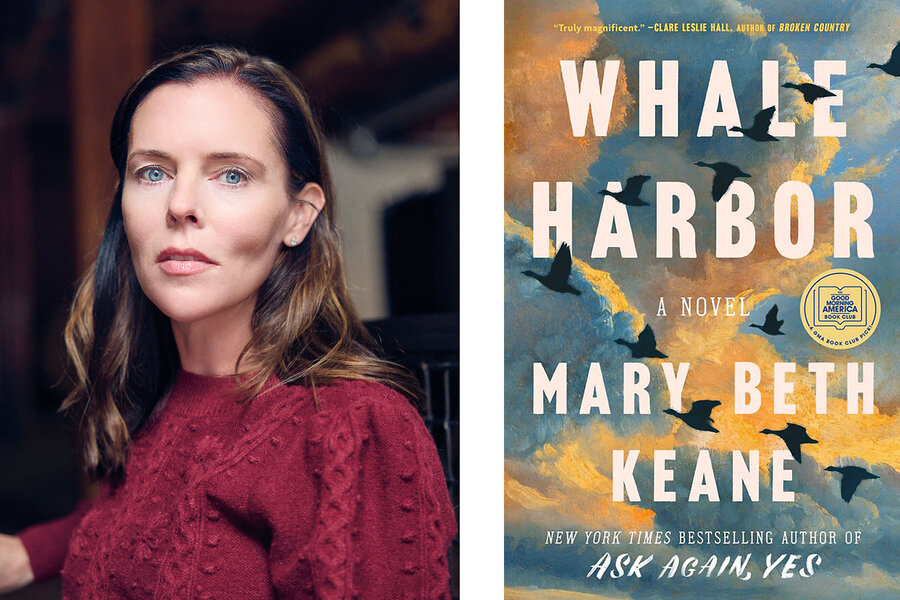
Early in Mary Beth Keane’s new novel, a nearly 70-foot, 40-ton whale washes ashore in the village of Cuan an Mhíl Mhóir in Ireland. It’s 1963, so word of the beached creature spreads neighbor to neighbor, child to mam, over fences, and in the lanes.Sixteen-year-old Macdara Joyce, who’s barely left the Cuan, let alone Ireland, has only ever seen whales far off the coast swimming north in their pods. “How or why one had lost its way,” Keane writes, “he couldn’t imagine.”Such bafflement at separation, tinged by the fear of solitude, shapes “Whale Harbor.” A late-fall gem for readers’ teetering 2026 book piles (and a finalist for Barnes & Noble’s Book of the Year), the novel offers the rare side-by-side pleasures of craft and zip. Keane deftly weaves poetic glimpses, precise details, and the rhythms of her Irish-flecked dialogue into an absorbing, well-paced tale. A recipient of the Guggenheim Fellowship for fiction, Keane has written four other novels, including The New York Times bestseller “Ask Again, Yes.” Ireland’s emigrants, New York, marriage, work, and generational ties and tests pepper her work.“Whale Harbor” continues these themes via the story of Mac; his (wait for it) 10 brothers; their restless father, Cathal; and their understandably exhausted mother, Mary. Here in the Cuan, where the cold slithers beneath sweaters and the most abundant crop is the stones on the shore, the boys gather seaweed, hunt for odd jobs, and rarely wear shoes. Their simple cottage already full to bursting, the family has welcomed a newborn into the fold when the whale appears.Not two weeks after the baby’s birth, Mary collapses while making breakfast. Her sudden death unmoors the family, driving Cathal to send two of the boys to seminary school, another to meet his older brother in England, and the baby to join a well-off family in town. Most alarmingly, their father has announced he’s marrying a woman from America who will arrive in mere days. It’s a whirl of news for all, but particularly Mac, who is the oldest still at home. Of all his brothers, 9-year-old Rian looms largest in Mac’s heart. Impulsive, smart, and eager to see the world, Rian worships Mac. The younger boy makes Mac swear that he’ll never abandon him. Mac hesitates and then promises, knowing “the words felt fragile even as he spoke them.”When a neighbor urges Mac to leave the Cuan for a Montana ranch where her son already works, he accepts. He tries to secure a spot for Rian on the journey, to no avail; as Mac heads to the airport, Rian gives chase, flinging hurt and blame at the vanishing car.Keane then moves her story to the wide landlocked spaces of the American plain. Mac observes and adjusts to his new home, recording oddities, similarities, and surprises. There’s his first blizzard, Christmas with presents, and cute young women to meet in town on the weekends. The ease with which he slides into his new life disorients Mac. The hard, steady work; the abundance – “It made home seem not only very far away, but also impossible, that that place should exist in all its various moving parts at the very same time as this one.”Mac’s days are dogged by the guilt he feels for breaking his promise to Rian. An encounter with a grizzly bear, plus the news that Rian has run away from the Cuan, unnerves Mac. He makes his way to New York where he’s soon joined by three of his brothers and, as the years progress, nearly all the others. Keane’s eye for the ways in which newcomers settle into a place – finding their feet, adopting habits, trying on language, missing old ways, starting families – never wavers. It’s gentle, wise, and one of the book’s many pleasures.“Whale Harbor” never feels grim. A quiet wonder suffuses the story, whether a character dashes down a mountainside “dove-white ankles flashing in the sun,” or a pair strolls down a road in Ireland lined with vivid yellow furze “making a bright, beautiful tunnel leading home.” Deepen your worldviewwith Monitor Highlights.Politics with respectGet political stories with respectful analysis.There‘s a world of new ideas in everyBooks newsletter.There‘s more to life, enrich yours withCulture & Learning weekly.Follow humanity‘s discoveries withScience & Nature stories in your inbox.Gain a spiritual perspectivefrom the stories in your inbox.Want to understand the deeper impact of critical events? Learn the Monitor‘s insight.Already a subscriber? Log in to hide ads. Also resonant is the ever-present pull of family, that centripetal, grounding force, and the responsibility of care each individual has for the lives in their orbit. “They were lovely, his girls,” Mac observes late in the novel at an extended family gathering. “They were such funny, opinionated, compassionate people. God knew he had no idea what he was doing.”And yet Mac very much does know what he’s doing. Here is a good man, finding his path, acknowledging his mistakes, and knowing the worth of his pod. ALREADY A SUBSCRIBER? LoginReal news can be honest, hopeful, credible, constructive.The Christian Science Monitor was founded in 1908 to lift the standard of journalism and uplift humanity. We aim to “speak the truth in love.” Our goal is not to tell you what to think, but to give you the essential knowledge and understanding to come to your own intelligent conclusions. Join us in this mission by subscribing.
In ‘Whale Harbor,’ an Irish family seeks safe mooring
Full Article
Original Source
Read the full article at Csmonitor →KhanList aggregates and links to publicly available news content. We do not host full articles from third-party sources. Always verify important information with original sources.