
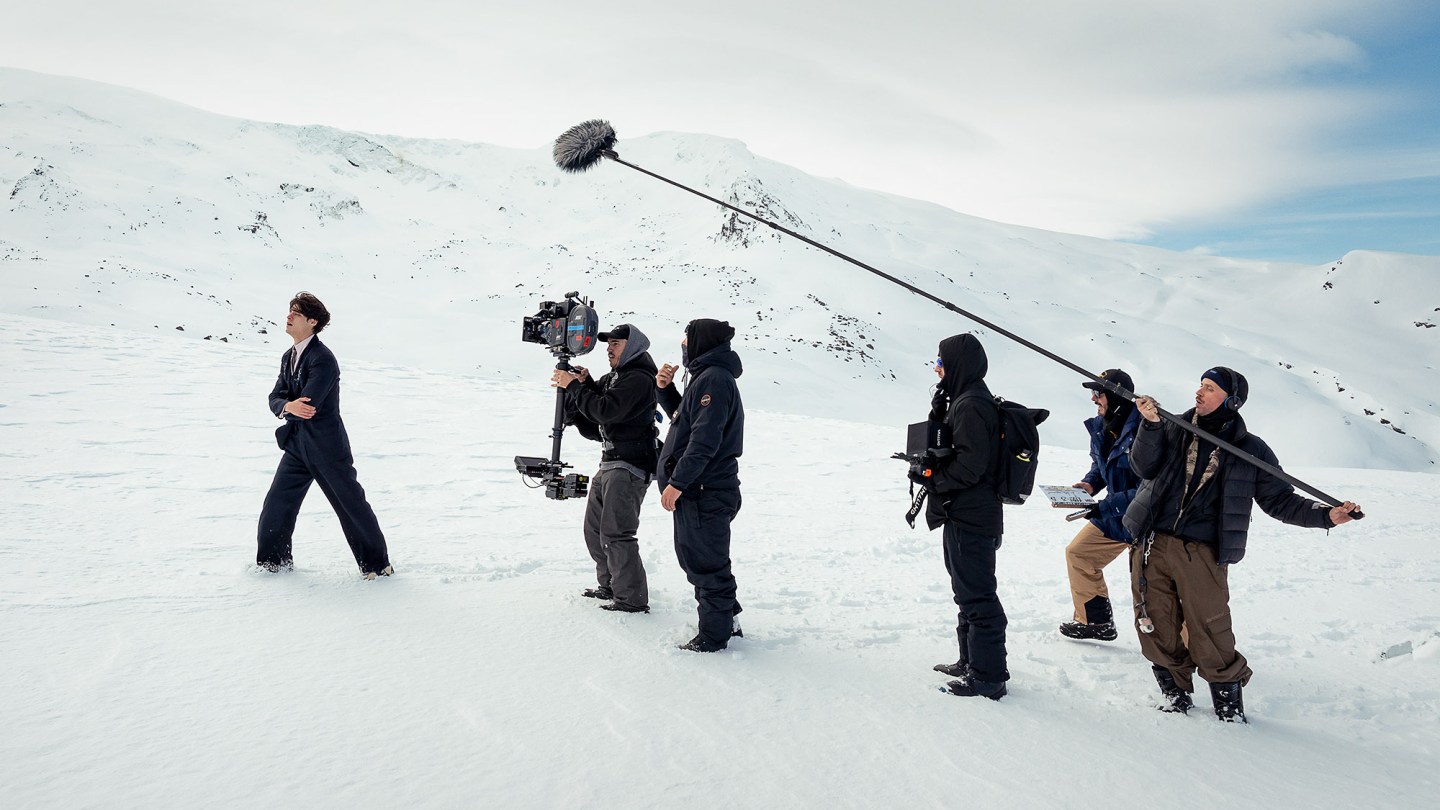
Javier Calvo was traveling with his filmmaking partner, Javier Ambrossi, when he read Alberto Conejero’s play La Piedra Oscura (The Dark Stone) and the idea for La Bola Negra (The Black Ball) took hold. Conejero’s drama, set in a military hospital during the Spanish Civil War, imagines the last night of Rafael Rodríguez Rapún — a Republican lieutenant and the real-life lover of playwright Federico García Lorca — in conversation with Sebastián, the young Nationalist soldier who is to execute him at dawn. “I imagined this little gay boy having to leave his town, all this tragedy, and how this happened to my country only 90 years ago, and having a gay character in the civil war,” says Calvo. “We never talk about that. Where were we? What happened to us? It hit me, and I started to cry. I told Javi, ‘I think we have to make this.’ ” The film, co-written with Conejero, braids three timelines. In 1932 Granada, Carlos (Milo Quifes), a young upper-class Andalusian, is blackballed from an exclusive casino because he’s gay — the premise of Lorca’s unfinished play La Bola Negra, of which only four pages survive. In 1937, Sebastián (singer- songwriter Guitarricadelafuente) keeps watch over Rafael (Miguel Bernardeau). And in 2017 Madrid, Alberto (Carlos González) learns that he is Sebastián’s grandson. Sebastián has left him the rest of Lorca’s play — pages the film imagines into being — which he had promised Rafael he would save. Those pages — verified by Glenn Close, who plays a Spanish-speaking American scholar named Isabelle Durand — lead Alberto and his relatives to discover that Sebastián spent most of his life secretly living with another man. The casino from which Carlos (Milo Quifes) is banned was the only structure that was built for the film. Carla Oset/Netflix “This is a movie about what we pass on to the next generation,” Ambrossi says. “It’s about inheritance.” The co-directors, known as Los Javis among their collaborators because of their shared first names, reassembled their usual crafts team to begin shaping each timeline: cinematographer Gris Jordana, editor Alberto Gutiérrez, production designer Roger Bellés, costume designer Ana López Cobos, composer Raül Refree and casting directors Eva Leira and Yolanda Serrano. Javier Ambrossi outside of a 1937 seminary that was turned into an army hospital. Carla Oset/Netflix The directors were already keen on Guitarricadelafuente and Bernardeau for their respective roles, as well as González for the part of Alberto, which Ambrossi calls “a creation.” “He’s so comedic and flamboyant, but we wanted to give him a role where he can prove the actor that he is because sometimes queer people are given the same [stereotypical] roles,” Ambrossi says. Quifes, who like Guitarricadelafuente makes his screen debut in the film, was found through an open casting call. “He has a sense of melancholy about him, but it’s not about hopelessness; there’s a sense of hope and beauty,” says Leira. “And he has such a beautiful gaze. It’s a gaze that comes from ancient times.” Los Javis also knew they wanted to shoot in 35mm from the outset, which aligned with DP Jordana’s approach. “You don’t have to fight the format to get images,” she says of 35mm film. “If you use the right light direction, the rest just comes together. It’s like magic.” Light also drove the design of the opulent casino in Granada, the only set built from scratch. Everywhere else, the production restored existing buildings, hiring local artisans who still work with prewar methods. “At first glance, it looked like something crazy and unnecessary when we built it in the middle of Spain, but when you open the windows, you see Spain, not a green screen,” says production designer Bellés, who commissioned artist Ignasi Monreal to paint the mural on the ceiling in the style of Joaquín Sorolla, “one of the great painters of Spanish light,” he explains. The windows were made of sugar glass so that they could shatter safely when the casino explodes near the end of the film after being overtaken by a mob as Carlos makes a final case for admission. The remaining structure was then filled with fake snow as the scene transitions to Carlos lying on a mountainside, realizing he has died from the bomb’s explosion. The shot, captured at an altitude of 3,000 meters (more than 9,800 feet high) in the snowy region of the Sierra Nevadas, brought to life elements described in Lorca’s poem — like the skiers on the slopes — which also inspired Guitarricadelafuente’s original song, “La Nieve (The Snow),” that plays in the background. “With Federico García Lorca, there’s a lot of powerful imagery and symbolism, like in the beginning of the film, the horse running past Sebastián is a representation of untamable desire,” Guitarricadelafuente explains. “ ‘La Nieve’ symbolized the end of a journey and approaching death. I had to leave the emotional baggage of Sebastián to fully understand what he was carrying to be able to write that.” Penélope Cruz portrays a cupletista cabaret singer named Nené Romero in a La Bola Negra. Carla Oset/Netflix Refree took a hands-on approach with Penélope Cruz, who portrays Nené Romero, a cupletista cabaret singer. “She told me, ‘I’m not a singer,’ but as soon as I heard her singing … I fell in love with her singing,” he says. “The problem was that she hadn’t created the character yet.” Over the course of several days, Refree went to Cruz’s home for rehearsals, and she began to craft the persona of Nené, who serves as a portal to a world in which Sebastián can be free to be his true self when he sees her perform “Las Tardes del Ritz (Afternoons at the Ritz)” and “Batallón de modistillas (Seamstress Battalion)” on the base. “My goal was to have this kind of music that she could be influenced by when talking to the soldiers and to create this evocative thing, like making two men play together as a couple,” Refree explains of the first number. “The second one needed a dirty energy that would make the soldiers lose control and want to touch her. So we created something very rhythmic and feminine at the same time.” Wardrobe also helped shape Nené. Cobos drew from research on 19th century cuplé singers, like María del Consuelo Vello Cano, to sketch Cruz’s feathery, embellished ensemble. The abandoned village of Castil de Carrias in the province of Burgos, Spain, was restored for the opening scene in which an Italian aircraft bombs civilians. Carla Oset/Netflix “When she saw the white dress, she said, ‘This is it; she has to be wearing white,’ and Gris also said it would be helpful because we don’t have a lot of lights in the theater,” says Cobos. “[For the second number,] because I know Penélope’s a big fan of Mugler, I went through their images and found these overalls and dresses that reminded me of military costumes. So I did my own interpretation of them, and it worked really well because it helped her move and it was very comfortable for her to do the choreography with the tank and all of the other dancers.” In the final scene of the film, Sebastián reads a poem with the words, “Mira, que nos acechan todavia (Beware, they still haunt us),” after being forced to shoot Rafael. It’s the final verse of “Love Sleeps in the Poet’s Breast,” one of the Sonetos del Amor Oscuro (Sonnets of Dark Love), written by Lorca for Rafael, expressing his forbidden desire for him amid the looming threat of societal persecution. For Calvo, the warning is just as relevant today. “We had it on the whiteboard, and it was kind of a guide [for us],” he says. “Putting it [at the end of the film] was perfect and so significant because they do still haunt us.” Miguel Bernardeau (left) portrays poet Federico García Lorca’s real-life lover Rafael Rodríguez Rapún, and Guitarricadelafuente stars as Sebastián. Carla Oset/Netflix This story appeared in the Nov. 18 issue of The Hollywood Reporter magazine. Click here to subscribe.
A Pop-Star Acting Newbie, the Afterlife and “Dirty Energy”: The Making of ‘La Bola Negra’
Full Article
Original Source
Read the full article at Hollywoodreporter →KhanList aggregates and links to publicly available news content. We do not host full articles from third-party sources. Always verify important information with original sources.