
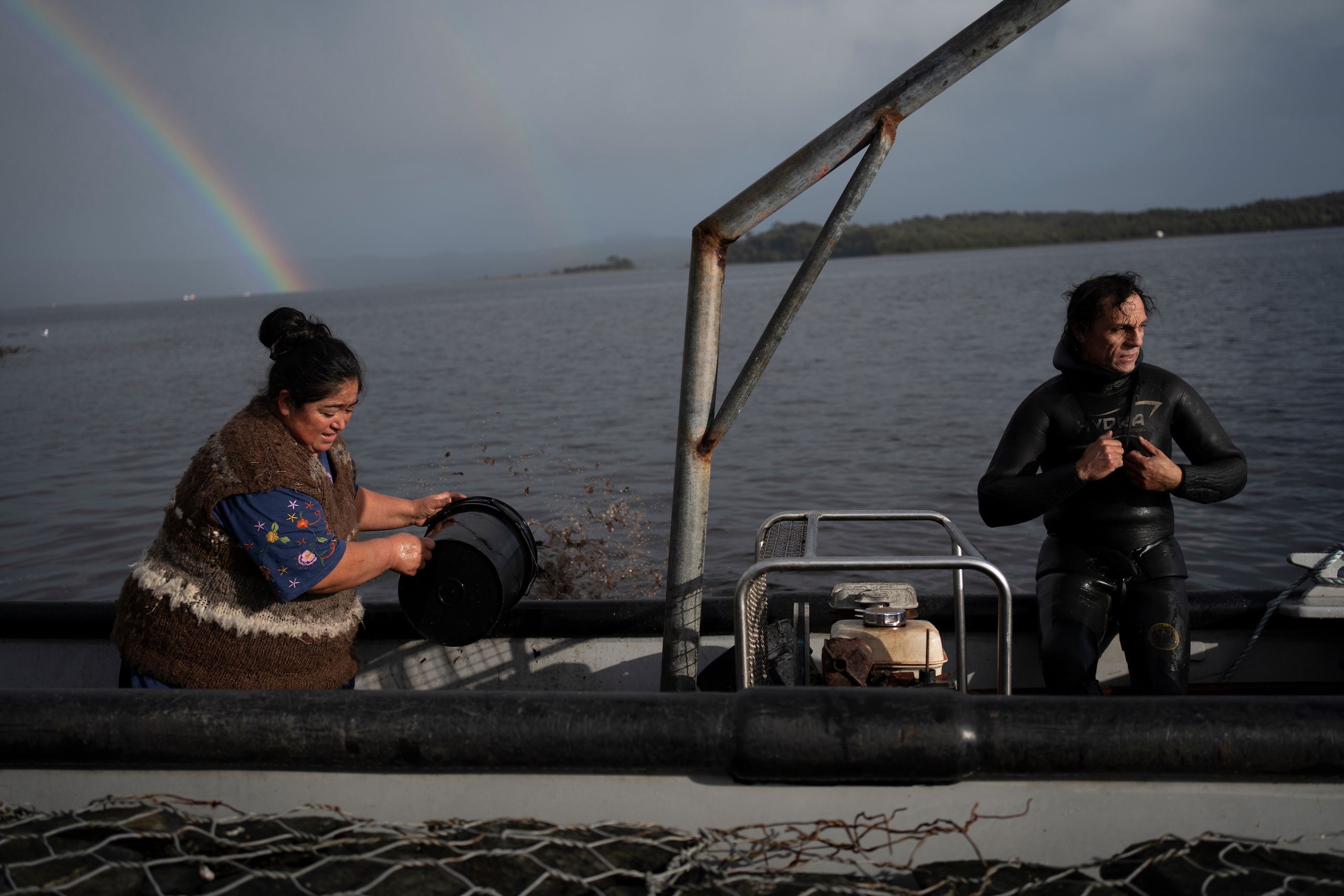
MELINKA, Chile (AP) — Yesica Fabiana Leviñanco steers her small wooden boat while her partner, Paulo Vera Perez, dives into the cold ocean waters off the coast of southern Chile.Within a few hours, the couple, both in their mid-40s, has filled the boat with shellfish, sea urchins, mussels and crabs that Leviñanco will sell at the market in Melinka, the main island in the Guaitecas Archipelago.Even a few years ago, such a haul would have been unthinkable.“It seems incredible looking at it today, but for years the sea throughout this area was dead,” said Leviñanco. “There were no birds, fish or marine animals. A salmon-farming facility had destroyed everything.”__EDITORS’ NOTE: This story was supported by Journalismfund Europe.__Made up of more than 40 small islands, the Guaitecas Archipelago is a gateway to Chile’s Patagonia region that is one of the world’s most remote places. Despite being a national reserve, it’s also home to numerous salmon farms that discharge hundreds of tons of chemicals and antibiotics into the sea every year.At least 313 salmon farms were authorized in the archipelago, according to Terram, a Chilean foundation focused on sustainable development.Leviñanco and Vera Perez say the intensive farming damaged where they fished, so they decided to try to counter that. They started bringing in healthy mussels and clams from other areas. Friends and family thought they were crazy, but over years the work paid off.“The fish, birds and other marine animals came back,” said Leviñanco.Salmon fishing is a major industry in ChileChile is the world’s second-largest salmon producer after Norway, and the fish is the Latin American country’s second-most exported product, after copper. In 2025, over 1 million tonnes were produced in the country, according to Sernapesca.Salmon is not native to Chilean waters. The fish was first imported from Norway in the 1970s and 1980s, during the dictatorship of Gen. Augusto Pinochet.For years, intensive salmon farming in Chile has been criticized by scientists, environmental advocacy groups, fishers, Indigenous communities and local residents, who accuse the industry of polluting the sea because of the large quantities of chemicals used at the farms, failing to respect the rights of Indigenous communities and breaching workplace safety regulations. According to figures provided by the Chilean nonprofit Ecoceanos, 90 workers have died in the industry since 2013. Fatal accidents range from workers getting entangled while cleaning nets to shipwrecks among vessels in the area.The Guaitecas Archipelago is the largest nature reserve in the country and one of the oldest, having been established in 1938, and has many endangered marine species.Many locals and scientists say that salmon farms have severely damaged multiple marine areas, leaving parts of the seabed with oxygen levels so low that other forms of life struggle to survive. They describe these areas as “dead.” One such area is where Leviñanco has fished throughout her life and which she helped to restore.“Intensive salmon farming can have various impacts on marine ecosystems. Pollution can result both from the accumulation of organic matter and from the use of chemicals,” said Catalina Sapag, a marine biologist and scientific area coordinator at the nonprofit Oceana in Chile.Despite opposition, particularly in the south of the country, there is strong support for the salmon industry, as it generates many jobs.SalmonChile, a trade association representing many farming companies, argues that the decline in fish stocks can’t be attributed just to salmon farming.“It may be due to various factors, such as climate change, changes in water temperature, illegal fishing, overexploitation of resources and the introduction of non-native species for recreational fishing. The industry therefore represents only one of the factors at play,” the association said in a statement.The United States accounts for 40% of Chile’s salmon exports ($2.6 billion), followed by Japan with 17% (just over $1 billion) and Brazil with 13% ($796 million), according to figures from SalmonChile.Locals hope to use a law to boost protectionChilean fishers claim that pollution caused by salmon-farming facilities is significantly reducing the abundance of fish and shellfish in the sea. One of the most vocal figures to have raised these concerns lives in Melinka.His name is Daniel Arturo Caniullan Huentel. He is 52 years old, has worked as a diver for 35 years and is an ancestral authority of the Indigenous Mapuche Pu Wapi community in Melinka.“The seabed was teeming with life, with colors and animals everywhere. Today it is completely different,” said Caniullan Huentel. “The colors have faded, many species have disappeared and organisms that did not exist before have appeared. Every time a new salmon-farming facility was installed, we saw the impacts increase.”The Mapuche community is pushing to protect the area’s waters under Ley Lafkenche, a law passed in 2008 that allows Indigenous communities to protect marine and coastal areas and manage them jointly with state institutions, provided they can demonstrate that their community carries out ancestral practices there.The arrangement does not grant Indigenous peoples ownership of the sea or seabed, but protects the area’s ancestral uses, including fishing, shellfish and seaweed gathering, as well as access to sacred sites and areas used for navigation.Once a community applies to manage an area, the state can no longer authorize new concessions — such as those for salmon-farming facilities — within it.In 2017, the Chilean state rejected an application by Caniullan Huentel’s community for an additional 8,000 hectares (19,800 acres), and in 2024 it rejected another one that requested 350,000 hectares (865,000 acres). Last March, the community submitted an application for a further, smaller area of 3,000 hectares (7,400 acres), and they are now awaiting a response.“This struggle is not just about us,” said Caniullan Huentel. “It is about the future of the sea, small-scale fishing and generations to come. If we do not defend these territories today, tomorrow we risk permanently losing an immense natural and cultural heritage.”Subscribe to our free newslettersOur weekly newsletter Closing Arguments offers the latest about ongoing trials, major litigation and rulings in courthouses around the U.S. and the world, while the monthly Under the Lights dishes the legal dirt from Hollywood, sports, Big Tech and the arts.Additional Reads
In southern Chile, locals push to protect oceans that have been hurt by intensive salmon farming
Full Article
Original Source
Read the full article at Courthousenews →KhanList aggregates and links to publicly available news content. We do not host full articles from third-party sources. Always verify important information with original sources.