
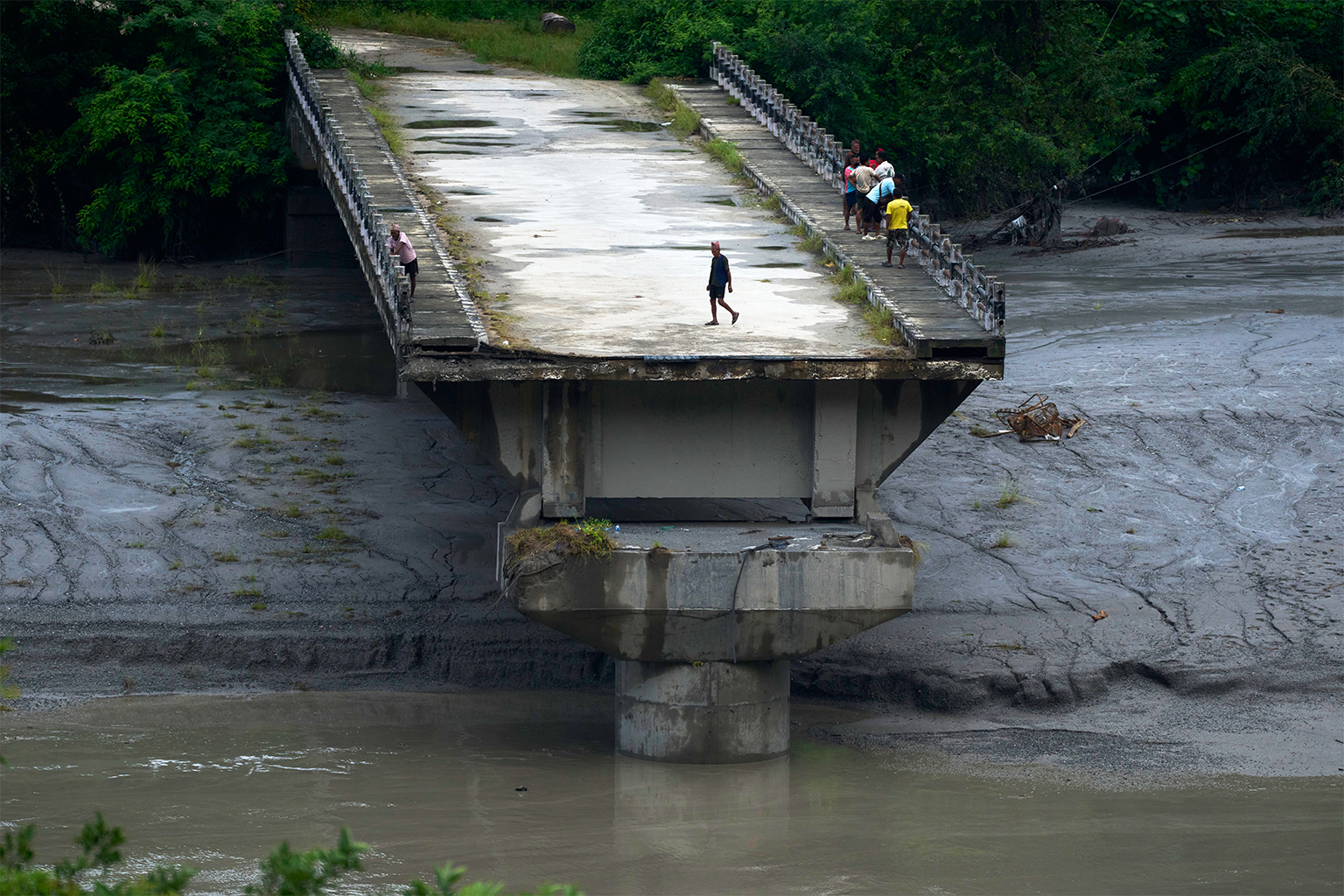
On Aug. 26, a catastrophic flood killed more than and has reopened Nepal’s debate over mega-dams.Proponents say high reservoir dams could absorb floods and ease winter power shortages.Those against such dams say stored water adds risk if a glacial lake bursts, and support solar and pumped storage as alternatives.Research suggests Himalayan hydropower is widely exposed to such floods but, so far, no study has tested whether reservoirs worsen them. KATHMANDU — Until recently, residents living in the lap of the Himalayas saw the peaks as immovable giants silently nurturing them with snowmelt. But on Aug. 26, there was a road from the mountain overlooking the Bhotekoshi rivershed in central Nepal roared. What appears to have been an avalanche on Langtang Lirung sent a churning wall of water, mud and boulders down the valley. In Nepal, more than 1,353 people were killed and many thousands went missing. The flood also damaged at least a dozen hydropower projects. As the flood receded, a debate surfaced in Nepal’s policy circles about the future of hydropower. Some experts now advocate mega-dams in the Himalayas to contain large floods, manage winter power shortages and even prepare for a future without snow in the Himalaya. But limits to engineering and earthquakes in the young mountains challenge any such endeavor, experts tell Mongabay. “The question for the future is not whether Nepal will continue to develop its rivers,” writes David Fickling, climate and energy columnist for Bloomberg. “It is whether the next generation of hydro projects merely extracts electricity with run-of-river, or builds storage dams to give downstream communities greater protection against the consequences of our increasingly deadly climate.” Reservoir dams, which store large volumes of water and generate electricity on demand, have long been part of government policy. The pro-dam camp points to Kulekhani, located southwest of Kathmandu, which generates 92 GWh (Gigawatt-hour) annually and helps meet winter peak demand. But the four-decade-old plant is the only one of its kind in the country. All other operating plants are run-of-river, which divert flowing water without storing it, so their output drops to less than half of installed capacity in the dry season. Privately operated generators, who supply nearly 60% of the country’s electricity, have been reluctant to build reservoirs because of the steep costs and risks, says Mohan Kumar Dangi, chair of the Independent Power Producers’ Association, Nepal (IPPAN). Kulekhani Dam, also known as Indra Sarobar, in Makwanpur, southwest of Kathmandu. The pro-dam camp points to Kulekhani, which generates 92 GWh (Gigawatt-hour) annually and helps meet winter peak demand. Image by Shadow Ayush via Wikimedia Commons (CC BY-SA 4.0). The case for mega-dams Geologist Bishal Nath Upreti, who taught geology at Kathmandu’s Tribhuvan University for 35 years, says he believes high dams can hold the water and debris of mega flash floods and give downstream communities time to evacuate. “High dams are safe if geological studies are properly conducted and designed with the latest technology,” he tells Mongabay. Dangi from IPPAN says high dams are also needed to address winter power shortages. The Nepal Electricity Authority (NEA) expects domestic plants to generate 1,218 MW this winter, against peak demand of 2,250 to 2,300 MW. It reportedly plans to import 1,154 MW from India — roughly half of what the country needs at peak. Hitendra Dev Shakya, former managing director of the NEA, says reservoirs could also protect water supplies as mountain snow disappears. An ICIMOD report suggests that under current emissions pathways 80% of glaciers’ current volume will be gone by 2100. A decline is already visible: ICIMOD’s latest snow update in April found that snow persistence, the proportion of time that snow is on the ground in a given period, in the Hindu Kush Himalaya was 27.8% below average in 2026, the lowest level in 24 years. There’s limited knowledge on what this could potentially mean for hydropower generated from perennial snow-fed rivers. Preliminary modeling of four major basins, presented at a conference in 2024 and not yet peer reviewed, found generation potential could rise by up to 36% by 2100 as meltwater increases. Drier scenarios pointed towards the . Shakya told Mongabay dams should serve multiple purposes, including providing drinking water, flood control and irrigation, and the cost of construction as well as operation should not fall on electricity users alone. Storage dams in the pipeline The Tanahu Seti dam, in Seti River in Gandaki province, with storage of 300 million cubic meters (around 79 billion gallons), is scheduled to start operating next year. At least two others are ready for construction, including the 263-meter (863-feet) Budhigandaki, which would store 4.467 million m3 (around 1.2 billion gal). West Seti, Pancheshwor and Saptakoshi High Dam are at earlier stages. Budhigandaki is estimated to cost around $2.77 billion. In his budget speech for the current fiscal year in May, Finance Minister Swarnim Waglé announced plans to build it through a special purpose vehicle using the country’s own resources. The government has spent more than 45 billion Nepalese rupees (around $301 million) on land acquisition and has listed it as a “priority project” for over a decade. A man crosses a bridge over a rising Seti River in Dipayal Silgadhi, October 2021. Floods and landslides triggered by days of torrential rains killed more than 100 people. Image by AP Photo/Laxmi Prasad Ngakhusi. Case against mega-dams Opponents argue that stored water adds risk in the event of a glacial lake outburst flood (GLOF), when a lake high in the mountains suddenly bursts. Dwarika Nath Dhungel, a water resources expert and former government secretary, says the Bhotekoshi flood has reinforced his anti-dam stance. “We feel like ‘living just below an atom bomb of the glacial lakes’ which may fall upon us at any time,” he tells Mongabay. “So much information is out there on dams and it’s high time to change our way of thinking of the dams.” His worry is not unfounded: A 2016 study found that two-thirds of 257 sampled Himalayan hydropower plants sit on potential GLOF routes, and up to a third could see floods well beyond their design limits. The study looked at plants of every kind, not reservoirs in particular, so whether stored water makes an outburst worse is still open to discussion. Dhungel also points to the Teesta III hydropower project in India, where a 1,200 MW dam was destroyed in 2023 by a flood from South Lhonak lake. At least 55 people died and 74 went missing. A study found that the outburst, the sediment it carried, landslides and the rain that followed all added to the toll — it did not single out the dam. Another analysis from Pennsylvania State University’s Institutes of Energy and the Environment says the dam’s collapse made things worse downstream. Teesta III stood about 60 m (197 ft) high, less than a quarter of Budhigandaki’s height, and its flood was the result of a true lake outburst. Bhotekoshi’s trigger, as of now, is largely attributed to an avalanche. The Lower Dam III across Teesta River in West Bengal state, India, 2017. Image by A. J. T. Johnsingh, WWF-India and NCF via Wikimedia Commons (CC BY-SA 4.0). Himanshu Thakkar, coordinator of the South Asia Network on Dams, Rivers and People, advises solar and pumped storage energy projects instead. “The incidence of this kind of situation is only going to increase in the Himalayan region,” he tells Mongabay by phone. Pumped storage built away from rivers could make that practical, argue Sunil Prasad Lohani of Kathmandu University and Andrew Blakers of the Australian National University, authors of research that counts about 2,800 suitable sites in Nepal. The price is not yet competitive: A 2025 model of solar with pumped storage and a biomass gasifier came out at about 8.5 US cents per kilowatt-hour, against the 6.7 US cents the NEA pays in the dry season. Both studies are models. Can big dams check floods like August’s? Hydropower engineers say big dams may check floods from the high Himalayas to an extent, but it may not be possible to mitigate floods of the size and intensity of Aug. 26. “The size of Tanahu Hydropower dam can store water of the flood but the question lies whether it can check the floods with debris and mudslides of the kind of [the] Bhotekoshi flood,” Pradeep Kumar Thike, a retired NEA civil engineer who was briefly CEO of the Budhigandaki Jalbidhyut Company Limited in 2023, told Mongabay. If the Bhotekoshi flood or a GLOF is taken as the design case, he says, hydropower projects may not be financially feasible. Bibek Raj Kandel, an adviser to Nepal’s energy minister in a government that lists Budhigandaki as a priority project, flagged another risk. Dams with kilometers of backwater can absorb some extreme flooding, he told Mongabay, but the construction period is where the threat lies: “The real danger zone is the construction period. It takes years to build these projects, and that multi-year window is precisely where the terrifying uncertainty of climate disasters lies.” A drone view shows a major section of Pasang Lhamu highway washed away along a swollen Trishuli River by the flash floods in August. Image by AP Photo/Rajesh Kumar Singh. Seismic doubts Nepal’s young mountains also pose seismic risks. More than a dozen hydropower plants and projects under construction were damaged by the 7.8-magnitude earthquake and aftershocks in 2015, which temporarily cost the country more than 30% of its hydropower production, a 2018 study found. The 45-MW Upper Bhotekoshi plant suffered major damage. Former managing director of the NEA Shakya doubts mega-dams could withstand the big tremors the Himalayas are known for. The proposed Budhigandaki project has a 263-m (863-ft) concrete arch dam. “The dam is strong enough to withstand a magnitude 7 quake, but what about 8 or above?” he says. “Also, what if the epicenter is within 20 km radius and depth is less than 10km deep.” Geologist Upreti says that shouldn’t be the reason to reconsider dams. “Even earthquake-vulnerable countries like Japan have built high dams and they have endured over 100 years of earthquakes,” he tells Mongabay. “Their experience makes us confident of our would-be high dam structures.” But unprecedented events like Bhotekoshi make it hard to account for factors not encountered before, says Shakya. It was not just water, the flow also contained a lot of debris and sludge, he says. Nepali engineers who simulate floods in laboratories to test designs have no practice modeling floods with such a high share of debris, he adds, “The physical modeling of such floods is still under research globally.” An electrical equipment at a power plant is partially buried in slush brought in by the Trishuli River in flash floods, in Dhading district, Aug. 30, 2026. Image by AP Photo/Niranjan Shrestha. Way forward Adviser Kandel argues that the debate needs to move beyond pro or anti-dam, as hydropower is Nepal’s mainstay. “We should look beyond a binary pro- and anti-dam stance,” Kandel says.. “Nepal must focus on optimizing appropriate dam projects that match our specific climate, topography and grid realities.” Kandel acknowledges the valid fear of downstream communities. “While we cannot engineer away 100% of risks coming from catastrophic risks of unknown scale,” he says he believes structural integrity can be assured by designing within advanced engineering safety margins. The regulatory framework, he says, must legally enforce those standards alongside downstream safety protocols, strict financial guarantees for infrastructure breaches and transparent emergency inundation mapping. Banner image: People stand on remnants of a bridge which spanned across Trishuli River and was washed away in flash floods, in Dhading district, August 2026. Image by AP Photo/Niranjan Shrestha. Nepal’s flood disaster puts its hydropower-first strategy, exports to the test Citations: Schwanghart, W., Worni, R., Huggel, C., Stoffel, M., & Korup, O. (2016). Uncertainty in the Himalayan energy–water nexus: Estimating regional exposure to glacial lake outburst floods. Environmental Research Letters, 11(7), 074005. doi:10.1088/1748-9326/11/7/074005 Sattar, A., Cook, K. L., Rai, S. K., Berthier, E., Allen, S., Rinzin, S., … Bhat, S. Y. (2025a). The Sikkim flood of October 2023: Drivers, causes, and impacts of a multihazard cascade. Science, 387(6740). doi:10.1126/science.ads2659 Lohani, S. P., & Blakers, A. (2021). 100% renewable energy with pumped-hydro-energy storage in Nepal. Clean Energy, 5(2), 243–253. doi:10.1093/ce/zkab011 Poudel, P., Neupane, N., Chaudhary, Y., Devkota, S., Lohani, S. P., & Uprety, B. (2025). Hybrid renewable energy system optimization to mitigate climate vulnerability of Nepal’s run-of-river hydro grid. Journal of Energy Storage, 129, 117311. doi:10.1016/j.est.2025.117311 Adhikary, S., & Aryal, M. (2026). Spatial heterogeneity in basin hydrology and hydropower potential: Implications for climate resilience and economic development in Nepal. River, 5(2), 265–281. doi:10.1002/rvr2.70055 Credits Topics
In Nepal, experts debate future of mega-dams after August’s flood
Full Article
Original Source
Read the full article at News →KhanList aggregates and links to publicly available news content. We do not host full articles from third-party sources. Always verify important information with original sources.