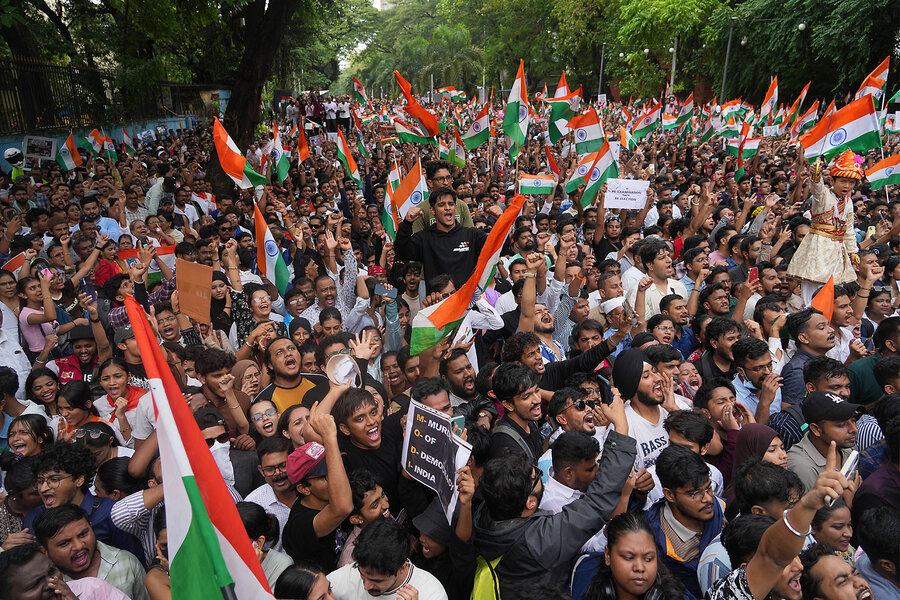
Indian Prime Minister Narendra Modi has spent 12 years in office cultivating an image as a leader who does not bend to pressure. His government was steadfast in the face of multiple protests, quick to curb dissent, and, unlike its predecessors, did not ax ministers in times of crisis. Until this week.For the past couple of months, a youth movement known as the Cockroach Janta Party (CJP) demanded Education Minister Dharmendra Pradhan’s resignation over a string of exam paper leaks that affected millions of students across the country. Tens of thousands of young Indians rallied in the heart of New Delhi in pursuit of this goal. They marched on Parliament. Some were arrested. And after weeks of resistance, the government blinked.Mr. Pradhan’s resignation letter described his exit as a sacrifice made to spare the nation from chaos. Why We Wrote This The success of India’s “Cockroach” protests is reinvigorating something experts say has been lost under Prime Minister Narendra Modi’s 12 years in power – a sense that dissent matters. That's good for democracy. The Cockroach movement – named in the wake of a disparaging comment India’s chief justice made about unemployed youth – is now taking a breather, preparing, its leaders say, to throw its weight behind other issues affecting young Indians. But this week’s win, which marks the first real dent in Mr. Modi’s strongman image, is already shaping how opposition politicians, activists, and even members of Mr. Modi’s own Bharatiya Janata Party (BJP) perceive the government’s vulnerability. Many say the movement has cracked open new space for dissent.“For years, Indian politics had settled into an air of pessimism and defeatism, with [opposition] parties fractured and demoralized,” says Apoorvanand, an expert in Indian political movements and Hindi professor at the University of Delhi, who, like many in India, uses a single name. “The Cockroach uprising has jolted [the country] awake.” Indian Prime Minister Narendra Modi addresses the media on the first day of the monsoon session of Parliament in New Delhi, July 20, 2026. Cutting through Modi’s “deification”The Modi government’s aversion to resignations has deep roots. In 2015, as opposition leaders demanded Cabinet resignations over two separate political scandals, a senior minister drew a line between the new, BJP-led government and the coalition that governed India before Mr. Modi.“Ministers don’t resign here,” said then-Home Affairs minister Rajnath Singh, in a clip that has circulated broadly since Mr. Pradhan’s exit.Apoorvanand says that stance reflects a broader deterioration of democratic norms over the past decade.“This government had turned into a kind of monarchical government, one in which the basic democratic idea that power answers to the people had disappeared,” he says. Under Mr. Modi, India has seen “fatal train accidents, chaotic pandemic management, a disruptive currency overhaul, [but] nobody took responsibility. It was as if everything was happening with divine order.”Indeed, sociologist Surinder S. Jodhka of Jawaharlal Nehru University in New Delhi says that recent events have punctured Mr. Modi’s near-mythical political persona, what he calls a “kind of deification” of the prime minister as a figure above criticism. What unsettled that image, he says, was not Mr. Pradhan’s resignation alone, but the Cockroach movement’s overall tone – a generation of protesters showing “a complete lack of reverence” for India’s political establishment. Anushree Fadnavis/Reuters A tear gas canister flies as supporters of India's Cockroach Janta Party demand the resignation of Education Minister Dharmendra Pradhan, in New Delhi, July 25, 2026. Mr. Pradhan announced his resignation later that day.. Mr. Modi’s government has faced large protests before, including the 2020-21 farmers’ protests, which forced a rare repeal of agricultural laws. But these movements were typically rooted in a specific constituency, making them easier for New Delhi to contain and discredit. The CJP rapidly mobilized a broader base by tapping into frustration over repeated exam scandals – a problem which touches virtually every Indian family.“Education binds all, cutting across social barriers, income barriers, everything,” says Apoorvanand. And CJP organizers say it’s only the beginning.What comes next for the CJP?“This is not the end,” CJP founder Abhijeet Dipke told supporters as they dismantled their protest camp in Delhi. “We will meet again soon.”Since Mr. Pradhan’s resignation, movement leaders have said they are “resting and regrouping” while building a decentralized campaign that will “put our weight behind one issue at a time,” expanding beyond education through town hall meetings and grassroots organizing. Protesters react to the resignation of Indian Education Minister Dharmendra Pradhan, a key demand of the Cockroach Janta Party's protest movement, in Mumbai, India, July 25, 2026. The CJP’s approach – a single grievance, sustained pressure, no formal party banner – is a template others are already copying.The clearest example is the E20 Janta Party, a social media campaign that appeared within days of Mr. Pradhan’s resignation, and has drawn hundreds of thousands of followers. It demands the resignation of the road transport minister, who champions ethanol blending in with petrol, which critics argue damages older vehicles’ engines. Taxi unions have joined in, with a march on Parliament planned for Aug. 4.But analysts say next year’s election in Uttar Pradesh, India’s most populous state and the BJP’s political heartland, will offer the first real measure of whether the Cockroach movement has lasting electoral consequences.Even if Mr. Modi’s party wins, a narrower victory margin – what Michael Kugelman, senior fellow for South Asia at the Atlantic Council, calls the “Cockroach factor” – would suggest that this organic, youth movement has succeeded in reshaping India’s political landscape.
In Modi’s India, many felt dissent didn’t matter. Then came the ‘cockroaches.’
Full Article
Original Source
Read the full article at Csmonitor →KhanList aggregates and links to publicly available news content. We do not host full articles from third-party sources. Always verify important information with original sources.