
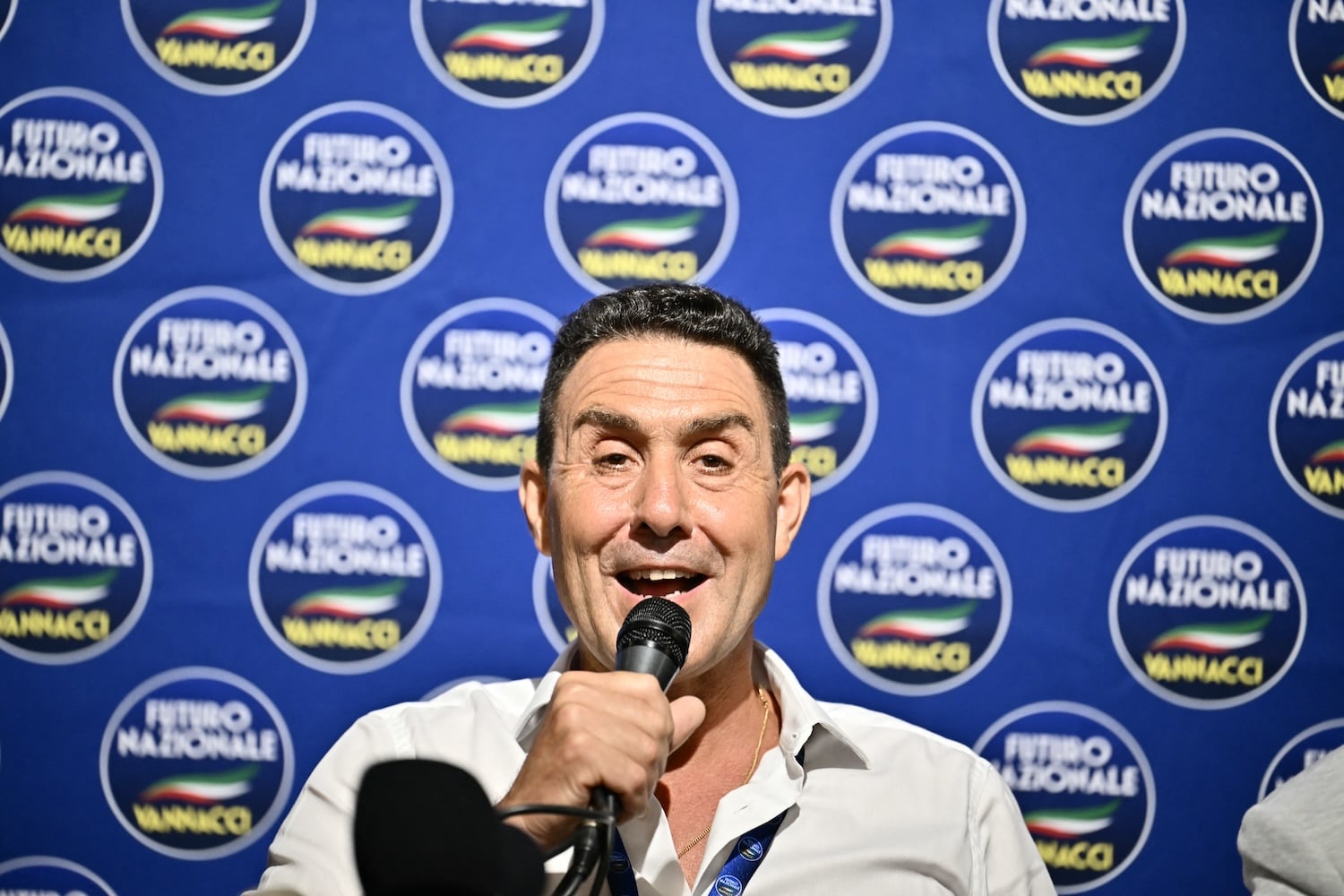
Italian Prime Minister Giorgia Meloni celebrated the fourth anniversary of her government with a large rally in the port city of Bari in September. Her administration is now the longest-serving in Italy—and the most far-right—since World War II. Meloni, who leads the far-right Brothers of Italy party, rules in a coalition with the populist League and center-right Forza Italia. A pamphlet handed out at the Bari rally highlighted Meloni’s economic and immigration policies, a major public housing plan, proposals to build new prisons, and a push to reintroduce nuclear power. Missing among the milestones was any mention of Italy’s support for Ukraine. That absence is no coincidence. Meloni is now grappling with a challenger further to her right on many issues: Roberto Vannacci, a former general who leads the ultranationalist, pro-Russian National Future party. His influence is putting the prime minister in a difficult position with voters and shaping her political choices, especially on Ukraine—already seen as a weak point for Meloni. Vannacci rose to national prominence in 2023 with a bestselling self-published book, The World Upside Down, that railed against LGBTQ rights, feminism, immigration, and environmentalism. He was elected to the European Parliament the next year with the League, but in January, he left the party to found his own. Amid pressure from Vannacci and his party, Meloni’s government has hardened its line on immigration; passed law-and-order measures targeting violent protests, vandalism, and illegal gatherings; and expanded legal protections for police. The prime minister also backed a controversial antisemitism bill, approved by Parliament this week, that opponents say conflates criticism of Israel with anti-Jewish sentiment. Until recently, Meloni had no serious rivals, and her Brothers of Italy party led every poll. Though Vannacci’s National Future is now losing some ground, he could still serve as a spoiler for Meloni. Her party’s rightward shift could even hand the divided center-left an unexpected victory in the general elections that are due next year. Brothers of Italy, which Meloni co-founded in 2012, has roots in the former Italian Social Movement (MSI)—a neofascist party that emerged from the remnants of Benito Mussolini’s regime in 1946. Meloni has never disavowed those origins, arguing that MSI was a “party of the democratic right” even as she has distanced herself from historical fascism. Meloni’s coalition partners have helped her project that image of distance, to varying degrees. Forza Italia, which is a member of the center-right European People’s Party, defines itself as the moderate wing of the coalition. The League doesn’t have fascist roots but tries to outflank Brothers of Italy on the right on certain issues. For the past 30 years, no far-right party has succeeded as a permanent force in Italy outside of the center-right coalition. Elsewhere in Europe, the far right has solidified its presence and destabilized mainstream politics—including the National Rally in France, the Alternative for Germany (AfD) party, and Britain’s Reform UK. Italy no longer seems to be immune to that trend. “We were convinced that the right stopped at Giorgia Meloni. Evidently, that was not the case,” said Mattia Diletti, a political scientist at Sapienza University of Rome. He compared National Future to the AfD due to the “strong value placed on national identity and national culture, as well as its strongly anti-European spirit.” Much of Vannacci’s platform echoes nationalist-populist positions espoused by Meloni and her allies before she came to power. He explicitly endorses “remigration”—the large-scale deportation of migrants and asylum-seekers as well as long-term residents and those born in Europe but deemed “unassimilated.” Vannacci has described Russia’s invasion of Ukraine as an “existential war” for Russians, arguing that NATO’s eastward expansion forced it into a war. Just 10 years ago, Meloni openly cited the “great replacement” conspiracy theory. She called for an end to sanctions against Moscow as recently as February 2022, days before Russia’s full-scale invasion of Ukraine began. On the campaign trail that year, Meloni exploited anti-establishment sentiment and presented herself as an underdog, allowing her to build a base as the left wing fractured. However, the prime minister has governed as a more moderate leader than expected. Since taking office, Meloni has insisted to other European Union countries that she is no longer pro-Russia or Euroskeptic, embracing a pro-Ukraine stance and making several trips to Kyiv. She has maintained a cautious economic approach, focusing more on balancing the budget and adhering to European Commission procedures than on public investment. While Brussels appreciated this pivot, it was not welcomed by her whole base. “Meloni has become institutionalized, and many of her voters have not liked this,” said Martina Carone, a pollster at Italy’s YouTrend. “People are struggling with rising petrol prices and the cost of living … it’s difficult to convince voters that things are getting better by presenting them with statistics.” Italy’s center-left, for its part, has struggled to overcome divisions between the Democratic Party and the populist Five-Star Movement over foreign policy, the environment, and the economy. Facing a fragmented opposition, Meloni long maintained enough support to avoid a serious challenge. But she suffered a significant defeat in March, when voters rejected a constitutional reform proposed by her government. The emergence of Vannacci’s party, precisely as Meloni sought to project strength, is “exactly the kind of unexpected development that throws her plans into disarray,” said Massimo Rebotti, a political journalist. Vannacci is borrowing from Meloni’s own opposition tactics: criticizing those in power without bearing any responsibility for governing. National Future surged in the polls in August and September before slumping more recently. But even on the margins, it could pose a threat to Meloni in next year’s general elections. Around two-thirds of Italy’s parliamentary seats are distributed proportionally in multimember districts; the remaining seats are filled in single-member districts using a first-past-the-post system. Meloni’s coalition is particularly vulnerable in these single-member constituencies. If the center-left wins enough of those districts, then Meloni’s current coalition could fail to win a parliamentary majority. Meloni could instead form an electoral alliance with National Future. But that would put her in a sticky position with European allies, who are wary of a party described by the Financial Times as “Russia’s ‘Trojan horse’ in Italy.” Though there is no documented link between Vannacci and the Kremlin, the National Future leader has praised Russian President Vladimir Putin for restoring the country’s wealth and international standing. His foreign-policy platform aligns with that of Moscow: He opposes EU rearmament, wants to restore economic ties with Russia, and has called on Ukraine to accept Russian peace terms. Meloni has publicly ruled out allying with anyone who opposes support for Ukraine. After all, an alliance with Vannacci would erode the credibility that Meloni has built in Brussels as a fixture at meetings of the so-called “coalition of the willing,” with potentially significant financial consequences. In June, European Commission President Ursula von der Leyen signaled her openness to Meloni’s request for more budget flexibility, allocating 14 billion euros over three years to mitigate increasing energy costs. The arrangement relies on the EU’s national escape clause, which allows states to deviate from approved expenditure plans by up to 0.3 percent of GDP annually due to exceptional circumstances. Created to accommodate increased defense spending amid the war in Ukraine, the clause has been extended to account for energy security as well. The EU also quietly let Italy off the hook when it overshot its debt-to-GDP ratio last year above the bloc’s fiscal ceiling. If Meloni were to let Vannacci—who opposes the EU rearmament plan—into her coalition, these concessions would likely be impossible for Brussels to justify. In October, facing a threat from Vannacci’s party, Meloni’s coalition pushed through an electoral law that scraps most of the single-member constituencies ahead of next year’s elections. The new law includes a bonus system to hand whichever coalition or electoral list that exceeds 42 percent of the vote 70 extra seats in the lower house and 35 extra seats in the Senate to reach a governing majority. If no coalition reaches that threshold, then seats are allocated proportionally. Meloni is also still shifting her policies to the right to connect with extreme factions within her base. In July, the prime minister proposed a law to make minors between the ages of 14 and 18 automatically presumed to be criminally liable. She has proposed a cap on foreign students in classrooms and a burqa ban. The prime minister is also cautiously recalibrating her stance on Ukraine. At the beginning of her term, Meloni made political and military support for Kyiv an unequivocal objective of her foreign policy. At the time, more than half of Italians were willing to back Ukraine. As that support began to wane, Meloni could still afford to prioritize her standing with allies abroad over potential discontent at home, given that there was no opposition capable of unseating her. Now, however, Meloni talks about Ukraine as little as possible. Only 28 percent of Italians support arming Ukraine today, according to an Ipsos poll; it is particularly unpopular among right-wing voters. According to Rebotti, aid to Ukraine is Vannacci’s issue to exploit, since his party “can call for the money being spent to be used in other ways, from healthcare to security to education.” In recent months, Meloni has said that she is opposed to providing Ukraine with more effective offensive weapons and expressed reservations about Kyiv joining the EU. She postponed the delivery of an aid package in August, disrupting an established six-month schedule. Meloni said the package would only contain power generators, but Italian media reports that it included weapons. Italy’s bilateral aid to Ukraine has always been modest, amounting to just 0.24 percent of its GDP, which places it 18th of 27 EU countries. The risk is more symbolic: A founding member of both the Group of Seven and the EU cutting back its assistance to Kyiv would weaken the narrative of unity that the EU has built up as U.S. President Donald Trump has scaled back aid to Ukraine. It would also give a boost to pro-Russian parties across Europe that hope for similar pullbacks. To win in 2027, Meloni must solve a nearly impossible equation. Allying with Vannacci could guarantee a majority but cost her major international support. Refusing that alliance could split the right-wing vote, either costing her power or producing a hung parliament and leaving Meloni dependent on the center-left. The question is whether Meloni’s rightward shift will be enough to navigate that narrow path.
In Italy, Meloni Grapples With a Potential Spoiler
Full Article
Original Source
Read the full article at Foreignpolicy →KhanList aggregates and links to publicly available news content. We do not host full articles from third-party sources. Always verify important information with original sources.