
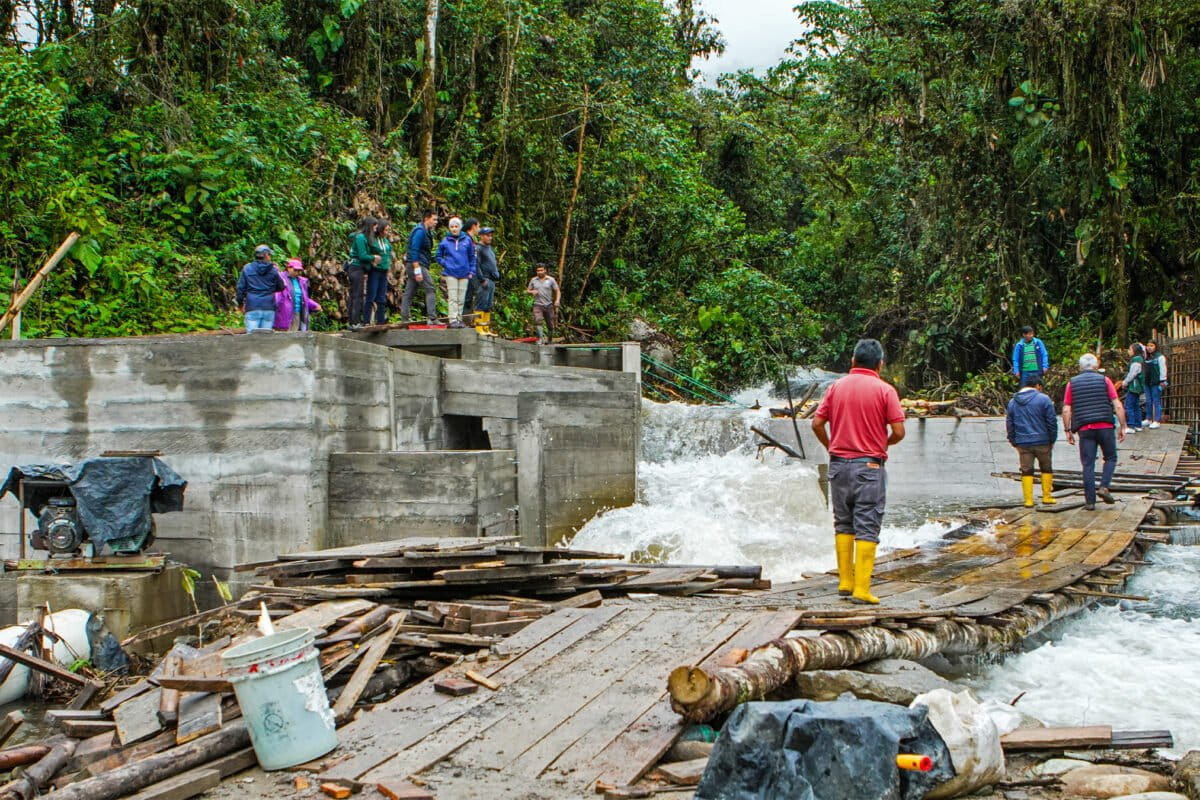
In Ecuador’s Intag Valley, 19 families are developing a 300-kilowatt hydropower project that can provide an alternative source of income to the large-scale extractive and productive industries that are common in the Imbabura province.The communities own 90% of the HidroAguagrún project and half of its net electricity revenue will go directly into a trust for conservation activities once the plant is fully operational.The project offers a potential model for community-owned renewable energy, but replicability depends on community willingness and cohesion, water availability and funding. In Ecuador’s Intag Valley, one of the major watersheds that supply the country’s Imbabura province in the north, 19 families from four communities are developing a 300-kilowatt (kW) run-of-river hydropower plant — a project that generates electricity by capturing the Aguagrún River’s natural flows without the construction of a large dam or water storage reservoir. Engineers say this makes them less environmentally impactful. The families, which are from the communities of Cerro Pelado, Chinipamba, Nangulvi Bajo and Barcelona, own 90% of the HidroAguagrún project. Registered as a business since 2022, half of the revenue raised from selling electricity to the national grid will go directly into a trust for conservation activities, such as the protection of cloud forests. The idea to create a small hydropower plant came from a general concern among the families about water availability in the region and the impact of the climate crisis, said Jorge Guachagmira, the president of the Río Aguagrún Renewable Energy Production Association, which represents the 19 families of the micro-basin and surrounding areas. “We live in a remnant of the natural world, and our daily activities are affected by the expansion of the exploitation frontier, such as agriculture, livestock farming, logging or deforestation of natural ecosystems,” he told Mongabay in a video call. “By expanding the agricultural frontier, we are generating greater water insecurity, water instability and climate instability.” The community of Barcelona, which depends on the Aguagrún River micro-basin within the Cotacachi canton, Imbabura province, Ecuador. Image by Denis Laporta. Ecuador, which depends on hydroelectric power generation for 78% of its electricity, has faced a severe energy crisis in recent decades, driven by successive droughts. In 2024, this led to daily blackouts lasting up to 14 hours and affected essential services, public health and social wellbeing. The Intag Valley’s cloud forests and its numerous rivers and streams are part of one of the world’s most biodiverse regions, the Ecuadorian Chocó bioregion, which covers more than 200,000 hectares (494,211 acres). Local communities have long raised concerns about large-scale mining projects in the region, and the deforestation, water contamination and biodiversity loss caused by these industries. HidroAguagrún is projected to make $120,000 a year from the electricity sold to the general national energy grid and it expects operations and maintenance to cost $40,000 a year. According to a document provided by corporate responsibility nonprofit Fundación Futuro, the project has so far increased income and improved skills across 17 rural businesses, and 28 leaders and youth have been trained in bringing sustainable energy to their communities. It has also created 11 permanent jobs in operations, monitoring and ecotourism, and 345 people will benefit from the profits received over the 30 years of the plant’s life. (Left) Leaders of the Río Aguagrún Families Association, together with the technical team of the Toisán Corporation and the Futuro Foundation, at the intake infrastructure of the hydroelectric plant. (Right) Members of the association participate in a community workday to construct the micro-hydroelectric plant. Images courtesy of Fundación Futuro. ‘Locals are the owners’ From day one, the families insisted that ownership of the project would forever remain in the hands of local families. “The owners won’t be conventional corporations,” said Guachagmira. “We want the owners to be the people who live in the area.” Companies are usually disconnected from the environmental impacts of large-scale river infrastructure projects, often not knowing where the water even originates, he said. But when local communities hold a majority stake, there is a greater awareness within the company about the need to protect and monitor the water and communities can directly benefit. Once the project gained momentum, residents formed mingas, a traditional system of collective, voluntary labor, to build the infrastructure. Technical and financial support came from nonprofit the Corporación Toisán and Fundación Futuro, which each hold a 5% stake in HidroAguagrún and provided more than half of the funding. Local builders, transporters, mechanics and monitors were the first choices for construction. “The minga requires willingness, camaraderie, friendship, commitment and everyone looking toward the same goal,” Guachagmira explained. “When you’re in the minga, it’s also a space for integration, socialization and the exchange of experiences and ideas.” Decisions about the project were voted on in community assemblies or general meetings. The project is near completion, constructed largely by local residents with technical support from specialists. “This is essential for its success,” said Denis Laporta, representative for alternative energies at Corporación Toisán, in a video call. “It’s not a solution conceived from behind a desk, but rather one that combines elements to allow for direct construction management. This is a significant advantage because it allows for the integration of local people, small businesses, service providers, food vendors and accommodation providers, creating a local economic ecosystem.” A community worker from the Río Aguagrún Families Association participates in the construction work of the hydroelectric plant infrastructure. Image courtesy of Fundación Futuro. Laporta outlined the project’s three phases to Mongabay. The first phase, now complete, involved the building of an intake system to divert the water needed to power the turbine. Unlike a conventional, large-scale hydroelectric plant, this run-of-river design does not require the construction of a dam. The second phase, which is also complete, involves building a pipe that channels the water toward the powerhouse where the electricity is generated. To minimize landscape and environmental degradation, the community decided to build an 800-meter (2,625-foot) underground pipe, Laporta said. The project has now entered its third and final phase, which is hydrostatic testing to check the water system. In an interview with Mongabay in early August, Laporta said the 60-square-meter (646-square-foot) powerhouse was 30% complete. The facility will house the plant’s essential equipment, including the pump, motor, valves and dismantling gaskets. Laporta said the families hope to complete the structure by the end of 2026. Once complete, to be able to eventually sell energy to the national grid, the plant needs to first be integrated into the local grid. The area currently relies on single-phase electrical power, typically used for residential purposes, which cannot support the plant’s output. Laporta said that HidroAguagrún is currently negotiating an agreement with the regional electricity company to co-finance the necessary upgrade. Aerial view of members of the Río Aguagrún Families Association along with the technical team during a visit to the HidroAguagrún infrastructure, in the middle of the cloud forest of Intag. Image courtesy of Fundación Futuro. Young members of the Río Aguagrún Families Association participate in the construction of the community micro-hydroelectric plant. Image courtesy of Fundación Futuro. How to replicate Ecuador’s 2008 Constitution and 2015 Organic Law of the Public Electricity Service (LOSPEE) opened the door for the Popular and Solidarity Economy (EPS) to participate in the country’s energy sector. The Constitution, for example, establishes that while the state is responsible for strategic sectors like electricity, it can also delegate these activities to private economies and community and solidarity economy enterprises, which has worked in HidroAguagrún’s favor. In addition, Ecuador has recently updated its regulatory framework to promote distributed electricity generation — a decentralized approach that shifts focus away from massive, cross-country transmission lines and redirects it toward regional resilience. This was in response to the country’s energy crises and severe droughts that have affected its centralized hydroelectric plants. “Those two factors make HidroAguagrún and other HidroAguagrún-related projects interesting for the regional electric company,” said Laporta. “It helps them reduce their dependence on energy that they sometimes have to buy from abroad.” Carolina Proaño, the executive director of Fundación Futuro, told Mongabay via WhatsApp that the organization has identified five additional sites in Intag where the project can be replicated, each capable of producing 300 kW to 1 megawatt (MW) of electricity. It is also developing financing models to accompany each new community. “We are currently working on the second one,” Proaño said. “These are communities that have already organized themselves, and their challenge is generally access to economic capital. Technical and organizational assistance is required, but the most complex aspects have already been achieved through the self-management of the inhabitants.” President of HidroAguagrún discusses plans with local people and external engineers. Image courtesy of Denis Laporta. Laporta told Mongabay that there are several conditions that need to be met to make a project of this kind possible. This involves community willingness and cohesion, water availability, strong alliances, access to capital, and technical capacity that thinks beyond profits and instead prioritizes limiting environmental harm. When selecting a site, he said he recommends prioritizing a location where a small plant can be integrated seamlessly into the natural landscape, without draining local water sources. He also emphasized the need to protect vulnerable aquatic ecosystems from collapsing, especially during the drier summer months. Laporta said it’s crucial to avoid the idea that because something is technically possible, it should be done. It might be so, he said, but at what social and environmental cost? The HidroAguagrún micro-hydroelectric plant’s intake infrastructure is integrated into the natural riverbed amidst the Intag cloud forest. The system harnesses the water flow to generate energy using a run-of-river scheme, without the construction of a dam. Image courtesy of Fundación Futuro. Banner image: The Río Aguagrún Families Association, together with the technical team of the Toisán Corporation and the Futuro Foundation, during a day of construction of the hydroelectric plant in the Aguagrún river basin. Image courtesy of Fundación Futuro. Women weave a culture of resistance and agroecology in Ecuador’s Intag Valley Ecuador court upholds ‘rights of nature,’ blocks Intag Valley copper mine Citations: Ortiz-Prado, E., López-Cortés, A., Suárez-Sangucho, I. A., Salazar-Santoliva, C., Vasconez-Gonzalez, J., & Izquierdo-Condoy, J. S. (2025). Facing crisis: How Ecuador’s energy shortages threaten public health. Frontiers in Human Dynamics, 7. doi:doi:10.3389/fhumd.2025.1607564 Pérez-Escobar, O. A., Lucas, E., Jaramillo, C., Monro, A., Morris, S. K., Bogarín, D., … Antonelli, A. (2019). The origin and diversification of the Hyperdiverse flora in the choco Biogeographic region. Frontiers in Plant Science, 10. doi:10.3389/fpls.2019.01328 FEEDBACK: Use this form to send a message to the author of this post. If you want to post a public comment, you can do that at the bottom of the page. Cite this articleAimee Gabay (2026). In Ecuador’s Intag Valley, communities build their own micro-hydropower plant. Mongabay Conservation news. DOI: https://doi.org/10.66709/news-328157 Credits Topics
In Ecuador’s Intag Valley, communities build their own micro-hydropower plant
Full Article
Original Source
Read the full article at News →KhanList aggregates and links to publicly available news content. We do not host full articles from third-party sources. Always verify important information with original sources.