
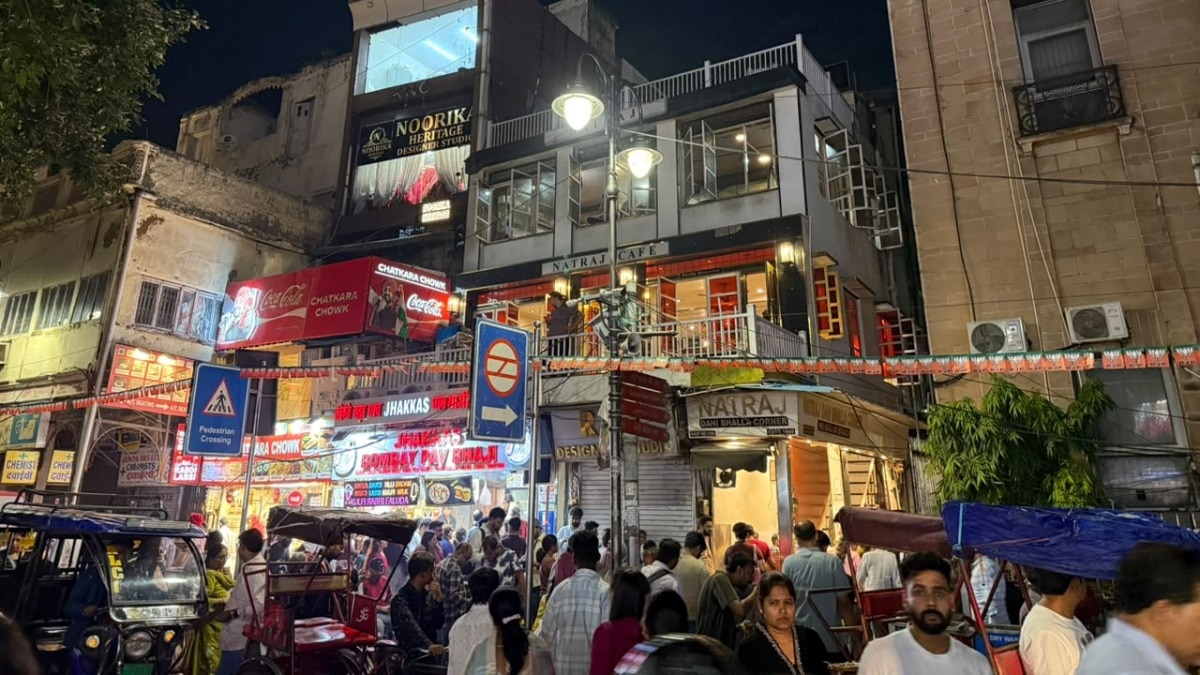
Come Diwali, and then the wedding season, Chandni Chowk becomes a shopping destination for lakhs of people — 4 to 8 lakh a day, to be precise (yes, you've seen those viral videos). From bridal lehengas and wedding suits to jewellery, cosmetics and everything in between, the market has something for almost everyone. Tarun Tahiliani-inspired replicas, Manish Malhotra-style sequin sarees (rip-offs, obviously), wedding invitations that wouldn't look out of place at an Ambani wedding, or jewellery to match your favourite outfit — the options are endless. Your day might run out of hours, but Chandni Chowk's shopping list won't.For women, in particular, this can turn a day of wedding shopping into an exercise in planning bathroom breaks. Where do you go when you need to pee? Is there a toilet nearby? Will it be clean enough to use? And, perhaps most importantly, will you even be able to get there through the crowds?These are not questions that should come with shopping in one of Delhi's busiest markets. Yet, for many women visiting Chandni Chowk, they are part of the experience. With the festive season drawing crowds and the wedding season set to bring another wave of shoppers, the problem deserves a closer look, and India Today did a little digging.A market built around wedding shopping, but what about the women shopping here?Chandni Chowk is home to a sprawling network of shops selling everything from bridal wear and wedding invitations to jewellery, beauty products and household goods. There are wholesale businesses, too, but women's wedding shopping is undoubtedly a significant part of the market's appeal. And this is rarely a quick in-and-out shopping trip. For Delhites, Chandni Chowk needs no introduction. It's a shopper's paradise. (Photo: Author) You might arrive at 11 am and spend the next five, seven or even 10 hours moving between shops. You could be looking for a wedding outfit, comparing prices, checking out jewellery or accompanying a family member who is getting married. Often, one visit isn't enough. You return for fittings, alterations and the final collection of an outfit. Now imagine having to plan all of this around your bladder.Dr Vaishnavi Vats, a dentist and resident of Civil Lines, frequently visits Chandni Chowk with her family before festivals and weddings. For her, the availability of clean toilets is a recurring concern."There are no good toilets here," she says, pointing to the options available to shoppers.Even the washrooms at Haldiram's, which many people rely on, can be difficult to use because of the smell and the number of people that visit the loo, she says. The strong smell of urine makes the experience unpleasant. Haldiram's is in a prime location in Chandni Chowk. And that's before you account for the crowds.Chandni Chowk's narrow, busy stretches can make moving between shops a task in itself. A distance that looks manageable on a map can take a considerable amount of time to cover, particularly during the festive rush. If you need to find a toilet urgently, getting to one isn't always as simple as locating the nearest pin on Google Maps.'Go to Haldiram's or the gurudwara'Ask people working in the market where you can find a washroom, and the answers tend to follow a familiar pattern."Haldiram's chale jao ya gurudwara wahi aapke use karne layak hai (go to the washrooms in Haldiram's or gurudwara, those are the only ones that you can use)," is what several people told us when we asked where we could use a toilet. Others suggested walking to Omaxe Mall (which was only built in 2024). This is one of the toilet cubicles in Chandni Chowk’s Omaxe Mall. It did not reek of urine, but given the footfall, it was evident that managing it was also becoming challenging. (Photo: Author) For many shoppers, Gurdwara Sis Ganj Sahib is one of the more dependable options. Visitors say its toilets are relatively clean and accessible. Haldiram's is another place people turn to, although, as Vats points out, the condition of its washrooms can leave much to be desired.Neither option, however, solves the problem for everyone. Their usefulness depends on where you are in the market, how crowded the area is and whether you can comfortably make your way there. And sometimes, even those are unclean.A shopkeeper who owns Aryan Cards, a wedding invitation shop, offered another perspective. According to him, some shopkeepers use toilets in other shops they own or those belonging to friends. Others have washrooms within their own establishments, which they allow only their customers or workers to use.These arrangements may work for people who know the market and have access to such facilities. A first-time visitor, a woman shopping with her family or someone who has spent hours walking between stores may not have the same options.For an ordinary shopper, the choices can come down to a handful of familiar establishments, the gurudwara or the metro station.That is a rather limited list for a market of this size.We followed Google Maps. It didn't always lead us to a toiletTo understand how accessible public toilets are for women in Chandni Chowk, we tried locating them ourselves, using Google Maps to identify possible options. The experience was revealing, though not always in the way we expected.At one of the locations listed on the map, we found no toilet at all. There was a bank instead. Trying to find the nearest SBM toilet, the map led us here. (Photo: Author) At another, we came across a small open public urinal used by male workers and shopkeepers in the area. Despite being listed among the toilet options, it was not a facility women could use.These were among the locations identified as Swachh Bharat Mission (SBM) toilets on Google Maps. The experience raised a basic question: if a public toilet is listed on a widely used navigation platform, how useful is that information when the facility doesn't exist at the location or isn't accessible to the person looking for it?The problem wasn't limited to locating the toilets. Their availability for women was another concern.A customer who had come to Chandni Chowk for her wedding shopping described how she could often smell a urinal from a considerable distance. Yet, even after reaching the spot, she couldn't find a women's toilet. The facilities she encountered were small, two-cubicle washrooms meant for men. A public urinal meant for men at the very entrance of the Chandni Chowk market. (Photo: Author) Finding a toilet on a map, then, is only the first step. The next is figuring out whether it exists, whether women can use it and whether it is clean enough to be usable.Why Chandni Chowk's problem is differentDelhi has several busy shopping markets, including Lajpat Nagar, Sarojini Nagar and Rajouri Garden. These, too, see crowds, particularly during the festive and wedding seasons. But comparing their sanitation facilities with those in Chandni Chowk requires looking at the nature and scale of the markets.Chandni Chowk is an extensive commercial district, with wholesale and retail businesses spread across crowded streets and lanes. Its shops attract people looking for wedding wear, jewellery, accessories and other goods, often drawing shoppers back several times before a purchase is complete. Its layout and density also make getting around difficult.In other shopping areas, eateries and other establishments can offer shoppers additional washroom options. Chandni Chowk has restaurants and other commercial establishments, too, but the availability of a clean, accessible facility cannot be taken for granted across the market.A basic need shouldn't be an afterthoughtThere is no denying that maintaining public toilets in an area as crowded and commercially active as Chandni Chowk presents challenges. Footfall is high, the streets are congested and sanitation facilities require regular cleaning and upkeep.But these challenges make the need for accessible toilets more pressing, not less.Private establishments may choose to provide washrooms for their customers and employees, and some shopkeepers have made informal arrangements to help people access them. However, private businesses cannot be expected to substitute for adequate public sanitation infrastructure across an entire market.That responsibility requires attention from the authorities tasked with providing and maintaining public facilities, along with clear information about where those facilities are located.It also calls for a distinction between a toilet that is technically available and one that people can actually use. A men's urinal does not meet a woman's needs. A facility that cannot be located or reached through a crowd is of limited help. And a toilet that is so poorly maintained that shoppers hesitate to use it does not adequately serve its purpose.A market's success is usually measured by the crowds it draws and the business it generates. But there is another, less glamorous measure of how well it serves its visitors: whether they can spend a few hours there without worrying about finding a toilet. On that count, Chandni Chowk still has some catching up to do.- Ends
In Chandni Chowk, you can shop for a wedding. But where do you pee?
Full Article
Original Source
Read the full article at Indiatoday →KhanList aggregates and links to publicly available news content. We do not host full articles from third-party sources. Always verify important information with original sources.