
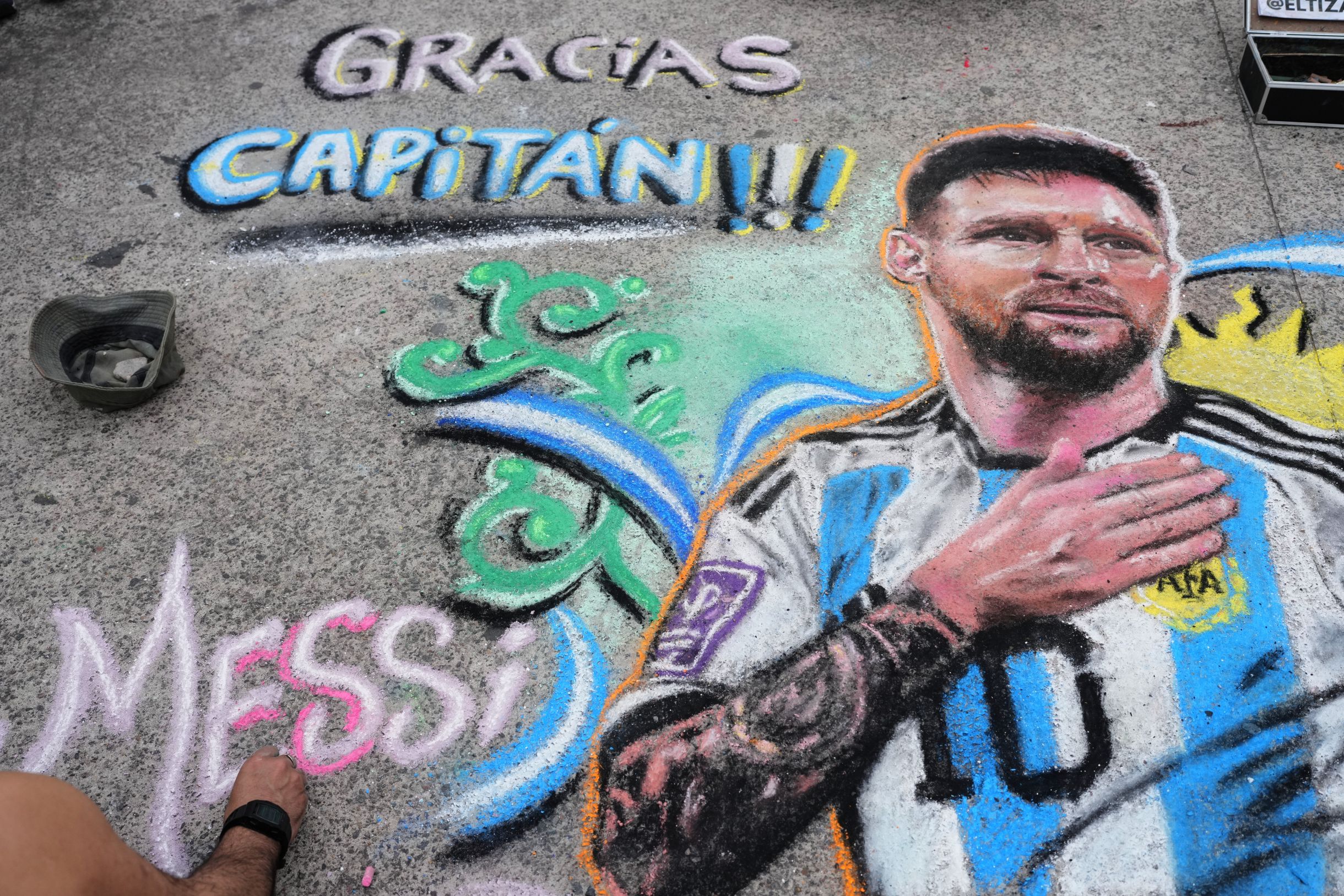
BUENOS AIRES (CN) — Thousands inside the stadium and millions beyond celebrated one of his goals for the last time, creating an echo that reverberated through the night. For over two decades, soccer fans around the world watched the South American nation’s games only to catch a glimpse of him. Now, an era has ended: Lionel Messi waved goodbye to his national team Tuesday night after a friendly match against Benin in Buenos Aires, where his team won 3-0.“Playing here has been the most beautiful thing that’s ever happened to me,” Messi said in tears before 85,000 attendees in the River Plate stadium after the game. “Not being a part anymore will be a huge pain.”Three months ago, Argentina lost the World Cup final to Spain, missing its chance to win a second consecutive cup. The 2022 title win consecrated Messi and his contemporaries — “la Scaloneta,” a name honoring their trainer, Lionel Scaloni — as the leaders of a golden era for the Argentine soccer team.But Messi, 39, had long said his time with the team was near its end. After the loss against Spain and the death of his father, Jorge Messi, his mentor and close aide, he published a letter announcing his decision.“Now I’ll be one more in the crowd, always rooting and cheering,” wrote Messi, who until this week was also the team captain.Fans hold masks depicting Lionel Messi before his final match for Argentina, a soccer friendly against Benin, in Buenos Aires, Argentina, Tuesday, Oct. 6, 2026. (AP Photo/Natacha Pisarenko)And on Tuesday night, the country seemed to stop to watch him take his last dance on Argentine soil, in a moment both melancholic and euphoric. After two decades of living his dream, Messi’s last goal — a penalty against Benin — was celebrated as much more than a point. It became a final punctuation mark on a career that has come to represent more than goals and trophies.And once the tango was over, surrounded by his teammates and best friends, standing in the middle of the field of the River Plate stadium in Buenos Aires, he spoke to the crowds: “I’m proud to be an Argentine,” he said, “and to have fulfilled my dream with all of you.”Tens of thousands cheered for him one last time. After 20 years and a bittersweet series of last games, including the recent World Cup loss and a win against historical rival England, it was over. Messi, the world’s greatest living player, was no longer a part of the national team. For a generation that grew up watching him wear Argentina’s light blue and white jersey, the farewell marked the end of something larger than a sporting career.“Watching him play was an immense privilege,” said Pedro Amadeo, 33, a fan who followed him from the start. “We’ve got nothing left to ask of him.”Messi was born in Rosario, one of Argentina’s largest cities, but at 13 moved with his family to join Barcelona’s youth academy and receive treatment for a growth hormone deficiency. Five years later, he joined his national team, making his World Cup debut in 2006. His career with Argentina became a long story of extraordinary highs, painful defeats and, eventually, redemption.But Argentina’s affair with Messi would take time.Despite his success in Spain and France, Messi struggled to win over Argentine fans, who compared him with national legend Diego Maradona and expected similar success. To many supporters, his brilliance abroad was not enough; what mattered most was what he could accomplish in the national jersey.Criticism peaked after Argentina lost the World Cup final to Germany in 2014 and, two years later, following another loss, Messi briefly retired from the Argentine team. He returned months later and finally won his first major international title with Argentina in 2021 at the Copa America championship.A year later, Messi completed the journey in Qatar. He scored twice in the World Cup final against France and converted his penalty in the shootout, leading Argentina to its third title.After years of doubts, Messi had finally won over his country.Parents named their children Leo. Thousands got his face tattooed on their arms. Messi became an icon who produced statues, appeared in murals, spurred songs and inspired millions across the world to play soccer. Throughout his career, he scored 126 goals with Argentina — second only to Portugal’s Cristiano Ronaldo.But statistics only tell part of the story.“Maradona put Argentina on the map,” recalled Diego Muzio, a sports sociologist and researcher at the University of San Martín, citing the player’s rise to international stardom in the ’70s. “But the weird thing is that then came Messi — in a peripheral country, two of the best players in the entire history came from Argentina.”In other words, said Muzio, “Messi gave Argentines a reason to feel proud.”Argentina's Lionel Messi holds the trophy while celebrating with teammates after defeating Colombia in the Copa America final soccer match in Miami Gardens, Fla., Monday, July 15, 2024. (AP Photo/Rebecca Blackwell)Verónica Stewart, 34, a teacher, said she was heartbroken. She has seen firsthand how Messi is a hero: From private schools to more vulnerable neighborhoods, children and teenagers wear his No. 10 everywhere. “He makes everyone equal,” Stewart said.The simplicity that has marked his public life is a trademark in a time of sports overmarketing.“He is, after all, a boy that just wanted to play soccer,” said Amadeo, who gathered with his friends near the stadium to watch the game.Immensely expansive on the field but less so in speeches, Messi spoke longer Tuesday night than ever before — making the moment seem even more unusual.But by the end, he said the simple words of a man leaving a place he loves to be.“I’m going to miss playing here so much,” Messi said. “I’ll be forever grateful for what we’ve lived.”A drone display featuring Argentina's Lionel Messi's jersey is seen at the end of his final match for the national team, a soccer friendly against Benin, in Buenos Aires, Argentina, Tuesday, Oct.6, 2026. (AP Photo/Julian Bongiovanni)Lucía Cholakian Herrera is a Courthouse News correspondent covering Latin America. She is based in Buenos Aires, Argentina.Categories / InternationalSubscribe to our free newslettersOur weekly newsletter Closing Arguments offers the latest about ongoing trials, major litigation and rulings in courthouses around the U.S. and the world, while the monthly Under the Lights dishes the legal dirt from Hollywood, sports, Big Tech and the arts.Additional Reads
In bittersweet night, Lionel Messi says goodbye to Argentina’s national team
Full Article
Original Source
Read the full article at Courthousenews →KhanList aggregates and links to publicly available news content. We do not host full articles from third-party sources. Always verify important information with original sources.