
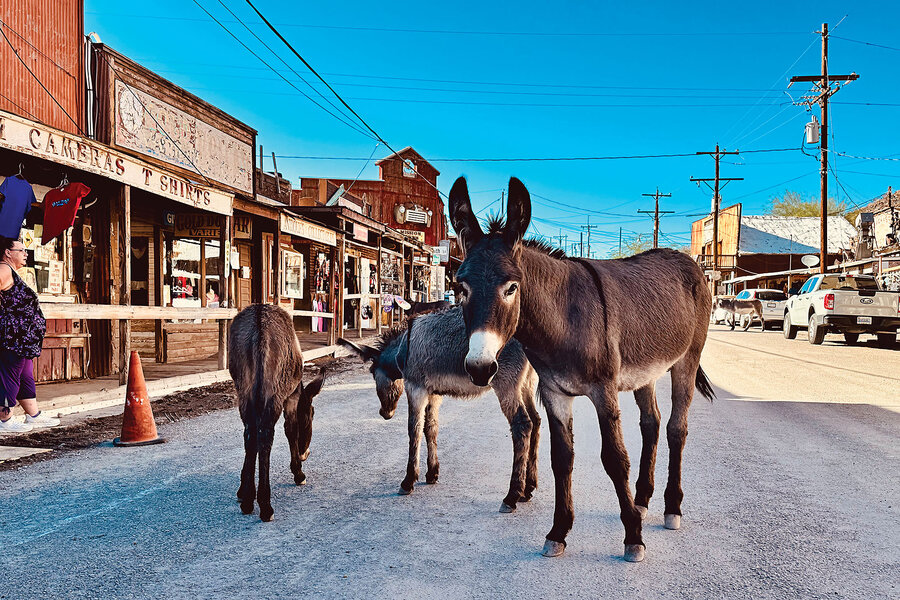
Kingman, Ariz. | Oct. 27, 2026, 11:54 a.m. ET | 3 min read For much of the journey west on Route 66, the old highway can invite a certain open-road feeling of freedom: long horizons, open throttle, the easy hypnotism of asphalt unwinding toward the desert.Then, in the Black Mountains of western Arizona, the road suddenly and dramatically tightens.The speed limit drops to 20 mph. The pavement climbs and folds back on itself. Hairpin turns arrive one after another, wrapped around steep slopes with little room for distraction. Guardrails are rare and brief. Locals call this the Arizona Sidewinder. This is the old Route 66 over Sitgreaves Pass, one of the highway’s most notorious surviving stretches. Early motorists sometimes found it frightening enough to hire local drivers to take their cars over the mountains. Today, the Bureau of Land Management (BLM) still warns of steep grades and tight switchbacks along this preserved section of the old road.And then, with your focus in demand, there are donkeys.In some sections, they stand in the middle of Route 66. They nose toward tourists who are carrying feed. They pose, more or less willingly, for photographs. In town, they wander between motorcycles and parked cars with the unhurried confidence of creatures who have concluded the road belongs to them. Oatman, Arizona, itself is compact and theatrical: weathered storefronts, Old West facades, tourists drifting along the street, cameras out, feed bags in hand. On one early October afternoon, tourists outnumbered donkeys at least 10 to 1. Local businesses lean cheerfully into the obvious joke. There are enough puns on signs and souvenirs to exhaust a middle schooler. Harry Bruinius/The Christian Science MonitorA Triumph Bonneville motorcycle owned by Monitor staff writer Harry Bruinius stands off Route 66, along the twisting stretch of highway known as the Arizona Sidewinder, near Oatman, Arizona, Sept. 30, 2026. The town began as a mining camp called Vivian around the turn of the last century, after gold was found in the hills. By 1909, it had taken the name Oatman, in what is generally believed to be a nod to Olive Oatman, a girl whose family was attacked by Native Americans on the Gila River trail in 1851 and who spent five years in captivity, some of them among the Mohave, before her ransom. She carried a blue chin tattoo from her captivity for the rest of her life, and her family’s story was widely told. The attack took place some 200 miles southeast of here, but why a mining camp in the Black Mountains claimed her name has never been entirely settled.By 1916, local mines made Oatman one of the richest camps in Arizona, and miners worked the hills with pack burros hauling ore and water. The gold exhausted by the mid-1920s, the mines faltered and then closed, the miners left and the burros stayed, turned loose to make their own way in the desert.Route 66 was designated through Oatman in 1926, bringing a new stream of travelers as mining waned. Every westbound motorist had to climb the Sidewinder to get to California. Then, in 1952, Arizona opened a flatter alignment through Yucca, bypassing the mountain route. Traffic vanished. Oatman nearly did, too. What revived it was the road itself, once people began driving old Route 66 for its own sake. The descendants of the miners’ burros wandered back down from the hills to find a curious audience willing to feed them. The animals that once carried ore out of the mountains now carry the town. But behind the tourists and puns, the burros are presenting serious problems. Oatman sits inside the enormous Black Mountain Herd Management Area, about 1.1 million acres of desert and mountains overseen by the BLM. In March, federal officials estimated roughly 3,900 wild burros roamed there – far above the agency’s management target of about 450 animals.This spring, federal workers captured almost 500 using bait-and-water traps. Most were sent for eventual adoption. The agency says the desert’s limited forage and water can’t sustain such a large herd. The animals damage the range, as well as people’s fences and gardens. Deepen your worldviewwith Monitor Highlights.Politics with respectGet political stories with respectful analysis.There‘s a world of new ideas in everyBooks newsletter.There‘s more to life, enrich yours withCulture & Learning weekly.Follow humanity‘s discoveries withScience & Nature stories in your inbox.Gain a spiritual perspectivefrom the stories in your inbox.Want to understand the deeper impact of critical events? Learn the Monitor‘s insight.Already a subscriber? Log in to hide ads. They are also traffic hazards. A donkey on the road in Oatman is an attraction. The same donkey a few miles down the road at night is a danger, the agency says, citing collision reports.There appear to be only a dozen or so among Oatman’s visitors as early evening sets in. Shadows lengthen. Shops begin to close; tourists climb back into their cars or onto their motorcycles. Some head west. Others start the 20 mph return over the pass, concentrating. ALREADY A SUBSCRIBER? LoginReal news can be honest, hopeful, credible, constructive.The Christian Science Monitor was founded in 1908 to lift the standard of journalism and uplift humanity. We aim to “speak the truth in love.” Our goal is not to tell you what to think, but to give you the essential knowledge and understanding to come to your own intelligent conclusions. Join us in this mission by subscribing.
In Arizona’s hills, roaming donkeys, not drivers, own Route 66
Full Article
Original Source
Read the full article at Csmonitor →KhanList aggregates and links to publicly available news content. We do not host full articles from third-party sources. Always verify important information with original sources.