
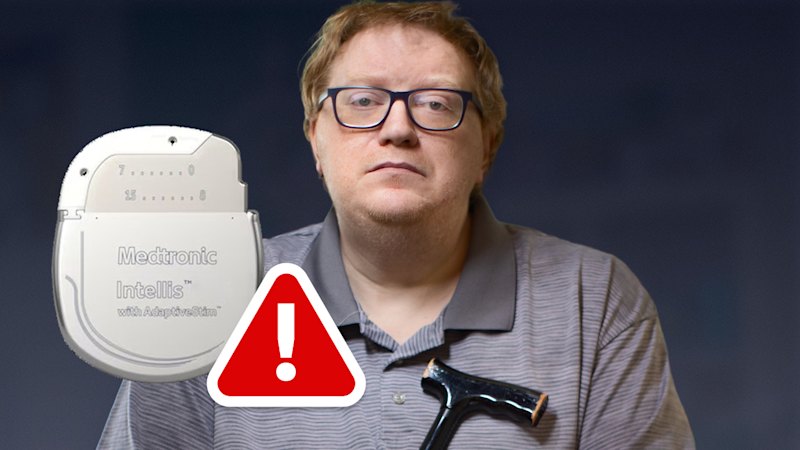
One of the world’s largest medical device companies is accused of deliberately misleading patients and doctors over the effectiveness of an implant for back pain.Australia’s medical regulator made the serious allegation in a confidential report obtained by this masthead, in a revelation that raises fresh questions about the company that dominates the multibillion-dollar medical device market.Medtronic, a $US118 billion ($165 billion) medical giant, tells patients and doctors on its website that its expensive Intellis spinal cord stimulator cuts back pain by more than half in the vast majority of patients. That claim is based on a 128-person study published in 2021.But unpublished real-world data Medtronic collected from a much larger group of patients reveals the Intellis works so poorly, it may provide no meaningful benefit to patients at all, according to an analysis by the regulator, while exposing patients to serious risks.“The performance data is substantially worse than the performance in the manufacturer’s published studies,” a government auditor wrote in a confidential Therapeutic Goods Administration report obtained by this masthead using freedom of information laws.“These results are very concerning and conflict with the study results. The improvements are so small that it is unclear whether these actually constitute a ‘benefit’ at all.“It is impossible to see how patients can give meaningful informed consent in this setting, nor how prescribers can make reasonable recommendations about care.”The Intellis was approved for sale by the TGA in 2018, and was the most popular stimulator sold in the private health system that year.The new data, submitted to the TGA years after the device was approved, made clear it did not meet Australian standards, the auditor concluded – and the studies backing it were “small” and poorly designed.Marcus Barlow received an Intellis in 2019 to treat chronic lower back pain. It did not help, despite his doctor repeatedly adjusting the stimulation. The bulky metal device pressed on his spine and interfered with his sleep.“I thought I had a very high chance of it working in me. I thought spinal cord stimulators were a safe, non-invasive treatment,” Barlow said.Had he known the actual success rates in Medtronic’s internal data, he said he “absolutely” would not have gone ahead with the operation. “They have misled patients,” he said. “I feel horrified about this.”Rachel David, chief executive of Private Healthcare Australia, described the revelations about Medtronic’s internal data as “disturbing”.“Medical device companies should be compelled to report their own data on complaints and adverse events to the TGA in a timely way,” she said. “If we can’t trust medical device companies to do this, the TGA needs to consider tougher penalties for non-compliance.”This masthead’s Medical Malfunctions series has revealed weak medical device regulations that allow sometimes untested technology to be put into the bodies of Australians, and fails to pick up problematic technology when it fails inside patients’ bodies.The uncovered documents have turned the spotlight on the huge medical device companies that sell billions of dollars of pacemakers, insulin pumps and spinal cord stimulators every year.A Medtronic spokesman said it was common for real-world and clinical trial data to differ.Medtronic was “committed to patient safety, transparency and ongoing evidence generation”, he said.It is not the first time the medtech giant has been accused of concealing data.It ran a study that collected more than 1000 adverse events linked to a bone-fusion product called Infuse, including deaths. The company shut the study down in 2008 but only reported the injuries to US regulators in 2013.Medtronic said that was due to a filing error, but paid US$12 million in 2017 to settle allegations by US attorneys-general that its Infuse marketing – including studies that downplayed side effects – was false and misleading. The company did not admit wrongdoing; it pulled the product from the Australian market in 2020.The stimulators, the ‘weak’ studies and the real-world dataEarlier this decade – the TGA refuses to reveal when – Medtronic applied to Australian regulators to register a new model of spinal cord stimulator, the Inceptiv.Spinal cord stimulators are essentially small computers wired into the spinal nerves, often used to treat back pain or chronic pain.In theory, electrical pulses can interfere with pain signals. The Inceptiv contains new technology allowing it to monitor and automatically change its output.The TGA claims every approved medical device in Australia has clinical evidence showing it is safe and works.Medtronic did not present any clinical studies of the Inceptiv. Instead, it relied on “equivalence”, which allows companies to win approval for new medical devices if they argue they are essentially identical to older, already registered devices.Medtronic claimed the Inceptiv was “equivalent” to the Intellis, the stimulator it won approval for in 2018 and which Marcus Barlow had installed.The Intellis was the most-popular stimulator in Australia in 2018-19, with each installation costing about $50,000, according to private health insurance data. About 1050 patients have received them in private hospitals since the device launched.Medtronic supplied two studies of the Intellis to the TGA to make the argument it was safe and effective – and, by extension, so was the Inceptiv.The first study concluded that 80 per cent of patients cut their back pain by 50 per cent after three months; Medtronic promotes that trial on its website. The TGA’s assessor described both studies as “small with weak designs”.However, Medtronic’s application also included data from its Product Surveillance Registry – real-world data from patients using the device around the world.The registry contains more patients than all the studies Medtronic submitted, combined, and tells “a remarkably different story”, in the words of the TGA assessor.In the real-world data, just 27 per cent of patients cut their back pain in half. Patients said the stimulator had improved their overall health by less than 5 per cent.“These results are very concerning and conflict with the study results,” the assessor wrote.“The data presents two conflicting pictures of device performance. In manufacturer studies which have been published, or which the manufacturer intends to publish, the device appears to be moderately to highly effective. In the larger real-world dataset which the manufacturer has collected but not published, the device performs poorly.”Unlike the positive studies, Medtronic had not published its poor real-world performance data, and told the TGA it had no plans to.“Doctors and patients considering use of this device are being misled,” said the University of Sydney’s Professor Barbara Mintzes, an expert in how medical companies sell their products. “If the study results look bad, keep them secret. If they look good, publish.”A former Medtronic Australia executive, speaking anonymously for fear of retribution, described the company’s efforts to obscure data about its devices as “par for the course, to be quite honest”.“That’s pretty well the company culture. There’s compromises everywhere. They are so desperate to get products to market – in the Australian market in particular, because it’s so profitable,” the executive said. “It’s not just Medtronic. It’s all the big device companies.”A spokesman for the TGA said the regulator had no legal powers to compel Medtronic to publish unfavourable data on its devices.Despite concluding Medtronic might have denied patients informed consent by withholding the data, the spokesman said the agency did not plan to take any action against the company, or inform patients.“The TGA does not regulate clinical practice or the informed consent relationship between a doctor and their patient.”Medtronic eventually withdrew their application for the new Inceptiv.The Intellis was cancelled in 2024 by the TGA, after a separate review triggered by this masthead’s investigation into the high risks and lack of evidence supporting spinal cord stimulation.The TGA said Medtronic failed to supply information showing the device continued to comply with Australia’s medical device regulations.In a statement, Medtronic said that differences between real-world and clinical trial data could be down to “differences in study design, patient populations, care settings, assessment methods, and other factors”.“Medtronic routinely collects, reviews and shares relevant information about its therapies with regulators as part of our post-market surveillance, quality and regulatory obligations. We are committed to supporting informed clinical decision-making and working collaboratively with regulatory authorities in accordance with applicable requirements.”The complication ratesThe documents also raise questions about how honest Medtronic is with regulators about the side effects linked to its spinal cord stimulators.The company’s submission documents adverse event rates of up to 40 per cent, and notes 22,000 “complaints” about the devices have been received - when only 76,000 had been sold globally.Yet, Medtronic has submitted only six formal adverse event reports to the medical regulator – three of them relating to device recharging problems – despite selling at least 1050 devices here.In 2024, the TGA wrote to Medtronic alleging “possible under-reporting of adverse event information” and demanding it release all adverse event complaints it held internally, other documents obtained under freedom of information laws reveal.The TGA discovered Medtronic had been “exempting” some adverse event reports it received – a loophole allowing medical device manufacturers to avoid reporting events to the regulator.The regulator refused to say how many additional reports Medtronic produced, citing “commercially confidential information”, and refused to answer questions on whether the company faced any sanction over its behaviour.In a statement, Medtronic said it “routinely collects, reviews and shares relevant information about its therapies with regulators as part of our post-market surveillance, quality and regulatory obligations”.“We are committed to supporting informed clinical decision-making and working collaboratively with regulatory authorities in accordance with applicable requirements.”The Neuromodulation Society of Australia and New Zealand, which includes doctors who install stimulators, said the therapy was “an important part of modern pain management and continues to play a valuable role in the treatment of carefully selected patients living with chronic pain”. The society lists Medtronic as a corporate supporter.The society put this masthead in touch with Emily Schmidt, who received an Abbott stimulator to treat chronic ankle pain in 2021.“It pretty much gave me 90 to 95 per cent pain-free,” she said, with “pretty much no complications”.
‘Impossible to give consent’: Medtech giant hid bad data from patients, doctors
Full Article
Original Source
Read the full article at Smh →KhanList aggregates and links to publicly available news content. We do not host full articles from third-party sources. Always verify important information with original sources.